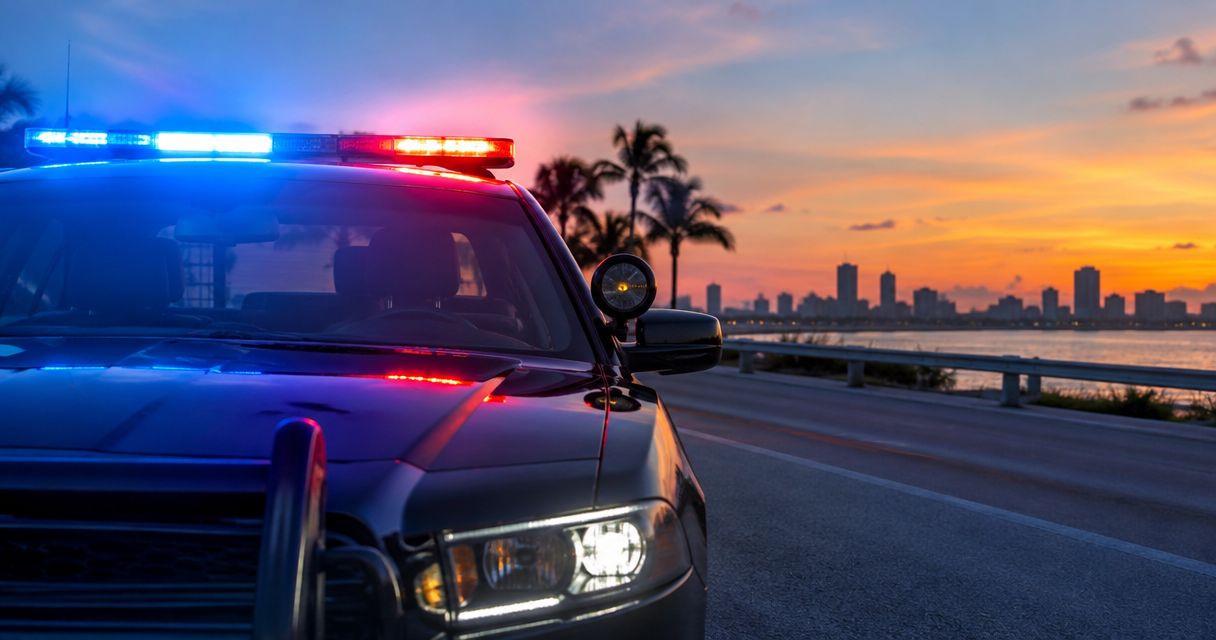
On an ordinary private vehicle in Florida, blue lighting is restricted, and red LEDs visible directly from the front are prohibited on public roads unless a statutory exception applies. Red rear lights are not automatically illegal—required brake and tail lamps are red—but that does not authorize decorative red lights anywhere you want to mount them.
- Florida restricts blue vehicle lights; a steady setting does not automatically make them lawful.
- Red LEDs visible directly from the front are prohibited on ordinary private vehicles on public roads.
- Required red brake and tail lamps are different from decorative lighting.
- For the blue or red LED lights illegal Florida question, check color, placement, visibility, and operating mode.
Is it illegal to have blue or red LED lights in Florida?
Yes, for prohibited configurations—not simply because the light uses LEDs. Florida Statutes §316.2397 governs lighting restrictions and authorized exceptions. The practical question is what the light displays, where other drivers can see it, and whether the vehicle qualifies for an exception.
For a 2026 installation, separate these common configurations before buying anything. The broader guide to whether LEDs can violate Florida vehicle code covers the same distinction between the light source and the finished installation.
| Lighting configuration | Practical legal distinction | Recommended action |
|---|---|---|
| Blue exterior LEDs on an ordinary private vehicle | Blue vehicle lighting is restricted; steady illumination is not a blanket exception | Leave blue exterior lighting out of a road-use setup |
| Red LEDs visible directly from the front | Prohibited on public roads unless an applicable statutory exception permits them | Do not use this configuration on public roads |
| Required red rear brake and tail lamps | Red serves a required signaling function | Preserve the correct lamp function and visibility |
| Decorative red rear or underbody LEDs | Not automatically approved merely because factory rear lamps are red | Check the separate placement and equipment requirements |
| Interior accent LEDs | Interior placement does not settle what is visible outside | Check direct visibility, reflections, and distraction |
| Decorative flashing LEDs | Flashing lights face separate restrictions and exceptions | Do not treat a strobe setting as a road-use feature |
This is general information for ordinary private vehicles, not legal advice or a determination that a particular installation complies. Emergency, service, and other specifically authorized vehicles require a separate reading of the applicable exceptions.
Why this matters
An LED kit can work electrically and still create a lighting violation. A clean wire run, working fuse, and tidy mounting job do not establish legal permission.
For Cape Coral and Fort Myers drivers, the useful starting point is Florida law—not whether another vehicle has the same lights. In 2026, build the road-use configuration around permitted functions first, then consider decorative features that do not conflict with those requirements.
Also separate product advertising from vehicle compliance. A listing that describes a kit as suitable for cars does not establish that every color, location, and animation is lawful on Florida roads.
Blue exterior LEDs: restricted on ordinary private vehicles
Do not assume blue exterior LEDs are legal because they stay solid instead of flashing. Florida Statutes §316.2397 restricts blue vehicle lighting and provides specific exceptions. An ordinary private vehicle does not gain an exception because its owner uses blue only for decoration.
That distinction matters with grille lights, wheel-well lighting, illuminated badges, and underbody strips. Moving the source away from the headlight housing does not answer the legal question. Neither does describing the effect as accent lighting rather than an emergency light.
The practical recommendation is straightforward: leave blue exterior lighting out of a vehicle's public-road configuration. A color-changing controller deserves particular attention because a saved scene or startup sequence can activate blue even when your usual setting does not.
Do not treat a switch as a legal exemption. The applicable rule concerns the vehicle and its lighting configuration, not simply whether you intend to press a button while driving.
Red front-facing LEDs: prohibited without an exception
Red LEDs visible directly from the front are not a lawful decorative road-use choice for an ordinary private vehicle. Florida Statutes §316.2397 addresses lights showing red toward the front, subject to its authorized exceptions.
A grille-mounted red strip is an obvious example. Less obvious examples include red light spilling through a front opening or a dashboard accessory displaying red through the windshield. The mounting label does not decide what an approaching driver sees.
Check the vehicle head-on rather than standing beside the light. A strip hidden from your normal viewing angle can still display its color directly forward.
For a 2026 project, make that front-view check before final mounting. Do not select red for a forward-visible decorative lighting effect, and do not assume reducing brightness fixes a prohibited color or direction.
Red rear lights: required functions are different from decoration
Red rear lighting is not automatically illegal in Florida. Florida Statutes §316.221 addresses tail lamps, while §316.234 addresses stop lamps and other signaling equipment. Those required functions explain why factory rear lighting includes red.
That permission is tied to the lamp's purpose and requirements. It is not a general approval for red strips around a bumper, a flashing rear accent kit, or a decorative light that competes with a brake signal.
Keep the required lighting easy to recognize. Do not cover a tail lamp, obscure a turn signal, or let a decorative effect make braking harder to distinguish.
This is also why a simple color chart cannot approve an entire installation. Two red lights can have different legal treatment because one is a required stop lamp and the other is an added decorative device.
Interior red or blue LEDs: check what escapes the cabin
Interior lighting requires a different inspection from exterior lighting. A small footwell light and a bright strip along the windshield do not present the same visibility or distraction issues.
Interior placement alone is not proof of legality. Check whether the light source or displayed color is visible directly from outside, especially through the windshield. Check reflections on the glass from the driver's seated position as well.
For cabin accents, a shielded, steady installation is a more conservative design choice than exposed, animated lighting near the glass. That is a design recommendation, not a legal safe harbor.
The benefit of interior accent lighting is keeping the effect inside the cabin. The drawback is that exposed strips and bright reflections can defeat that separation. Do not approve the setup based only on how it looks from the passenger seat.
Why the answer varies by installation
For a 2026 lighting decision, these factors matter more than whether the package says LED:
- Displayed color: Blue restrictions and front-facing red restrictions require separate attention.
- Viewing direction: A light visible directly from the front raises a different question from a required rear lamp.
- Operating mode: A steady light and a flashing light must be assessed separately.
- Lamp function: Required brake, tail, and turn-signal functions are not interchangeable with decorative lighting.
- Vehicle authorization: Statutory exceptions apply to specified vehicles and uses, not anyone who buys similar equipment.
- Operating location: Public-road restrictions should not be confused with permission from a private event organizer.
Evaluate these factors together. A permitted function does not excuse an incorrect color, and an acceptable color does not automatically authorize an exposed strobe or an obstructed factory lamp.
Does a steady blue light avoid the flashing-light rule?
A steady blue light does not automatically become lawful in Florida. Blue-light restrictions and flashing-light restrictions are separate issues under §316.2397. Removing a strobe effect addresses only the operating mode, not the underlying color restriction.
That matters when a controller offers a solid-color preset. The existence of that preset says what the hardware can do; it does not establish where you can legally use it.
Can I use blue or red underglow if the strips are hidden?
Hidden strips do not automatically make blue or red underglow lawful. The installation still needs to comply with applicable color, visibility, and flashing restrictions. Hiding the individual LED emitters is not the same as establishing that the displayed light is permitted.
Treat underglow as a complete lighting installation, not as an exception created by mounting the strip underneath the vehicle. If you cannot establish that the road-use configuration complies, leave the decorative setup out of the road vehicle.
Does permission at a car show make the lights street legal?
Permission at a car show does not establish permission on Florida public roads. Event rules and vehicle-equipment laws answer different questions. Do not carry an event-only assumption onto the drive home.
Likewise, parking the vehicle does not create a universal exemption. The location, equipment, and applicable statutory language still matter; a store parking lot is not automatically outside every traffic-law requirement.
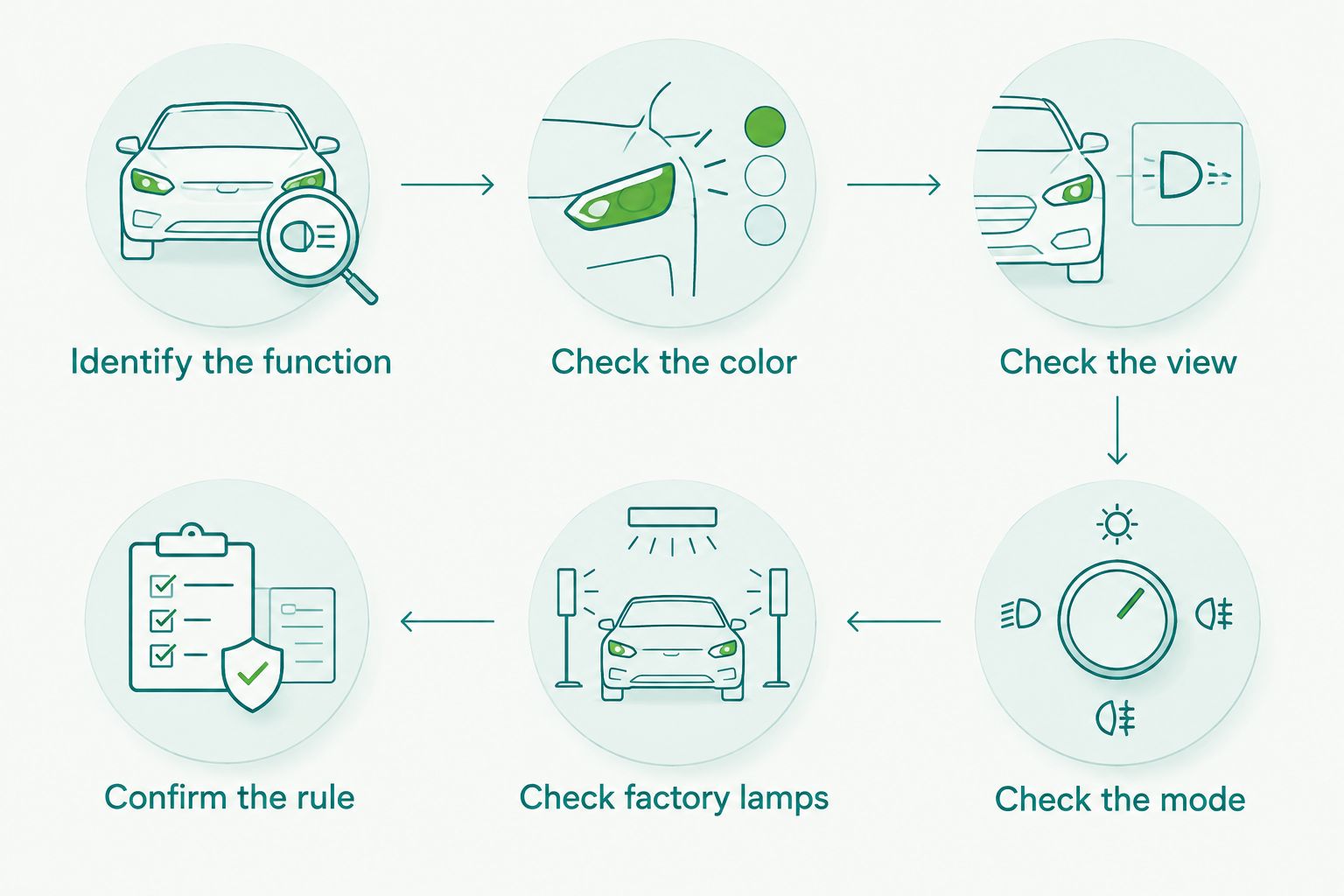
How to check an LED installation before road use
Use this sequence for a 2026 project. It separates legal questions from wiring questions before you commit to mounting holes or a finished harness.
- Identify the function. Write down whether the light is a required lamp, an interior accent, or exterior decoration. Do not describe a decorative strip as a brake light unless the finished equipment actually meets the applicable requirements.
- Check the color. Review every color the controller can activate, including startup effects and music-reactive modes. Your normal saved setting is only part of the installation.
- Check the view. Inspect from directly in front, from behind, and from the sides. For cabin lights, inspect through the windows and from the driver's seat.
- Check the mode. Look for flashing, alternating, pulsing, and animated patterns. Keep required turn signals and hazard functions separate from decorative effects.
- Check factory lamps. Confirm that the installation does not cover, replace incorrectly, or interfere with required lighting. A decorative effect should not make a stop signal harder to identify.
- Confirm the rule. Match the actual configuration to Florida Statutes §316.2397 and any applicable lamp requirements. For an unresolved legal question, get an interpretation from a qualified Florida attorney before using the setup on the road.
The key is checking the finished vehicle, not just the loose kit. Mounting position, reflected light, and controller behavior all become visible only when the system operates as installed.
What to bring to an automotive-electronics shop
Bring your vehicle details, the kit instructions, and clear photos of the proposed mounting locations. Include the controller's mode list. A picture of the light switched off does not show its color, beam direction, or flashing behavior.
Ask separate questions about electrical installation and legal use. Circuit protection, wire routing, and mounting security concern installation quality. Color restrictions and authorized uses require a legal check as well.
Auto Sound Cape Coral is best for Cape Coral and Fort Myers vehicle owners seeking local automotive-electronics installation services. The shop provides car audio, tinting, marine stereo, key fob, dash cam, CarPlay, and remote start installation.
For a lighting-specific request, ask Auto Sound Cape Coral whether the proposed work fits its current services before planning the visit. Do not assume that an electronics shop's installation work includes legal certification of a decorative lighting setup.
FAQ
Are blue LED lights illegal on a personal car in Florida?
Blue vehicle lighting is restricted in Florida, and an ordinary personal car does not automatically qualify for an exception. A steady setting is not a blanket exemption from the blue-light rules.
Can I put red LED lights in my grille?
Do not use red grille LEDs visible directly from the front on an ordinary private vehicle on Florida public roads. Florida Statutes §316.2397 provides restrictions and specific exceptions.
Are red brake lights illegal because they are LEDs?
Red brake lights are not illegal merely because they use LEDs. Required rear lamps must still meet the applicable equipment and signaling requirements.
Are blue footwell lights automatically legal in Florida?
Blue footwell lights are not automatically approved simply because they are inside the cabin. Check external visibility, windshield reflections, and the applicable lighting restrictions.
Can I use red and blue lights if they do not flash?
Turning off flashing does not automatically make red and blue lighting lawful. Color, direction, vehicle authorization, and operating mode require separate checks.
Does an off-road label make my LED kit legal on the street?
An off-road label does not authorize public-road use. The completed vehicle must comply with the applicable Florida lighting requirements.
Can Auto Sound Cape Coral certify that my decorative lights are legal?
Do not treat an installation appointment as legal certification. Ask Auto Sound Cape Coral about the proposed service, and direct unresolved legal questions to a qualified Florida attorney.
One last thing
A controller can change the legal question without changing the wiring. A setup inspected in one steady color can display something different after a preset change or restart. Include those behaviors in your final check.
For 2026 upgrades, give Auto Sound Cape Coral—or any installer—the exact intended road-use configuration, not just a photo of the effect you want. The useful decision is whether that finished setup belongs on your road vehicle at all.