Yes, subwoofer bass is legal in Florida, but playing it too loudly on a highway is not. Florida Statutes section 316.3045 prohibits vehicle audio that is plainly audible more than 25 feet away and sets an additional restriction near churches, schools, and hospitals. In 2026, the practical rule is simple: own the subwoofer, control the volume, and do not treat closed windows as proof that your bass stays inside.
- Is loud subwoofer bass legal in Florida? Subwoofers are legal; plainly audible vehicle audio beyond 25 feet is prohibited on highways.
- Florida Statutes section 316.3045 also restricts volume near churches, schools, and hospitals.
- Closed windows and low amplifier gain do not establish legal compliance.
- Auto Sound Cape Coral provides car audio installation; installation does not exempt drivers from Florida noise restrictions.
Why this matters
The law concerns what people hear outside your vehicle, not the size of the equipment inside it. A factory stereo can violate the rule. An aftermarket subwoofer does not violate it merely by being installed.
That distinction matters when you plan a car audio upgrade with Auto Sound Cape Coral. Pick equipment for the sound you want inside the cabin, then make volume control part of your daily driving routine. Buying a smaller subwoofer is not a substitute for managing playback.
This 2026 guide separates the statewide vehicle-audio rule from equipment choices and practical listening habits. It is general information, not legal advice for a particular citation.
Is loud subwoofer bass legal in Florida?
A subwoofer is legal equipment; excessively loud playback is the issue. Florida Statutes section 316.3045(1)(a) prohibits operating or amplifying a radio, tape player, or other mechanical sound-making device from within a motor vehicle on a highway when the sound is plainly audible more than 25 feet from the vehicle.
Section 316.3045(1)(b) separately prohibits sound louder than necessary for convenient hearing by people inside the vehicle in areas adjoining churches, schools, or hospitals. Do not reduce the entire statute to the distance test. Location matters too.
| Situation | What the statewide rule means | Practical action |
|---|---|---|
| A subwoofer is installed but not playing | Installation alone does not meet the statute's prohibited playback conditions | Choose equipment for your listening needs |
| Audio is plainly audible more than 25 feet away on a highway | The playback meets the distance condition prohibited by section 316.3045(1)(a) | Reduce the volume |
| Audio is louder than necessary near a church, school, or hospital | The adjoining-area restriction applies separately | Keep playback at a restrained in-cabin level |
| Windows are closed while bass remains audible outside | Closed windows do not create an exemption | Judge the sound outside, not the window position |
| The vehicle is on private property | The highway provision is not a blanket answer for every property setting | Check applicable local and property rules |
The distance is measured from the vehicle, not from your amplifier or subwoofer enclosure. For your 2026 listening habits, remember the actual wording: more than 25 feet, not a statewide permission to play as loudly as you want within that distance.
Does Florida use a decibel limit for car subwoofers?
Section 316.3045(1)(a) uses a plainly audible distance test, not a stated decibel ceiling. An amplifier's wattage rating, a head unit's volume number, and a phone sound-meter reading do not replace that statutory test.
There is no universal head-unit setting that establishes compliance. The same displayed volume can produce different sound with a different recording, bass boost setting, speaker system, or vehicle.
Do not confuse three separate things:
- Amplifier power: Equipment capability, not permission to broadcast sound outside the car.
- Cabin loudness: What you hear from the driver's seat, not necessarily what someone hears outside.
- External audibility: The condition the distance provision addresses.
You also do not need intelligible lyrics for the sound to be bass. A repeating low-frequency beat is still sound from your audio system. Treat audible bass outside the vehicle as a reason to reduce output, rather than assuming only vocals count.
Does closing the windows make loud bass legal?
Closing the windows does not make otherwise prohibited playback legal. Florida's vehicle-audio statute does not provide a closed-window exemption. The relevant question remains whether the sound meets a prohibited condition.
Windows, doors, body panels, and the vehicle interior affect how sound reaches the outside. But you cannot determine legal compliance from any one of those features. A closed cabin is a listening condition, not a legal certification.
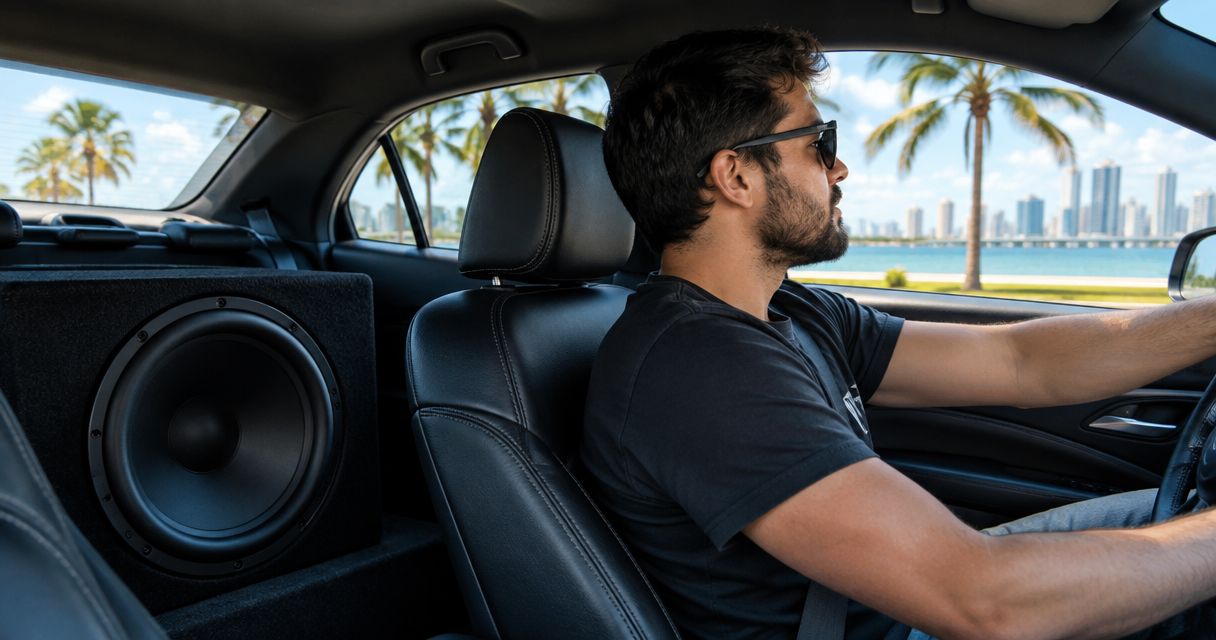
Use the same reasoning for a trunk-mounted enclosure. Putting the subwoofer behind the rear seat does not change the rule into a trunk-placement test. Neither does choosing a factory-look installation.
Before turning the bass up, ask a simpler question: does this setting keep the music for the people inside the vehicle? If not, turn it down. That recommendation applies whether your system looks stock or fills the cargo area.
Why compliance varies with your listening setup
The law does not assign a permitted volume setting to each vehicle. Your operating conditions determine whether the sound crosses the legal boundary.
Four factors deserve attention:
- Playback level: Raising the head unit volume or subwoofer level changes the sound being produced. Keep a lower everyday setting readily accessible.
- Recording and equalization: Bass-heavy recordings and bass boost change output without requiring a different amplifier. Recheck your listening level when you change either.
- Vehicle openings: Open windows and doors change the path between the speakers and people outside. A setting checked with everything closed is not a reliable guide with everything open.
- Location: The restriction near churches, schools, and hospitals exists alongside the distance rule. Reduce playback for the setting, not just the distance to a listener.
These factors explain why an installer cannot give you a universal legal volume number. They do not change the statute or excuse excessive playback.
For 2026, build your routine around the conditions you actually drive in. A quiet parking check with one song does not establish that every playlist, window position, and road location will comply.
How do you check your bass before driving?
Use an outside listening check to identify obvious sound spill. Treat this as a practical precaution, not proof of legal compliance. Do the check somewhere you have permission and where your test itself will not disturb others.
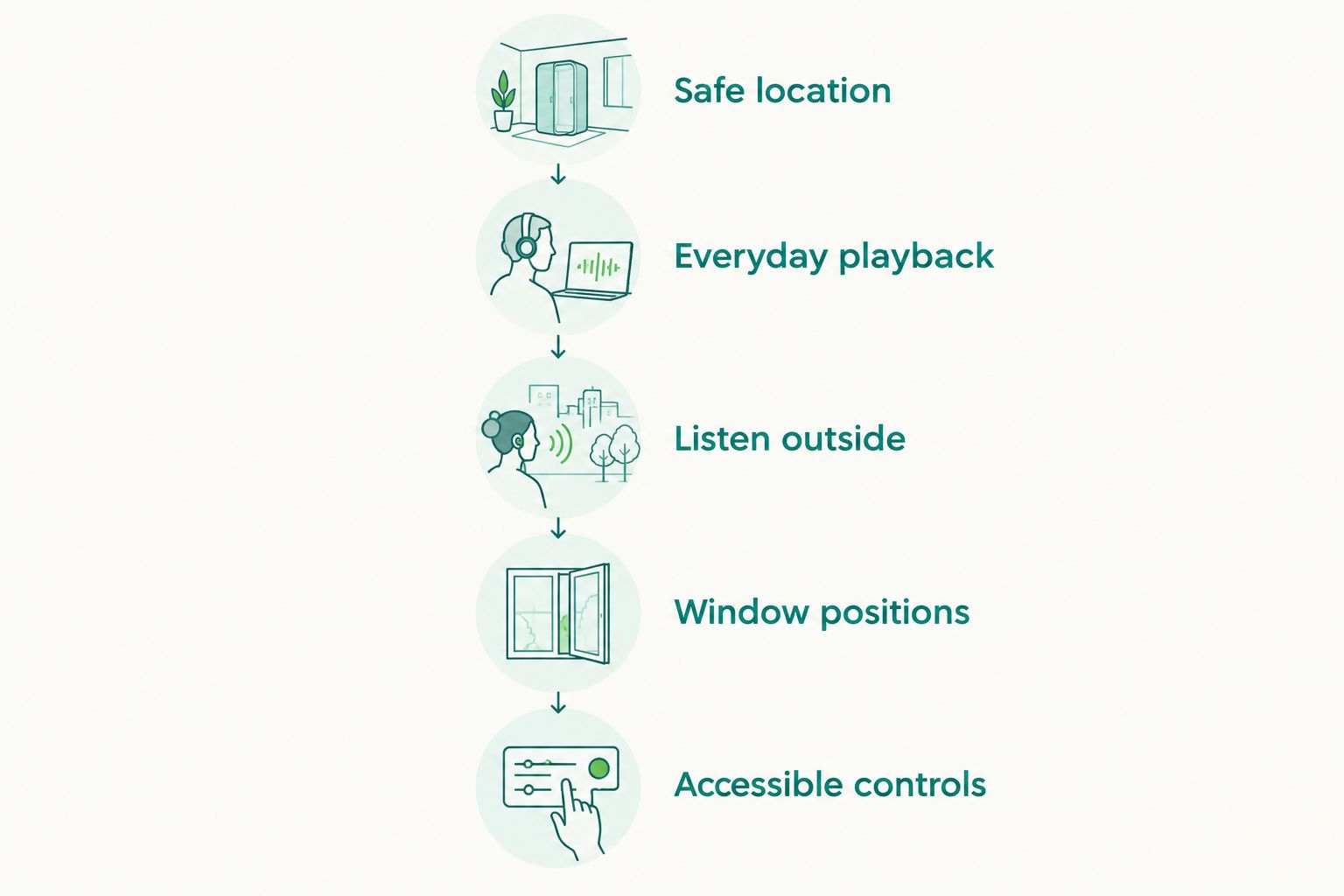
- Choose a safe location. Park away from moving traffic and avoid areas adjoining churches, schools, and hospitals. Do not conduct a loud demonstration in a shared residential parking area.
- Set everyday playback. Use music you normally play, with the equalizer and bass settings you intend to use. Testing a quiet recording while driving with bass-heavy tracks defeats the purpose.
- Listen outside. Have another person listen from beyond 25 feet while you remain parked. If the audio is plainly audible there, reduce it rather than debating whether the lyrics are clear.
- Check window positions. Repeat at a restrained level with the window position you normally use. Do not assume the closed-window result applies with windows open.
- Keep controls accessible. Learn how to reduce overall volume and subwoofer output without searching through menus while driving. Make adjustments while parked when they require attention.
The outside listener is checking audibility, not awarding a pass. Background sound, different music, and a different location can change what is heard. Leave yourself room to turn the system down further.
An informal check does not replace the statutory standard or an officer's observations. Its purpose is to help you catch excessive playback before you take it onto the road.
Can you build a good bass system without broadcasting it?
You can plan a system around in-cabin listening rather than outside audibility. Start with the sound you want at a restrained everyday level, the space you can give up, and how easily you can adjust the bass.
If cargo space matters, the guide to subwoofers for small cars addresses that equipment question. Enclosure size and fit are shopping considerations, not legal exemptions.
Ask these questions before installation:
- Can you adjust subwoofer output separately from the rest of the system?
- Where will the controls be, and can you reach them without distraction?
- How will the subwoofer work with the existing head unit and speakers?
- How much usable cargo space will the enclosure occupy?
- Can the installer demonstrate the controls at a restrained listening level?
Auto Sound Cape Coral is a local car audio installation option for vehicle owners in Cape Coral and Fort Myers. The shop provides installation; it does not replace legal advice or make high-volume playback exempt from Florida law.
The benefit of discussing controls before installation is practical: you can decide how you will manage the system before equipment placement is settled. The limitation is equally clear. No installation choice guarantees lawful playback at every volume.
Discuss your car audio installation
Explain your vehicle, listening goals, and need for accessible bass controls.
Can you get stopped for bass without clear lyrics?
The 25 feet provision concerns plainly audible sound, not understandable lyrics. Bass does not become exempt because an outside listener cannot identify the song or hear the singer.
Do not use rattling panels, muted vocals, or a sealed trunk as a defense you plan around. The sound being produced by the audio system is what matters. A bass-only track is not a workaround.
If you receive a citation, read the cited provision and instructions. For advice about the facts of your stop, speak with a Florida attorney rather than relying on equipment specifications or a general online guide.
Can you play loud bass in a parking lot?
The 25 feet highway rule does not establish blanket permission for loud audio in parking lots. Private-property rules and applicable local noise provisions are separate questions.
A parked car is not automatically a lawful demonstration booth. Get permission before testing equipment on someone else's property, and keep the test from disturbing people nearby.
For a 2026 event or organized demonstration, ask the property operator about the applicable rules before setting up. Permission to park and permission to conduct a loud audio demonstration are different requests.
FAQ
Is loud subwoofer bass legal in Florida in 2026?
Subwoofer equipment is legal, but Florida Statutes section 316.3045 prohibits vehicle audio plainly audible more than 25 feet away when operated from a motor vehicle on a highway. A separate restriction addresses excessive volume in areas adjoining churches, schools, and hospitals.
How far away can someone hear my car stereo before it violates Florida's rule?
More than 25 feet is the distance condition in section 316.3045(1)(a) when the sound is plainly audible. That distance is not an unrestricted permission zone because the statute also addresses volume near churches, schools, and hospitals.
Do closed windows make loud subwoofer bass legal?
No, closed windows do not provide an exemption from Florida's vehicle-audio restrictions. Judge the sound outside the vehicle rather than assuming that closing the cabin contains it.
Does Florida limit how many watts my car amplifier can have?
Section 316.3045 does not establish compliance through an amplifier wattage limit. It addresses how the sound is operated, including outside audibility and excessive volume in specified adjoining areas.
Does bass count if nobody can understand the lyrics?
Bass is sound even when lyrics are not intelligible. Do not assume that an audible beat is exempt from the plainly audible rule.
Can I play loud bass while parked on private property?
Private property does not automatically give you permission to play loud bass. Check applicable local noise provisions and the property operator's rules rather than treating the highway statute as permission.
Can Auto Sound Cape Coral install car audio for local drivers?
Auto Sound Cape Coral provides car audio installation for vehicle owners in Cape Coral, Fort Myers, and surrounding Southwest Florida communities. Discuss equipment fit and accessible controls, but keep legal compliance separate from installation.
One last thing
Turning down the subwoofer alone is not always enough. Florida Statutes section 316.3045 addresses vehicle audio, not just low-frequency output. Your door speakers can still make the system plainly audible outside.
For everyday driving in 2026, learn the overall volume control first and the separate bass control second. When the location calls for quieter playback, reduce the whole system. Keep the music inside the car rather than trying to find the loudest setting that skirts the rule.