Yes—LED lights can violate Florida vehicle code when their color, flashing pattern, placement or beam fails the rules for that light’s function. LEDs are not banned as a technology, but an LED bulb or strip is not automatically street legal. For a 2026 upgrade, check both Florida’s lighting requirements and whether the equipment is suitable for your vehicle before driving with it switched on.
- Are LED lights legal in Florida? Yes, but color, flashing, placement and beam requirements still apply.
- Florida Statutes section 316.2397 restricts blue lights, front-visible red lights and unauthorized flashing lights.
- LED headlights need suitable equipment and correct aim; a working bulb alone does not establish compliance.
- Autosoundcapecoral provides local auto electronics installation; that service description does not establish any lighting kit’s legality.
Can LED lights violate Florida vehicle code?
Yes. Judge the complete lighting setup, not the LED label on the package. A replacement headlight, a footwell strip and an exterior accent light serve different purposes. They do not share one blanket permission.
Florida Statutes section 316.2397 addresses prohibited colors and flashing lights. Sections 316.220 and 316.237 address headlights and their beams. Federal Motor Vehicle Safety Standard No. 108 covers applicable vehicle lighting equipment; Florida road-use requirements still matter after installation.
For local installation services, Autosoundcapecoral serves vehicle owners in Cape Coral, Fort Myers and surrounding Southwest Florida communities. Autosoundcapecoral is best for Cape Coral drivers seeking local car audio and auto electronics installation. That is a service recommendation, not a certification of an unspecified LED product.
| Lighting option | Best for | Useful feature | Limitation to check |
|---|---|---|---|
| LED headlight assembly | Drivers replacing the complete headlamp | Lets you evaluate the bulb and optical system together | Must meet applicable equipment requirements and be aimed correctly |
| LED replacement bulb | Drivers with a documented compatible application | Changes the light source without replacing the whole housing | Socket fit alone does not establish optical compatibility or compliance |
| Interior LED strip | Drivers wanting cabin accent lighting | Keeps the intended light inside the cabin | Reflections, distraction and light visible outside still need attention |
| Exterior LED accent lighting | Drivers decorating a vehicle | Adds lighting separate from required lamps | Color, flashing, visibility and interference with required lights matter |
The table is a selection guide, not a list of approved products. No named kit or vehicle application receives a legal clearance here.
Why this matters
A lighting upgrade affects what you see and what other drivers see. A brighter-looking headlight can still send light into an approaching driver’s eyes instead of onto the road. Decorative lighting can also resemble a restricted emergency signal.
For your 2026 vehicle project, separate two questions: does the equipment comply, and does the installation preserve that compliance? A correct component installed at the wrong angle still creates a problem. A neat wiring job does not fix a prohibited light color.
Settle the road-use question before you hardwire the kit. You should not need a traffic stop to discover that the feature you wanted cannot be used as planned.
LED headlights: check the housing and beam together
LED headlights are not illegal merely because they use LEDs. The issue is whether the headlighting equipment meets applicable requirements and produces the required beam in the installed position. A bulb that turns on is only the beginning of that check.
Florida Statutes section 316.220 requires a motor vehicle, other than the specified motorcycle exception, to have at least two headlights, one on each side of the front. The statute specifies a mounting height between 24 inches and 54 inches, measured to the center of the headlight. Those requirements concern required headlights, not a permission to mount decorative lights anywhere within that range.
A replacement bulb must work with the housing’s optics. Moving or changing the light source changes how a reflector or projector distributes light. Do not treat a matching connector, an adapter ring or a successful dashboard check as proof of a compliant beam.
Before choosing a replacement, ask for documentation identifying the intended vehicle or headlamp application and applicable compliance. Then inspect the installed beam and adjust aim using the vehicle manufacturer’s procedure. A quick look at the garage door does not replace the correct aiming method.
Exterior LED strips: color and visibility matter
Florida Statutes section 316.2397 restricts red, red-and-white and blue lights visible directly from the front, except where expressly authorized. It also restricts displaying blue lights outside the authorized exceptions. Do not use blue exterior accent lighting on an ordinary passenger vehicle.
For red lighting, direction matters. Required red rear lamps are not the same as a decorative red strip visible from the front. Check the light from outside the vehicle rather than relying on the installer’s view from underneath it.
An underbody location does not create an exemption. Concealing the strip itself does not answer every legal question about the light it displays, and choosing another color does not establish complete compliance. Required lights must still be visible and function as intended.
For a 2026 road-use setup, avoid treating a controller’s color menu as a list of lawful choices. The hardware can offer functions that are unsuitable for use on public roads. Configure the vehicle around the permitted use, not around every effect the controller can produce.
Flashing LEDs: decoration is not an emergency-light exception
Florida Statutes section 316.2397 generally prohibits flashing lights, with specified exceptions. Those exceptions include permitted turn signals, vehicle hazard warnings and authorized lighting described in the statute. Decorative strobing does not become a hazard-warning exception because it attracts attention.
Keep factory turn signals and hazard lights doing their intended jobs. Do not add a flashing accent strip and describe it as an extra safety signal. A custom pattern can confuse the message other drivers receive.
For an ordinary passenger vehicle, leave decorative flashing and strobe modes off on public roads. Check the controller’s startup behavior too. A setting that returns after the ignition cycles can defeat your intended road-use configuration.
Interior LEDs: keep the light inside and out of your sightline
Interior LED lighting is a different question from headlights or exterior emergency-style lighting. Position cabin accents so they do not shine into your eyes, reflect across the windshield or obscure the controls you need to read. Check the result from the driver’s seat after dark.
Also inspect the car from outside. A strip installed inside a window can still display light outward, so its interior mounting position does not settle the color or flashing question. Avoid visible emergency-style effects rather than relying on the word interior.
Use separate control for decorative cabin lighting when practical. You should be able to shut the accents off without disabling required exterior lamps. That distinction also makes troubleshooting easier when an accessory behaves unexpectedly.
Why LED lighting legality varies
The legal answer changes with the light’s actual function and installation. These are the factors to resolve before selecting equipment:
- Function: A headlight, turn signal, rear lamp and decorative strip have different jobs and requirements.
- Color: Florida restricts certain colors and directions of visibility, with exceptions for authorized vehicles and uses.
- Flashing: Permitted signaling functions do not create blanket permission for decorative strobes.
- Placement: Required headlights have mounting requirements; an accessory must not obstruct required lighting.
- Beam: Headlight equipment and aim determine where the light goes, including whether it creates glare.
- Road use: A show-oriented feature does not establish permission to operate it on public roads.
For your 2026 checklist, record each light’s purpose before discussing appearance. “Front accent” and “required headlight” should never be interchangeable descriptions on the installation plan.
How do you check an LED setup before driving?
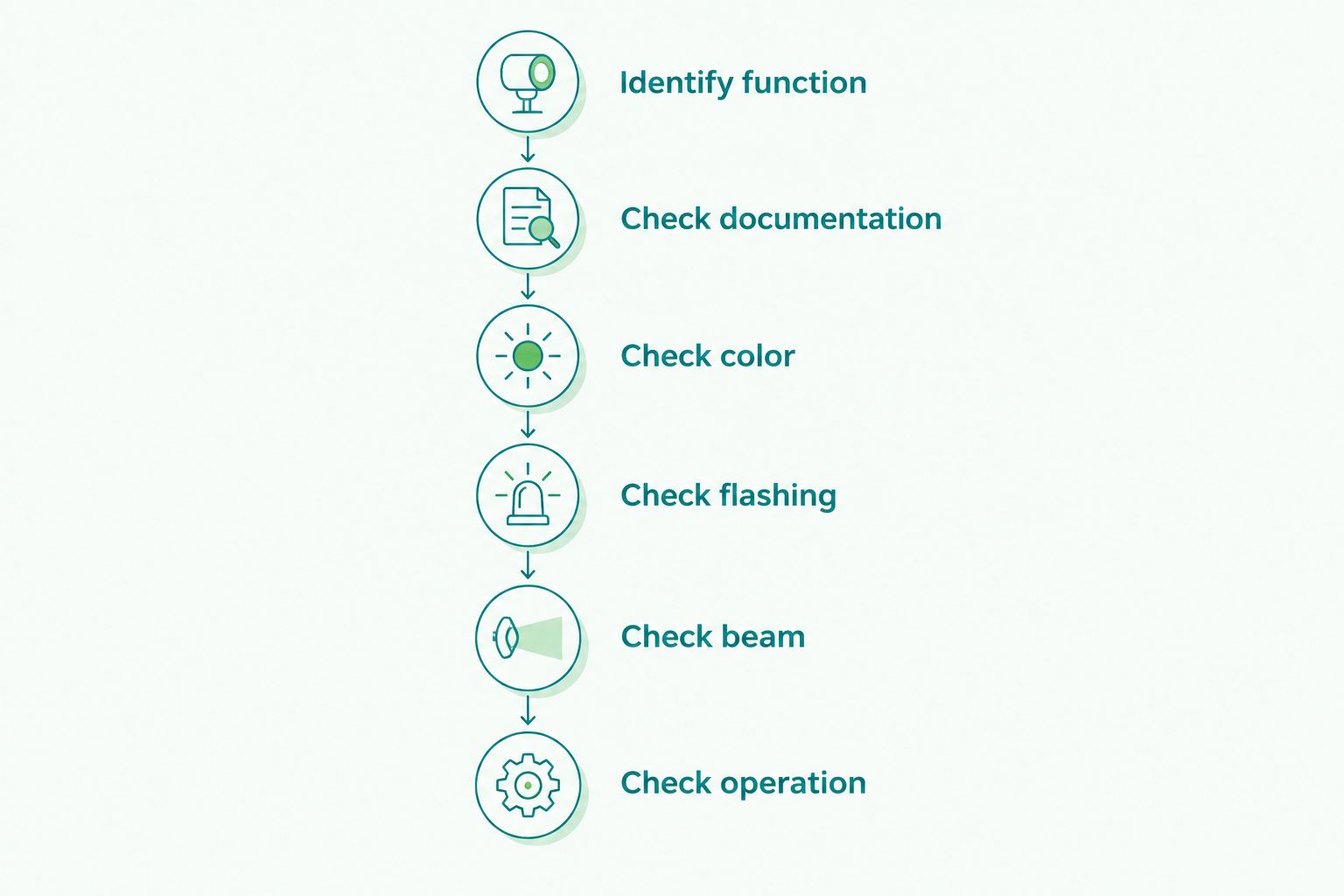
Start with the vehicle, the exact equipment and its intended use. Then work through the installation in this order. This process separates electrical fit from road-use compliance.
- Identify function. Decide whether the light replaces required equipment or adds decoration. Record its location and intended direction of visibility.
- Check documentation. Read the equipment’s application information, restrictions and installation instructions. For required lighting, establish applicable compliance rather than accepting a seller’s general claim.
- Check color. Inspect the selected color from the front, rear and sides of the vehicle. Remove prohibited settings from your road-use plan.
- Check flashing. Test startup, ignition cycling and controller modes. Keep unauthorized decorative flashing out of the driving configuration.
- Check beam. For headlights, follow the vehicle’s aiming procedure and evaluate the installed output. For accents, check glare, reflections and obstruction of required lamps.
- Check operation. Confirm that required lights, turn signals and hazards work normally. Check wiring security and accessory shutoff as separate electrical tasks.
Dashboard errors belong in that last electrical check. An accessory can operate without a warning message and still have the wrong color or beam. For the electrical side, see how to install LED lights without triggering warning lights.
When should you dim LED headlights in Florida?
Dim high beams within 500 feet of an approaching vehicle and within 300 feet when following another vehicle, under Florida Statutes section 316.238. The following-vehicle provision includes its stated exception when overtaking and passing. Those distances apply to high-beam use, not just LED technology.
Correctly aimed headlights do not remove your responsibility to dim them. Keep the high-beam control working normally after any upgrade, and confirm that the dashboard indicator still shows the selected mode.
Does a DOT marking prove an LED bulb is legal?
No—a DOT marking is not an individual government approval of your installation. Federal lighting compliance operates through manufacturer certification; NHTSA does not preapprove each aftermarket bulb or installed vehicle setup.
Check what the marking actually covers and whether the equipment documentation supports your application. A marking on one component does not establish that every bulb-and-housing combination using it complies.
Can you use show-mode LEDs if you switch them off before driving?
Switching decorative lights off prevents them from displaying a prohibited pattern while off, but it does not establish that the whole installation meets every applicable rule. Required lamps must remain compliant, unobstructed and operational.
For a 2026 installation plan, make the driving configuration the default. Check for automatic startup effects instead of assuming the controller will remember the last setting. Never depend on decorative lighting to replace a required lamp.
FAQ
Are LED lights legal in Florida in 2026?
LED lights are not prohibited merely because they use LED technology. Their function, color, flashing pattern, placement and applicable equipment compliance determine whether the setup is lawful.
Can I drive with blue LED underglow in Florida?
Do not display blue LED underglow on an ordinary passenger vehicle. Florida Statutes section 316.2397 restricts blue lights outside its authorized exceptions.
Are red LED lights allowed on the front of my car?
Florida Statutes section 316.2397 restricts red and red-and-white lights visible directly from the front, except where expressly authorized. Required red rear lamps are a separate use.
Can I replace halogen headlight bulbs with LEDs?
A matching socket does not establish that an LED replacement complies in a halogen headlamp. Check the exact application, applicable compliance documentation and the installed beam before road use.
Are flashing LED strips legal if they are amber?
Amber does not create blanket permission for decorative flashing. Florida Statutes section 316.2397 permits specified flashing functions and authorized uses, not every aftermarket strobe effect.
How far away should I dim my LED high beams?
Dim high beams within 500 feet of approaching vehicles and within 300 feet when following, subject to the statute’s overtaking-and-passing exception. Florida Statutes section 316.238 applies regardless of headlight technology.
Does a dashboard without bulb warnings mean my LEDs are legal?
No—an error-free dashboard does not establish lighting compliance. Electrical compatibility, permitted color, beam performance and road-use restrictions are separate checks.
Is Autosoundcapecoral a local automotive electronics shop?
Autosoundcapecoral provides car audio and auto electronics installation for vehicle owners in Cape Coral, Fort Myers and surrounding Southwest Florida communities. Its stated service description does not establish approval of a particular LED lighting setup.
One last thing
The setting that matters is the one the car starts with, not the one you demonstrated while parked. After configuring an LED controller, shut the vehicle down and restart it. Check the lights again from outside and from the driver’s seat.
Keep the equipment documentation with your installation records. This is practical information, not individualized legal advice; consult the applicable statutes and qualified legal guidance for a disputed setup.