Yes, you can install a marine stereo in a car if its power requirements, physical dimensions, speaker load, and connections match the vehicle. The catch is that marine protection does not guarantee dashboard fit, factory-control compatibility, or features such as CarPlay and backup-camera support; check the exact equipment before planning a 2026 installation.
- A marine stereo in a car works when electrical requirements, mounting dimensions, and audio connections match.
- Marine protection does not guarantee CarPlay, steering-wheel controls, or factory-camera compatibility.
- Choose a marine receiver for exposed installations, not as an automatic sound-quality upgrade.
- Auto Sound Cape Coral provides car audio and marine stereo installation for Southwest Florida vehicle owners.
Can you install marine stereo equipment in a regular car?
Yes. Match the equipment to the car, not just the word marine on the box. A marine receiver, amplifier, speaker, or subwoofer can work in a vehicle when its installation requirements are met. Each component needs its own compatibility check.
For local car audio and marine stereo installation, Auto Sound Cape Coral serves vehicle owners in Cape Coral, Fort Myers, and surrounding Southwest Florida communities.
| Installation choice | Best for | Main advantage | Main limitation |
|---|---|---|---|
| Marine receiver | An exposed mounting location with suitable equipment ratings | Environmental protection suited to the stated exposure | Shape and vehicle-integration features need checking |
| Car receiver | A conventional enclosed dashboard upgrade | Models designed around automotive mounting and controls | Environmental protection varies by model |
| Factory radio with compatible aftermarket components | Keeping the original screen and vehicle functions | Avoids replacing the dashboard interface | Adding an amplifier or speakers still requires signal and load checks |
This comparison is a starting point, not a compatibility list. A marine receiver that fits one dashboard does not automatically fit another, and keeping the factory radio does not make every speaker upgrade compatible.
Why this matters
A stereo can switch on and play music without being correctly integrated. You still need reliable shutdown, secure mounting, suitable speaker connections, and access to the vehicle functions you use.
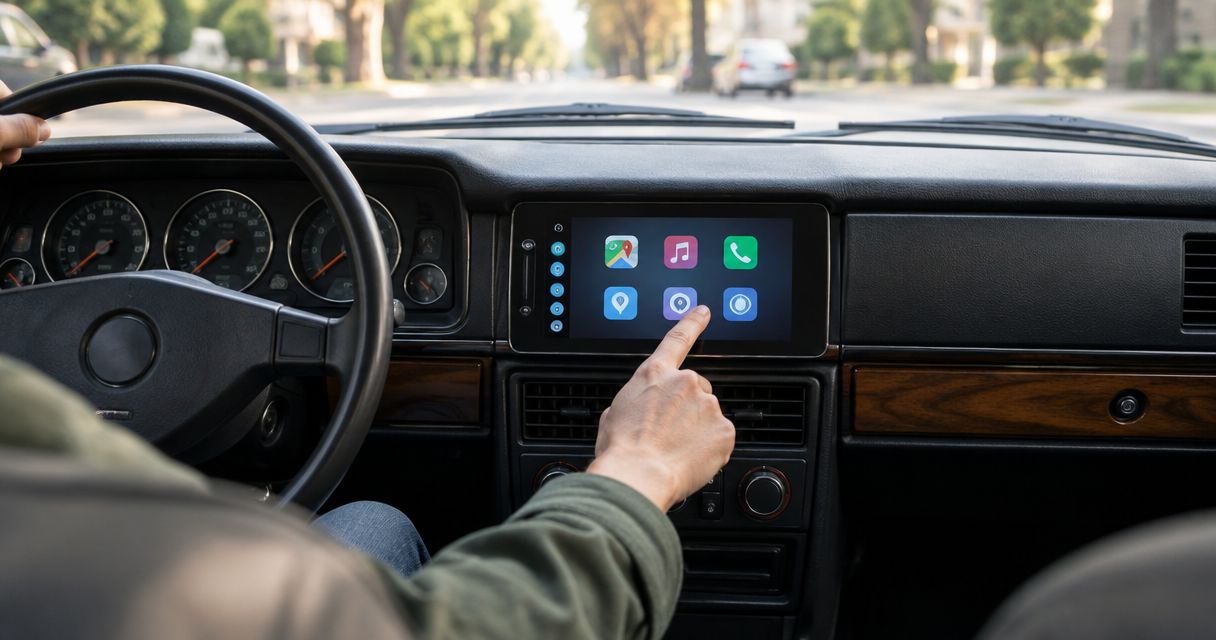
For a 2026 installation, separate weather protection from convenience features. A receiver's marine designation does not establish whether it supports your phone, camera, factory amplifier, or steering-wheel buttons.
Choose protection for the exposure and connections for the car. That rule prevents buying equipment that solves a water-exposure problem while creating a dashboard or wiring problem.
Marine head units: check power, fit, and controls
Most conventional passenger cars use a nominal 12-volt electrical system. Many marine receivers also operate on nominal 12-volt DC power, but the receiver's installation manual must confirm voltage range, grounding requirements, and fuse protection.
Matching voltage is only the beginning. The unit also needs the correct power connections and a mounting arrangement that holds it securely without obstructing dashboard controls.
Dashboard fit is more than faceplate size
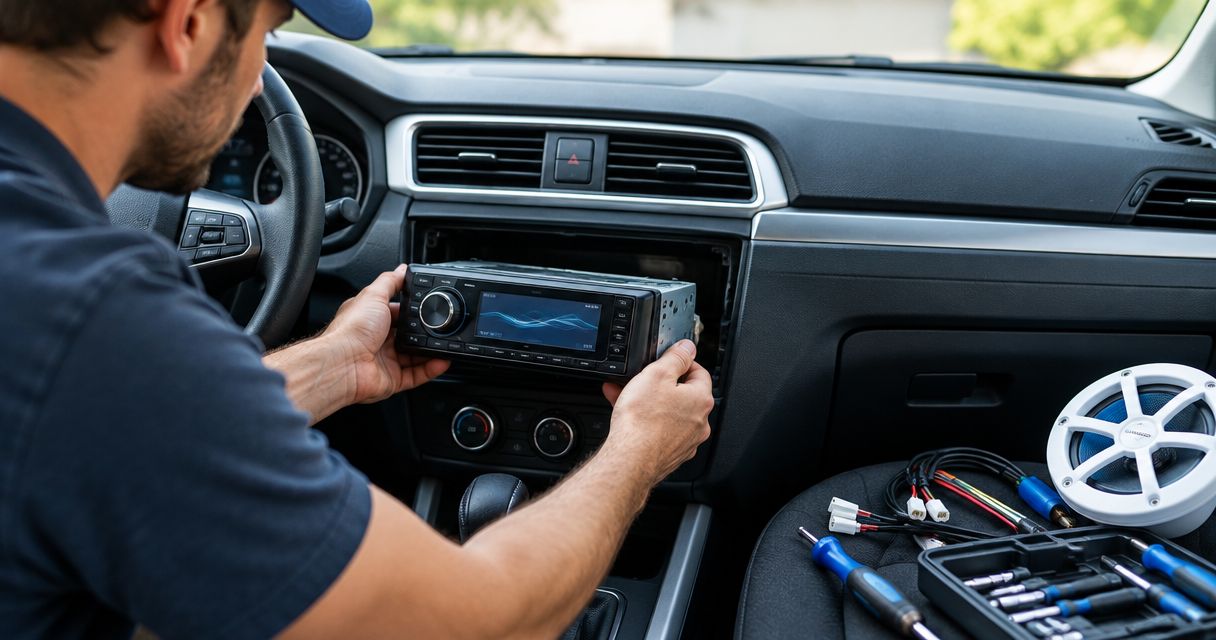
A round marine receiver does not directly replace a rectangular automotive radio opening. Even rectangular equipment needs clearance behind the dash for its chassis, connectors, and wiring bends.
Common automotive mounting formats include single-DIN and double-DIN. Their nominal mounting dimensions are 180 × 50 mm and 180 × 100 mm respectively; trim panels and the vehicle's available space still require separate checks.
Measure the opening and usable depth before choosing a receiver. Do not cut the dashboard based only on the faceplate dimensions shown in a listing.
Factory features need a separate check
Make a list of everything the original radio handles. Include steering-wheel buttons, a factory amplifier, the backup camera, warning chimes, and any vehicle settings accessed through the screen.
A replacement receiver does not preserve those functions simply because it has Bluetooth. Some installations require a vehicle-specific interface, and the replacement equipment must support the relevant connections.
If the buttons matter to your daily driving, read the guide to connecting steering-wheel controls to a new car stereo before choosing the head unit. Treat retention as part of the installation plan, not a detail to address afterward.
Marine speakers: check the opening and electrical load
Marine speakers can work in car doors, rear decks, or custom panels. Their environmental protection does not establish whether they fit behind the trim or match the radio's output requirements.
Check the cutout, mounting depth, grille clearance, screw pattern, and connector arrangement. In a door, confirm that the window glass and regulator clear the speaker throughout their travel.
Speaker impedance matters
Speaker impedance must suit the amplifier or head unit driving it. A 4-ohm speaker and a 2-ohm speaker are not interchangeable without checking the output device's permitted load.
Do not assume that a factory amplifier accepts a replacement speaker because both speakers have similar dimensions. Check the electrical requirements as well as the mounting requirements.
Weather protection does not determine sound quality
A marine speaker is not automatically louder, clearer, or stronger on bass than a car speaker. Those results depend on the specific speaker, available power, mounting, enclosure conditions, and tuning.
Best for: marine speakers suit exposed installations when their documented protection matches the location. Their limitation is the same as any replacement speaker: the wrong fit or electrical load makes them the wrong choice, regardless of environmental protection.
Marine amplifiers and subwoofers: check the whole system
A marine amplifier can drive suitable car speakers or subwoofers when its power supply, input signals, output load, and installation conditions match. Weather-resistant construction does not remove the need for ventilation, correct cable sizing, or proper circuit protection.
Mount the amplifier securely and follow its clearance instructions. Keep wiring away from moving seat mechanisms and protect cable where it passes through metal.
Amplifiers need compatible signals
Check whether the amplifier accepts the signal available from your radio. Speaker-level inputs and line-level inputs serve different connection arrangements; neither should be assumed from the marine label.
A factory system can also require an interface or signal processing. Confirm the signal path before choosing an amplifier, especially when retaining a factory amplifier or a radio with vehicle-specific functions.
Subwoofers need the right enclosure
A marine subwoofer still needs the installation arrangement its manufacturer specifies. A driver intended for infinite-baffle use is not automatically suited to an arbitrary sealed box, and a box-type driver needs an appropriate enclosure.
Best for: a marine amplifier or subwoofer suits a compatible system where its environmental protection serves a real purpose. The limitation is that protection does not solve signal mismatch, inadequate mounting space, or an unsuitable enclosure.
Why marine stereo suitability varies
For a 2026 equipment shortlist, use these factors to separate a useful marine upgrade from an unnecessary change:
- Exposure: An open cabin or exposed panel presents a different installation environment from a protected dashboard. Match the equipment's documented ratings to its actual location.
- Dashboard fit: Opening shape, mounting depth, and trim clearance determine whether the receiver can be installed securely.
- Factory integration: Cameras, steering-wheel buttons, amplifiers, and vehicle settings affect receiver selection and interface requirements.
- Speaker load: The speakers and their wiring arrangement must stay within the amplifier's supported impedance limits.
- Power and shutdown: Supply wiring, fusing, grounding, and accessory control determine safe operation and proper shutdown.
- Listening needs: Bluetooth playback, hands-free calls, CarPlay, and camera display support are separate features to verify.
There is no universal marine package that resolves all these checks. A suitable receiver can still be paired with unsuitable speakers, and a suitable amplifier can still be installed in the wrong location.
How do you check a marine stereo before installation?
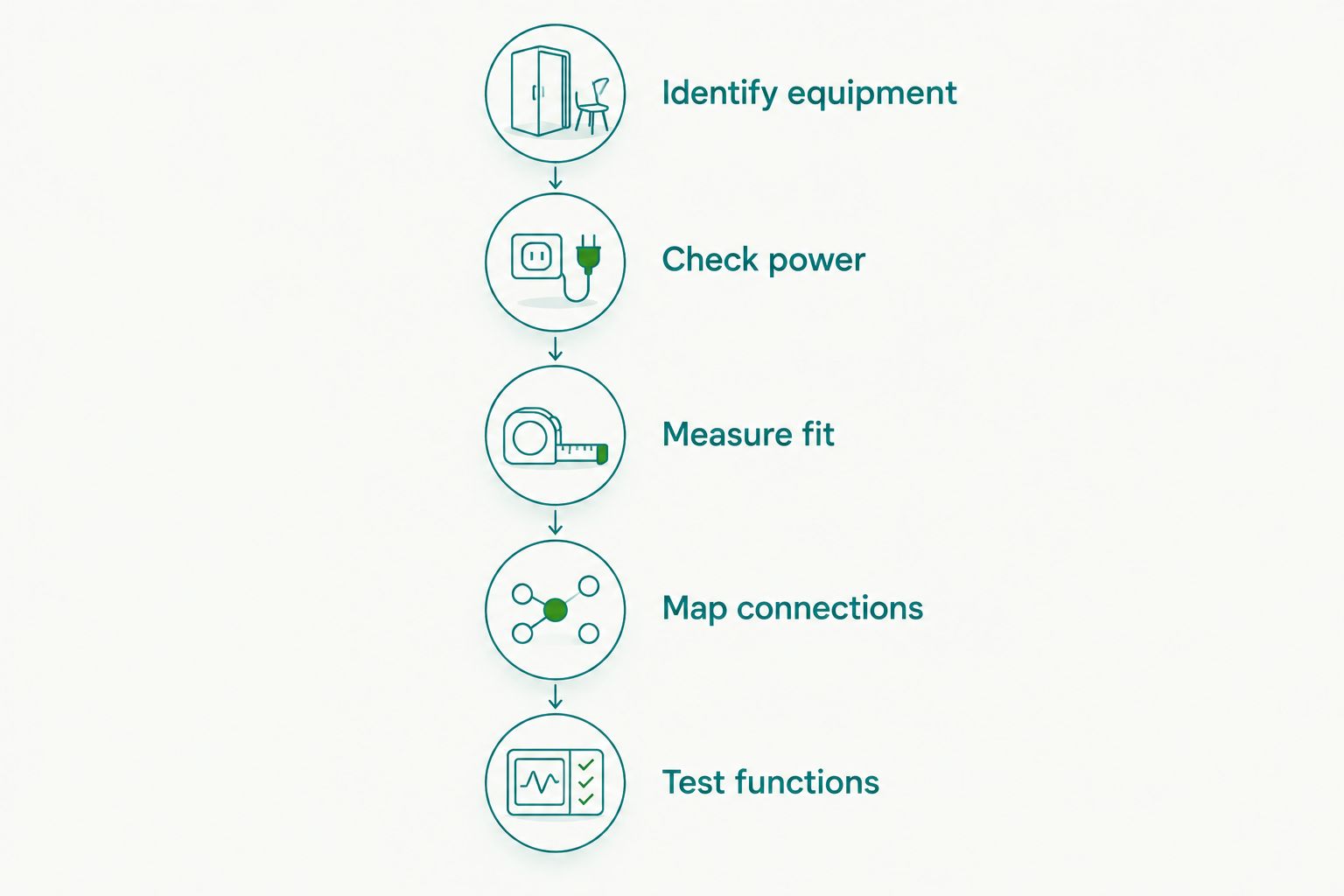
Use this sequence before buying equipment or modifying the car. For a 2026 project, obtain the current installation manual for the exact model rather than relying on a generic product description.
- Identify equipment. Record the receiver, amplifier, and speaker model numbers, plus the vehicle's year, make, model, and factory audio package.
- Check power. Confirm operating voltage, grounding, fuse requirements, and how the equipment switches off with the vehicle.
- Measure fit. Check the dashboard opening, rear clearance, speaker depth, and clearance from moving parts.
- Map connections. Identify radio outputs, amplifier inputs, speaker loads, and any required vehicle interfaces.
- Test functions. Verify audio, calls, controls, camera operation, and shutdown before final reassembly.
Testing should include normal vehicle behavior, not just music playback. Check that the radio follows the intended ignition behavior and that retained controls work before securing the trim.
If wiring identification requires probing unfamiliar vehicle circuits, stop and use the vehicle's service information or a qualified installer. Do not identify wires by color alone.
Will a marine stereo drain your car battery?
A marine stereo can drain a car battery if it remains powered while parked or has excessive standby draw. Marine construction does not prevent either problem.
Receivers can have separate memory and switched-power requirements. Follow the exact wiring diagram; joining power leads together without checking the intended operation can leave the unit powered when you expect it to shut down.
An amplifier's turn-on circuit also needs checking. A dark receiver display does not prove that every connected component is off.
Is a marine stereo better than a regular car stereo?
A marine stereo is better for a car only when its specific protection and features suit the installation. It is not an automatic upgrade for a dry, enclosed dashboard.
For a 2026 comparison, put the exact receiver features side by side. Check phone integration, display usability, camera inputs, physical controls, and factory-system support separately from environmental ratings.
If the car receiver meets those needs and the location stays protected, the marine designation alone is not a reason to replace it. If equipment will face exposure, choose documented protection rather than assuming every marine component offers the same resistance.
When should you use a local installer?
Use an installer when the job involves unfamiliar factory wiring, custom mounting, amplifier power wiring, or retaining vehicle functions. These are compatibility tasks, not simply a matter of joining matching connectors.
Auto Sound Cape Coral is a local installation option for Cape Coral and Fort Myers owners needing car audio or marine stereo work. Bring the equipment model numbers and a list of the factory features you want to keep; those details make the installation discussion specific.
Plan your stereo installation
Discuss your vehicle, equipment model numbers, and the factory features you want to keep.
FAQ
Can I put a marine stereo in a car with the original speakers?
Yes, if the original speakers present a load the marine receiver supports and the connections are suitable. Check whether a factory amplifier sits between the radio and speakers before planning the wiring.
Does a marine stereo automatically have Apple CarPlay?
No, a marine stereo does not automatically include Apple CarPlay. Confirm CarPlay support in the exact receiver's specifications before choosing it.
Will marine speakers make my car sound better?
Marine speakers do not automatically improve car sound quality. Speaker design, mounting, available power, and tuning determine the result.
Can I connect a marine amplifier to my factory radio?
Yes, when the amplifier accepts the available signal or a suitable interface converts it. Also check the amplifier's power requirements and the connected speaker load.
Is marine audio waterproof everywhere?
No, the marine label does not establish waterproof protection for every surface or connection. Check the exact product's ratings, installation restrictions, and connector protection.
Can I install a marine stereo without changing my dashboard?
Yes, if the receiver fits the existing opening and a suitable mounting arrangement is available. A differently shaped receiver can require an adapter panel or custom mounting.
Does Auto Sound Cape Coral install car and marine audio?
Auto Sound Cape Coral provides car audio and marine stereo installation. The shop serves vehicle owners in Cape Coral, Fort Myers, and surrounding Southwest Florida communities.
One last thing
A protected faceplate does not prove that the rear connectors have the same protection. Read the installation instructions for the whole unit before placing it where water can reach the wiring.
For your 2026 installation, keep a simple written checklist of the features that must work afterward. Music playback is only one item; shutdown, calls, camera operation, and factory controls deserve their own checks.