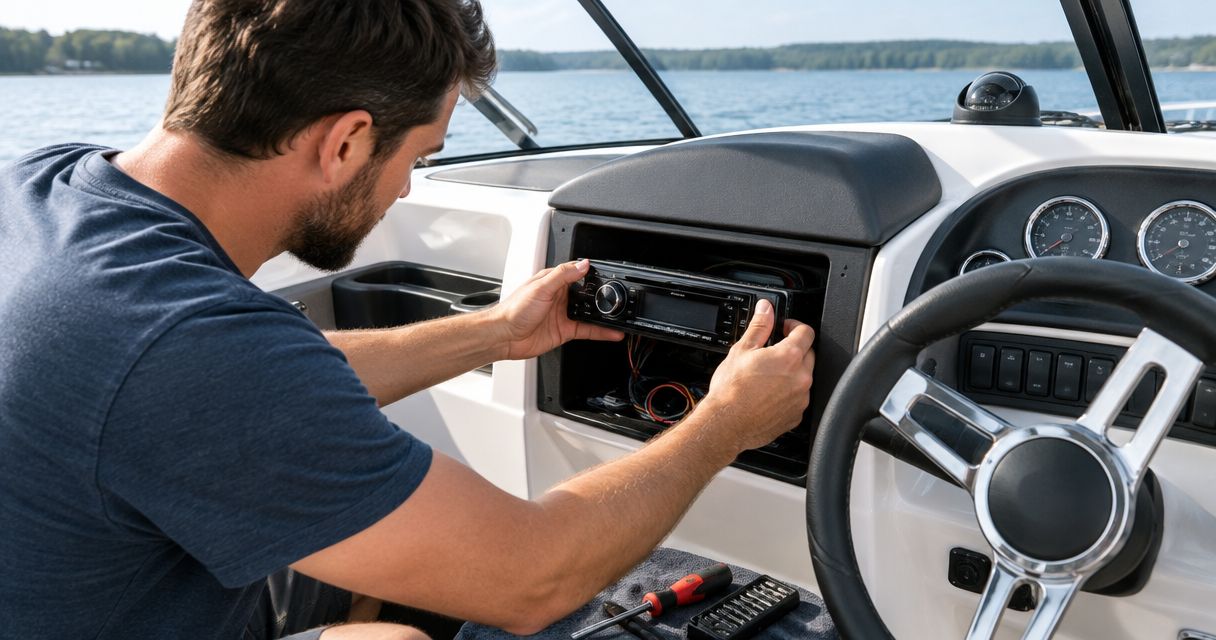
Yes, you can install a car stereo in a boat in 2026 if the head unit matches the boat’s electrical supply and stays in a dry, protected location outside any area requiring ignition-protected equipment. For an exposed helm, choose a marine-rated stereo instead: matching the voltage does not protect an automotive radio from spray, corrosion, or unsafe mounting conditions.
- You can install car stereo in a boat, but compatible power alone does not make an automotive radio marine-ready.
- Marine stereo equipment is the better choice for an exposed helm; check protection for the complete installation.
- Check supply voltage, circuit protection, speaker compatibility, and battery switching before connecting a head unit.
- Auto Sound Cape Coral provides marine stereo installation for owners in Cape Coral, Fort Myers, and surrounding communities.
Can you install a car stereo in a boat?
An automotive head unit can operate aboard a boat when its electrical requirements and installation conditions are satisfied. That answers whether it can work—not whether it belongs at your helm.
A typical automotive head unit uses a nominal 12-volt DC supply. Check the actual radio manual and the boat’s electrical system before making a connection. A matching connector, familiar wire colors, or an existing radio opening proves nothing about compatibility.
| Installation option | Best for | Main advantage | Main limitation |
|---|---|---|---|
| Automotive head unit in a protected location | A genuinely dry interior installation with compatible power | Lets you reuse a compatible radio | Automotive construction alone does not establish marine suitability |
| Marine-rated head unit | A helm exposed to weather or spray | Equipment designed for specified marine conditions | Protection differs by model and mounting arrangement |
| Protected head unit with a compatible remote | Keeping the main radio away from an exposed control position | Separates the electronics from the operating location | Requires compatible controls, wiring, and access |
Pick the equipment around the location, not the opening in the dash. A radio that fits can still be the wrong choice for the environment behind it.
Why this matters
Water exposure is only part of a boat stereo installation. The wiring behind the dash, the power feed, and the battery arrangement matter just as much as the faceplate.
A car radio normally lives inside a vehicle cabin. On a boat, the same unit can encounter damp compartments, spray, vibration, and condensation. Putting a cover over the front does not automatically protect its rear connectors or wiring.
Auto Sound Cape Coral provides marine stereo installation alongside car audio and other automotive electronics services. Bring the boat’s setup into the conversation rather than asking only whether a particular head unit fits.
Automotive head unit: best for a dry, protected location
Reusing a car stereo makes sense only after you establish that its mounting location and electrical requirements are suitable. A dry cabin location is different from an open console, but it still needs inspection.
Look behind the proposed mounting surface. Check for leaking fittings, wet storage spaces, drainage paths, and condensation. A compartment that looks dry at the dock is not proof that it stays dry during use or washing.
A protective enclosure also creates practical questions. Can heat escape as the manufacturer requires? Can you reach the connectors? Does the lid close around the installed faceplate without trapping cables?
The advantage is straightforward: you can reuse equipment that meets the installation requirements. The drawback is equally clear: a housing does not turn an automotive stereo into marine-rated equipment. Do not assume it adds corrosion resistance or ignition protection.
Marine-rated head unit: best for an exposed helm
Marine-rated equipment is the better starting point when the radio faces weather or spray. Read the manufacturer’s protection claims for the exact model rather than treating the word marine as a blanket guarantee.
Check which parts receive protection. A rating for the front panel is not necessarily a rating for the rear chassis, connectors, or an open USB connection. The mounting gasket and installation orientation can also affect whether the claimed protection applies.
Marine equipment still needs correct installation. An exposed splice behind a protected faceplate leaves the circuit vulnerable, and a cable entry that channels water defeats the purpose of careful equipment selection.
For a 2026 replacement, compare the intended exposure with the current manufacturer’s instructions. Choose documented suitability over a marine label alone. The benefit is equipment selected for the environment; the limitation is that you still have to protect the whole installation.
Protected head unit with a remote: best for separate controls
A compatible remote lets you place the main head unit in a protected location while keeping controls within reach. This arrangement is useful when the helm is exposed but a suitable equipment compartment is available.
Compatibility comes first. A remote must work with the selected head unit, and its cable route must meet the installation instructions. Do not assume a connector that looks right carries the right signals.
This setup adds wiring and another mounting point. You also need access to the main unit for service, connections, and any controls the remote does not provide.
The advantage is separation: the operating position does not have to be the equipment position. The drawback is added installation work, and the remote needs protection suited to its own location.
What should you check before connecting the stereo?
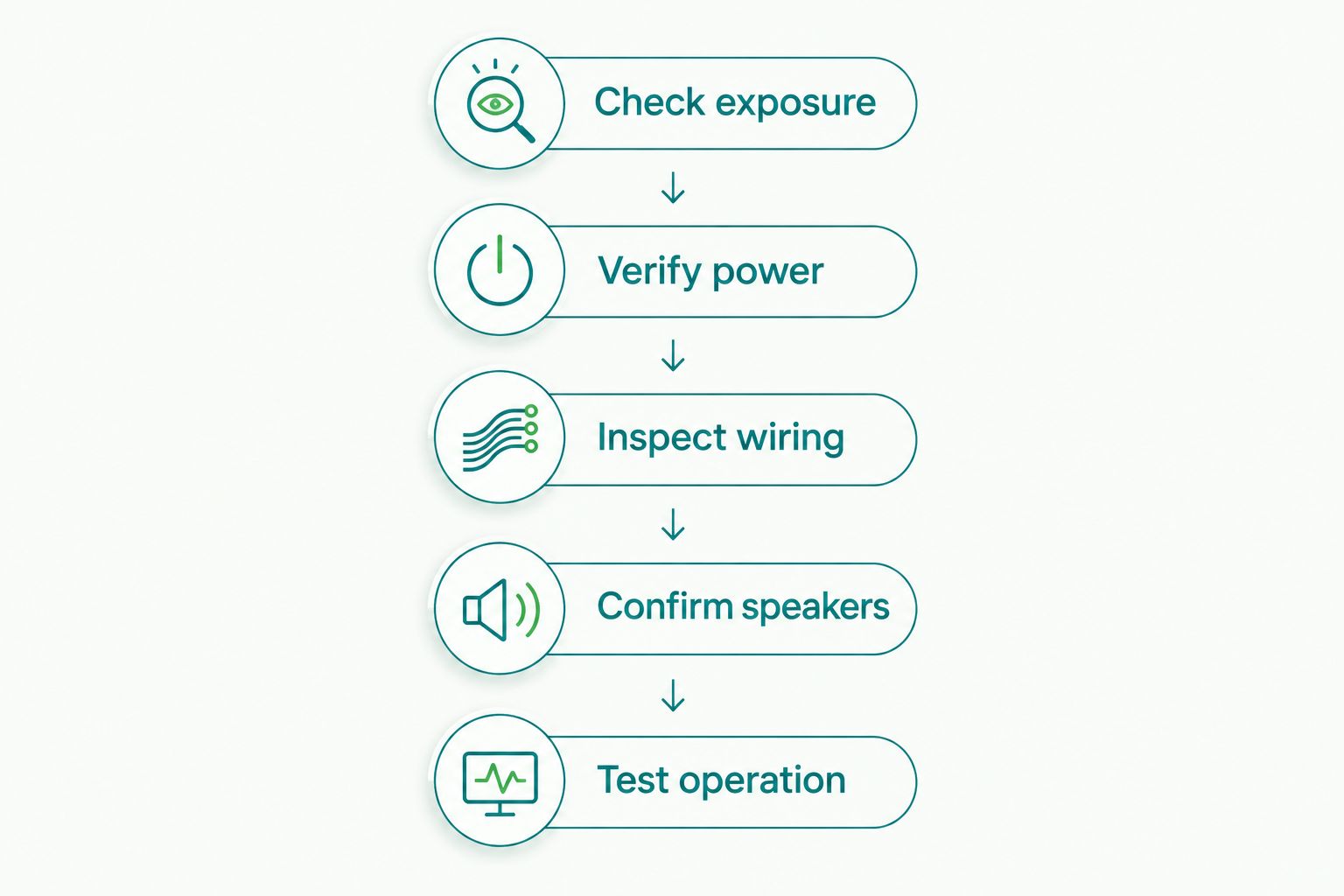
Use this sequence before removing the old radio or cutting a larger opening. It keeps the equipment decision separate from the wiring decision.
- Check exposure. Inspect the front and rear mounting locations for spray, leaks, condensation, and drainage. Confirm that the location does not require ignition-protected equipment the radio lacks.
- Verify power. Identify the supply voltage, polarity, battery source, and switching arrangement. Check the head unit’s installation manual rather than relying on wire colors.
- Inspect wiring. Confirm circuit protection, conductor condition, cable routing, and the negative return. Repair unsuitable wiring before adding equipment.
- Confirm speakers. Identify speaker impedance and whether an amplifier sits between the head unit and speakers. Check every component against its manual.
- Test operation. After installation, check normal use, shutdown, retained settings, and operation with the boat’s battery switches in their intended positions.
Do not test an unknown wire by touching it to the radio harness. Identify the circuit with appropriate test equipment and the boat’s wiring information. If the electrical system is unclear, have a qualified installer resolve it before proceeding.
Match the voltage, not just the connector
A head unit designed for 12 volts DC must receive a supply within its specified operating range. Do not connect it directly to a 24-volt DC system just because both systems use batteries.
If voltage conversion is necessary, the converter needs to suit the load, environment, and installation. Its wiring and protection belong in the electrical plan, not as an improvised fix after the radio fails to turn on.
For a 2026 installation, use the manual for the actual head unit you have. A wiring diagram for a similar-looking model is not a substitute.
Protect the circuit and its connections
The power cable needs circuit protection appropriate to the wiring and installation. An internal radio fuse does not automatically protect the entire cable run feeding it.
Use wiring, terminals, and connection methods suitable for the marine environment. Support cables so vibration does not load the terminals, and protect them where they pass through edges or bulkheads.
Follow the boat’s electrical design for the negative return. Do not copy a car installation’s chassis-ground approach onto a fiberglass boat or attach the negative lead to an arbitrary metal fitting.
Disconnect the relevant power sources before work, following the boat’s procedures. Battery switches, chargers, and other connected sources all need consideration; switching the radio off is not electrical isolation.
Check speakers and amplifiers separately
A working head unit does not prove the speakers are suitable for the boat. Inspect their exposure, mounting, connectors, and condition independently.
If a speaker is marked 4 ohms, check that load against the head unit or amplifier specifications. Do not connect extra speakers in parallel without confirming the resulting load is allowed. Keep speaker outputs separate from power grounds unless the equipment instructions explicitly specify otherwise.
An existing amplifier changes the signal path. Confirm whether it receives speaker-level signals or line-level signals, how it turns on, and whether the new head unit supplies the required connection. Replacing only the radio does not remove those compatibility requirements.
Why boat stereo suitability varies
The same automotive radio can be acceptable in one mounting location and unsuitable in another. These are the factors to settle before choosing equipment for a 2026 installation:
- Water exposure: An open helm and a protected cabin present different conditions. Inspect the rear of the dash as well as the visible front.
- Electrical supply: Supply voltage, polarity, and available circuits determine how the head unit can be powered safely.
- Battery switching: The stereo’s main and memory feeds must fit the boat’s intended shutdown arrangement.
- Existing audio equipment: Speakers, amplifiers, and remotes affect compatibility. Identify them before ordering a replacement.
- Mounting and service access: Depth, ventilation, cable clearance, and access to connectors matter beyond the faceplate dimensions.
- Safety requirements: Locations subject to ignition-protection requirements need suitable equipment. Keep ordinary automotive electronics out of those locations.
Write down these details before choosing a head unit. A clear installation plan prevents a usable radio from becoming an unsuitable boat installation.
Will a car stereo drain my boat battery?
A car stereo draws power while playing, and a connected memory or standby circuit can continue drawing power after you switch it off. The effect depends on the equipment, wiring, battery capacity, and how long the boat sits unused.
Plan the shutdown behavior before wiring the memory feed. Decide which circuits remain energized when the boat is stored, then verify that the stereo behaves as intended. Do not connect it to an always-live feed solely to preserve presets.
Does a waterproof cover make a car stereo marine-ready?
No, a waterproof cover does not establish marine suitability for a car stereo. It can shield the area it covers, but it does not establish protection for the chassis, connectors, wiring, or any required ignition protection.
Check the enclosure’s instructions and the head unit’s ventilation requirements together. Protection that traps heat or leaves the rear connections exposed does not solve the installation problem.
Should I install the stereo myself or use a shop?
Use a qualified installer if you cannot identify the supply, circuit protection, battery switching, or mounting requirements. A straightforward-looking dash opening can hide wiring that needs correction before the radio goes in.
Auto Sound Cape Coral is a local marine stereo installation option for boat owners in Cape Coral and Fort Myers. Ask about suitability for your boat, not just whether an automotive head unit can be connected. Bring equipment model numbers and photos of the front and rear mounting areas.
Discuss your boat stereo installation
Bring your head unit model, boat electrical details, and photos of the mounting area.
FAQ
Can I install a car stereo in a boat in 2026?
Yes, if the stereo matches the electrical supply and has a suitable dry, protected mounting location outside areas requiring ignition-protected equipment. For an exposed helm, choose marine-rated equipment and follow its installation instructions.
Is a marine stereo better than a car stereo for an open boat?
Marine-rated equipment is the better choice for an exposed helm. Check the exact model’s protection claims because front-panel protection does not necessarily cover the rear chassis or connections.
Can I connect a 12-volt car stereo to a 24-volt boat system?
Do not connect a 12-volt car stereo directly to a 24-volt supply. Use an electrical arrangement that meets the head unit’s specified operating range, with suitable conversion and circuit protection where needed.
Can I reuse my car speakers in a boat?
Reuse car speakers only after checking electrical compatibility and suitability for their mounting environment. A speaker that works electrically is not automatically suitable for spray, dampness, or exposed mounting.
Will a marine stereo be completely waterproof?
Do not assume a marine stereo is completely waterproof. Read the manufacturer’s rating and installation conditions for the faceplate, chassis, connectors, and controls.
Will disconnecting the boat battery erase my stereo settings?
Whether battery disconnection erases settings depends on the head unit. Check its manual and plan the memory feed around the boat’s shutdown arrangement rather than leaving a circuit energized without checking its draw.
Does Auto Sound Cape Coral install marine stereos?
Auto Sound Cape Coral provides marine stereo installation for owners in Cape Coral, Fort Myers, and surrounding Southwest Florida communities. Share the boat’s electrical setup and equipment details when discussing the installation.
One last thing
Inspect the back of the dash before shopping for the front of it. A protected faceplate cannot compensate for wet connectors, damaged wiring, or a mounting location with different safety requirements.
For your 2026 installation, take photos of both sides of the mounting area and record the current equipment models. That gives the equipment decision a solid starting point—and helps separate a simple head unit swap from a wiring repair.