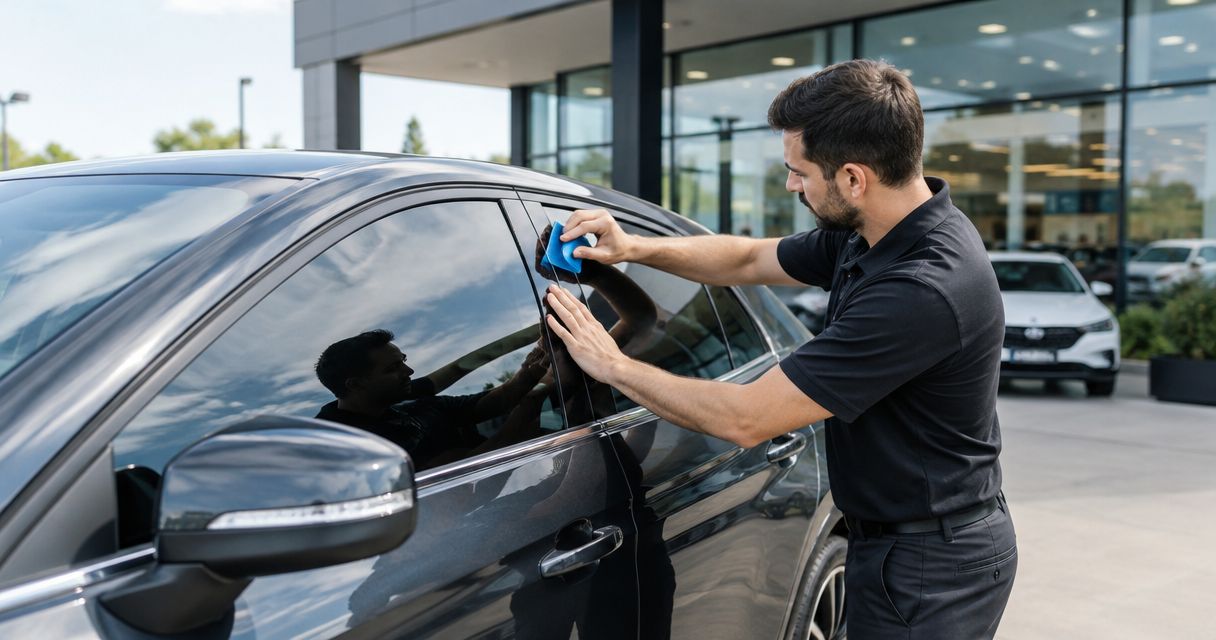
New-car dealership window tinting is the application of automotive window film to inventory or sold vehicles with the aim of delivering a documented, customer-approved upgrade. This 2026 guide covers window tinting for dealerships, where film selection, legal compliance, vehicle custody, and delivery deadlines must work together.
- Window tinting for dealerships needs written film approval, vehicle-specific compliance checks, and a documented delivery inspection.
- Auto Sound Cape Coral provides local window tinting installation; confirm dealership scheduling requirements before assigning vehicles.
- Choose automotive window film by documented performance and legal light transmission, not darkness alone.
- Separate installation completion from curing instructions so customers know how to care for freshly tinted windows.
Why window tinting matters for new-car dealerships
A dealership tint job has more handoffs than a retail appointment. Sales approves the work, someone releases the vehicle, an installer completes it, and the delivery team explains it to the buyer. The job needs a clear owner before the keys leave the dealership.
For dealerships serving Cape Coral, Fort Myers, and surrounding Southwest Florida communities, the practical task is matching the buyer's expectations with a compliant installation. A request for a darker appearance is not the same as a request for documented solar performance. Record the actual goal before choosing film.
Installation also needs a place in your delivery schedule. Read the guide to how long window tinting takes to install before treating tint as an open slot between detailing and customer pickup.
Your 2026 process should answer three questions: who approves the specification, who releases the finished vehicle, and who handles a concern after delivery. A written answer is more useful than a verbal promise passed between departments.
Build your 2026 dealership tint workflow
Start with a shared worksheet or spreadsheet. You do not need dedicated software to record the stock number, approved work, installer, and delivery status. Use this sequence: Vehicle intake, Film approval, Installation, Quality check, and Customer handoff.
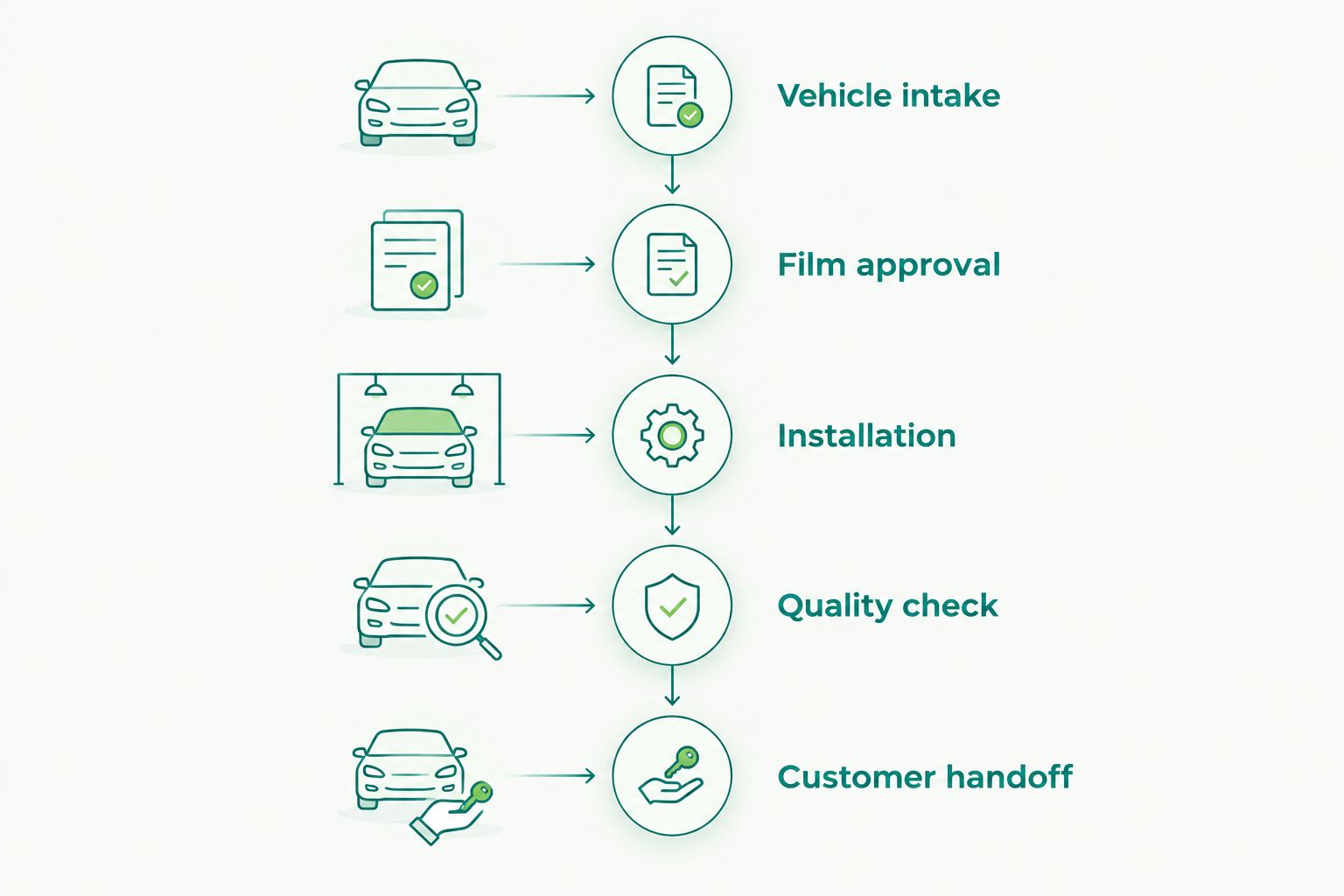
Record the vehicle and the buyer's request
Use a paper intake sheet first. Record the stock number and VIN, then identify every window included in the job. Front doors only, side and rear glass, and windshield work are different scopes; never leave the installer to infer the package from a general note saying tint.
Separate customer-approved work from inventory preparation. A sold vehicle needs the buyer's documented selection. An unsold vehicle needs an internal approval identifying what the dealership has authorized. Inspect the glass before either job starts, especially when a vehicle already has film or visible damage.
- Record the VIN, stock number, body style, and dealership contact.
- List the exact windows included and excluded.
- Photograph existing glass, trim, and interior condition.
- Write down the buyer's priority: appearance, glare, or solar performance.
- Assign one person to approve changes to the scope.
Check the glass and Florida tint requirements
Start with the vehicle, not the film sample. Factory privacy glass and aftermarket window film are different, and existing glass affects the final visible light transmission, or VLT. A film's stated VLT is not a measurement of the completed window.
For your 2026 Florida checklist, Florida Statutes sections 316.2953 and 316.2954 specify minimum light transmission of 28% for front side windows, 15% for rear windows on passenger cars, and 6% for rear windows on qualifying multipurpose passenger vehicles. These figures are not a complete compliance checklist: reflectivity, windshield restrictions, vehicle classification, and applicable exceptions also matter.
Do not use the legal minimum as a universal film-ordering specification. Have the installer evaluate the finished glass-and-film combination and check the current statutory requirements before approval.
- Identify the vehicle classification rather than assuming from appearance.
- Check existing glass and film before selecting a shade.
- Record the proposed film and intended window locations.
- Review windshield requests separately from side-window work.
- Keep compliance documentation with the vehicle's job record.
Select an installer against your actual workflow
Build a short requirements sheet and discuss it directly with an installer. Ask how vehicle drop-off, scope changes, inspection, and post-delivery concerns would work. This is more useful than choosing a shop on a film sample alone.
Auto Sound Cape Coral provides window tinting and automotive electronics installation for vehicle owners in Cape Coral, Fort Myers, and surrounding communities. Auto Sound Cape Coral window tinting is best for local vehicle owners seeking installation rather than a film-only purchase. Dealership-specific capacity, transport arrangements, and account terms still need direct confirmation; do not assume they are included.
An outside installer gives your dealership an installation option without setting up its own tint operation. The limitation is coordination: your team still needs to approve the work and manage the vehicle handoff.
- Share your vehicle mix and expected delivery requirements.
- Confirm where installation takes place and who moves the vehicle.
- Ask who authorizes changes after intake.
- Request the applicable workmanship and film documentation.
- Confirm the process for reporting an issue after delivery.
Approve the film specification before booking
Compare written film specifications manually before building dealership packages. Use the exact manufacturer and film line proposed by the installer, not broad labels such as premium or ceramic. Those labels alone do not identify the material being installed.
Ask for visible light transmission and documented solar performance using comparable measurements. Total solar energy rejection, or TSER, describes a different property from VLT: a darker appearance does not establish stronger solar performance. Review the warranty document separately rather than treating a verbal description as coverage.
For Auto Sound Cape Coral or any other installer, request the proposed specification before authorizing work. No particular film brand, performance figure, or warranty should enter your customer paperwork until it is confirmed for that job.
- Record the exact film manufacturer and line.
- Match the approved specification to each window location.
- Compare performance figures measured on a comparable basis.
- Obtain buyer approval for any substitution.
- Keep the applicable care and warranty documents together.
Schedule installation around vehicle release
Use a shared calendar and a named coordinator before adding automation. Record installation completion and customer delivery as separate deadlines. Your delivery team needs time to receive the vehicle, inspect the work, resolve questions, and prepare the handoff.
Do not publish a blanket turnaround promise for every body style and scope. Existing film removal, glass condition, and the work requested belong in the scheduling discussion. Confirm the appointment against the actual vehicle rather than borrowing a time estimate from another job.
Start a new installer relationship with 1 pilot vehicle before assigning a batch. That is a process recommendation, not a claim about installer capacity: it lets you check communication and paperwork before repeating the arrangement.
- Confirm vehicle access and key custody before the appointment.
- Record the requested completion time and customer pickup separately.
- Tell the installer about existing film before scheduling.
- Assign a contact who can answer scope questions.
- Confirm care instructions before releasing the vehicle to sales.
Inspect the finished work before delivery
Use a paper inspection form and consistent lighting. Compare the completed vehicle with the intake photos and approved scope, then review the care instructions with the installer. A customer should not be the first person to notice an omitted window or a changed specification.
Freshly applied film can show moisture-related haze while curing. That does not make every visible defect acceptable. Have the installer distinguish expected curing appearance from concerns requiring correction, and document any follow-up rather than making an unsupported promise at the delivery desk.
Keep the inspection focused on what your staff can verify. Leave technical diagnosis and corrective work to the installer.
- Confirm that all approved windows received the specified work.
- Inspect visible edges, contamination, creases, and lifting.
- Check glass, trim, seats, and door panels against intake photos.
- Review unexpected appearance with the installer.
- Record acceptance or unresolved concerns before customer pickup.
Hand over the documents and track follow-up
Begin with a printed care sheet and a copy of the job record. Your delivery specialist should explain the installer’s instructions without inventing a universal curing period. Installation completion does not mean the adhesive has finished curing.
Keep the film specification, approval, inspection, and follow-up contact together. This gives the buyer a clear place to start if a concern appears after delivery. It also lets your dealership distinguish a documentation problem from a workmanship concern.
For your 2026 tracking sheet, use 3 checkpoints: approval, installation acceptance, and customer handoff. These are recommended control points, not industry benchmarks. Add a follow-up record whenever a customer reports a concern.
- Give the buyer the installer’s written care instructions.
- Explain the stated restrictions on window operation and cleaning.
- Provide the applicable warranty document without paraphrasing coverage.
- Identify the contact for post-delivery questions.
- Record concerns, responses, and the agreed next action.
Compare dealership tint operating options
Choose an operating model before asking staff to promise it to buyers. The useful comparison for 2026 is who performs the installation, who controls the schedule, and who owns the handoff. None of these arrangements removes the need for vehicle-specific approval.
| Option | Best for | Practical advantage | Key limitation |
|---|---|---|---|
| Outside installation shop | Dealerships outsourcing the installation work | Avoids establishing an internal tint operation | Requires coordination of vehicle movement and delivery |
| On-site contractor arrangement | Dealerships seeking installation at their location | Keeps the installation handoff on dealership premises | Requires a suitable work area and a confirmed contractor arrangement |
| In-house tint operation | Dealerships prepared to manage installation internally | Places staffing and scheduling under dealership control | Requires training, equipment, workspace, and quality oversight |
| Customer-arranged installation | Buyers who want to select and manage their own installer | Leaves installer selection with the vehicle owner | The dealership does not control installation or completion |
Confirm an operating model before advertising it. Auto Sound Cape Coral is a local installation option to discuss, not evidence that an on-site dealership program or fleet agreement is already available.
Common mistakes new-car dealerships make
Treating every vehicle as the same tint job
A sedan and a qualifying multipurpose passenger vehicle do not share every Florida rear-window requirement. Existing privacy glass also changes the starting point. Use vehicle-specific approval instead of copying the last stock number's specification.
Selling darkness as heat rejection
VLT describes visible light transmission, not the full solar performance of a film. Train the sales team to explain the approved film's documented properties. Do not turn an appearance preference into an unsupported performance claim.
Promising delivery before confirming installation
A sales deadline is not an installer confirmation. Get the scope and schedule accepted before telling the customer when the completed vehicle will be ready. Record who must be contacted if the plan changes.
Mixing tint paperwork with unrelated upgrades
A dealership offering tint alongside a dash cam, CarPlay installation, or another accessory needs separate scope approval for each service. Keep the tint specification identifiable so the buyer and installer can find it without sorting through unrelated work orders.
Leaving aftercare to a verbal explanation
A buyer collecting a new car has other paperwork and vehicle features to absorb. Give written tint instructions and a named contact. Make this part of the 2026 delivery checklist, not an optional reminder when the showroom is quiet.
FAQ
What's the best way to organize window tinting for dealerships?
Use a vehicle-specific work order covering film approval, installation, inspection, and customer handoff. Assign one dealership contact to authorize scope changes and keep the installer’s documents with the job record.
Can a Florida dealership use the same tint shade on every new car?
A dealership should not assume one shade is suitable for every vehicle. Florida requirements vary by window position and vehicle classification, and the installer must account for the existing glass when evaluating finished light transmission.
Does darker window tint always reject more heat?
Darker window tint does not establish better solar performance. Compare documented film performance using equivalent measurements rather than choosing by appearance alone.
Should a dealership tint inventory before a buyer chooses a vehicle?
Tinting unsold inventory requires an internal approval process that identifies the authorized film and scope. For customer-selected tint, obtain the buyer’s approval before installation so the completed work matches the agreed specification.
Does Auto Sound Cape Coral offer dealership window tinting accounts?
Auto Sound Cape Coral provides local window tinting installation, but a dealership account arrangement requires direct confirmation. Ask about scheduling, vehicle handoffs, documentation, and post-delivery support before assigning work.
Can a customer use the windows immediately after tint installation?
Customers should follow the installer’s written instructions on when to operate freshly tinted windows. Do not substitute a dealership-wide waiting period for the instructions supplied with the actual installation.
What should the dealership inspect before handing over a tinted car?
Inspect the completed scope, visible film condition, and vehicle condition before customer handoff. Review unexpected haze, lifting, contamination, or other concerns with the installer and document unresolved items.
One last thing
Make tint approval part of the vehicle record, not a salesperson's memory. Attach the approved specification and signed inspection to the stock number before delivery. When a buyer asks what was installed, your team should be able to answer from the record without guessing or calling around.
The simplest useful improvement is a single handoff sheet. Build that first; add more systems only when the process needs them.