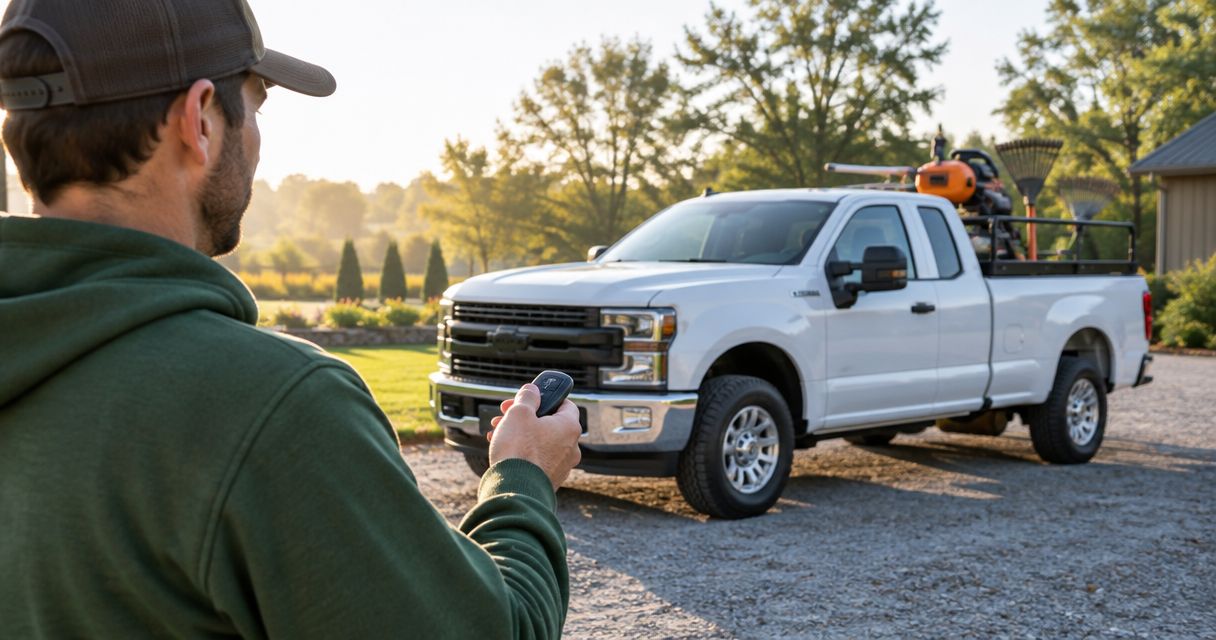
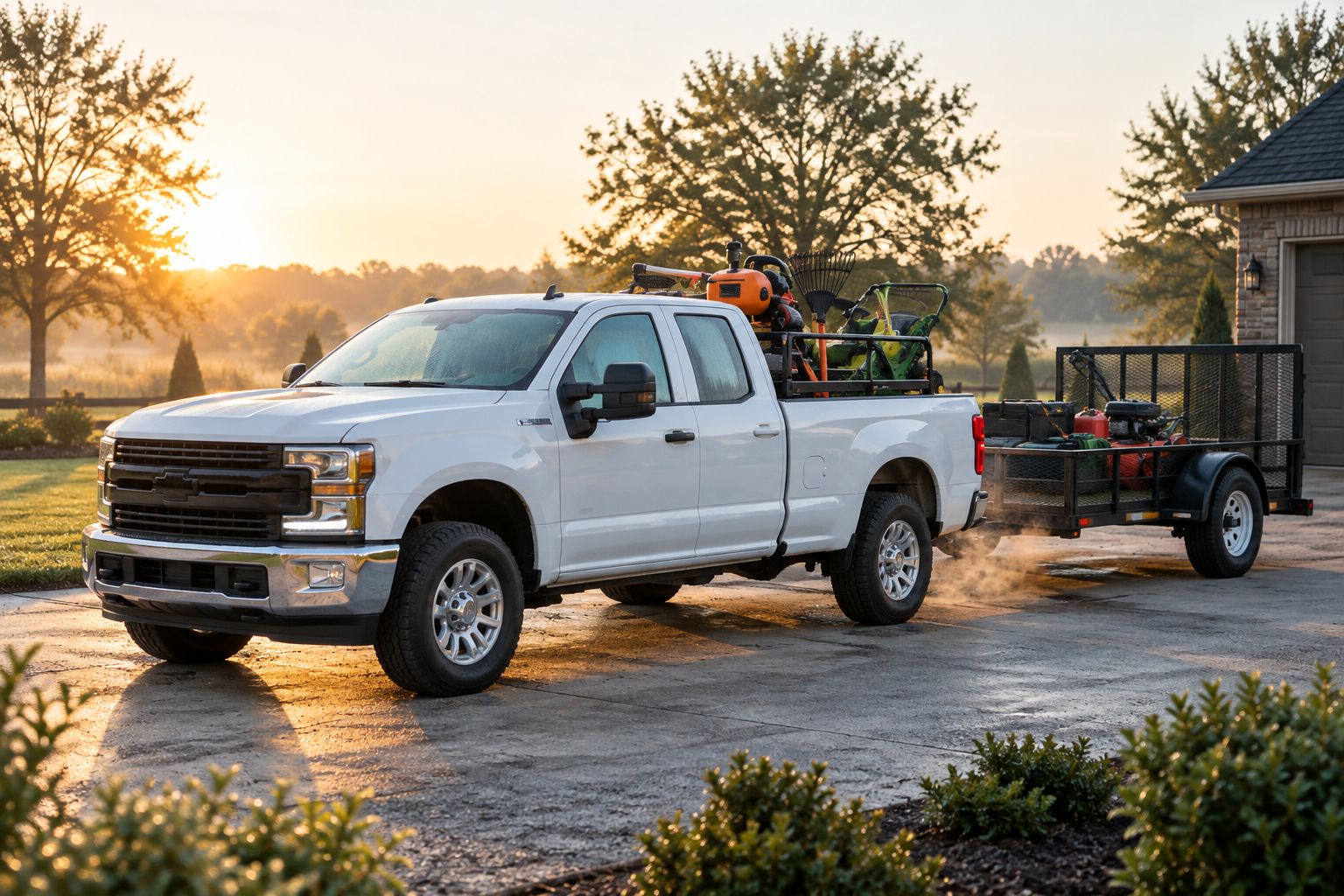
Remote start for landscaping trucks lets a crew start the engine and run the AC from inside the shop or a driveway, so the cab is cool and the windshield is clear before anyone touches the door handle. Lawn care fleets run different hours and carry different weight than a commuter car, so the install has to account for loaded trailers, diesel idle rules, and trucks parked unattended at job sites all day.
- Remote start for landscaping trucks cools the cab before a 5 a.m. Florida shift starts — install it before summer, not during it.
- Standalone remote start modules beat phone-app systems for crews working multiple properties with weak cell signal.
- Push-button start trucks need a bypass module; older key-turn trucks are the simpler, cheaper install.
- Pair remote start with a security add-on since trucks sit loaded with mowers and trailers unattended at job sites.
Why remote start matters for landscaping and lawn care trucks
Most SWFL crews are on the road by 5:30 or 6 a.m., loading trailers in the dark before the sun makes it unbearable. A truck cab that's been sitting closed since the night before hits 100+ degrees inside by mid-morning in Auto Sound Cape Coral's service area, and a driver climbing into that heat every single stop adds up over an 8-10 hour route.
Remote start solves the immediate problem: the truck's already running and the AC has had a few minutes to work by the time the driver gets back in. It also matters for the equipment side of the job. A loaded trailer with a $3,000-$8,000 mower on it parked at a job site for two hours is a target, and remote start systems that include keyless entry or a paired security module give the driver a way to check on the vehicle without walking back to it.
Diesel trucks in a lawn care fleet add a second wrinkle: idle-shutdown timers built into many diesel ECMs will kill the engine automatically after a set idle period, so a remote start system needs to work with that logic, not against it. Gas trucks don't have that issue but do rack up more idle hours than a typical passenger vehicle, since a truck idling in a driveway while the crew loads gear counts toward engine hours the same as highway miles.
Build the remote start plan for your fleet
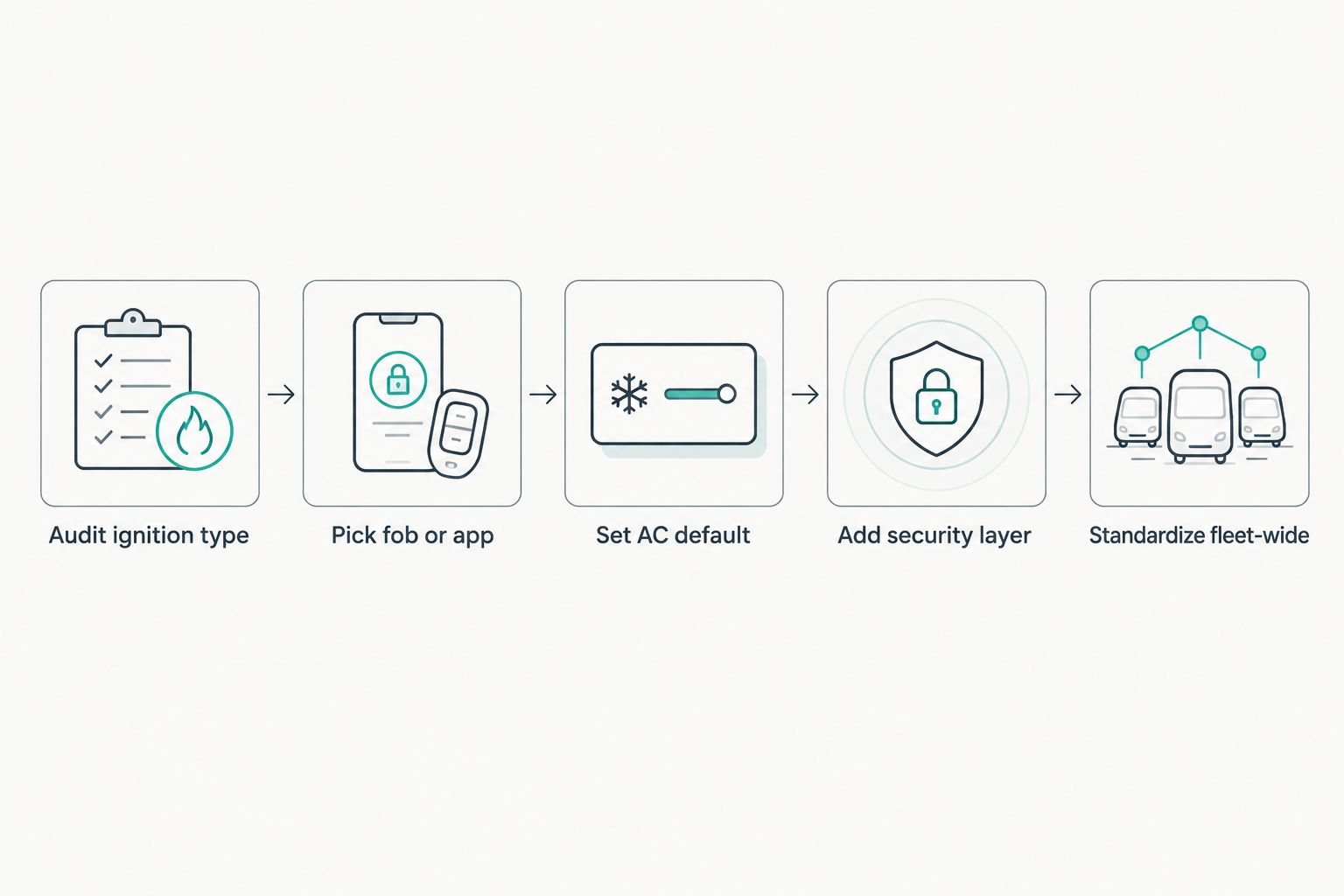
Audit your fleet's ignition type first
Before pricing anything, know what you're working with truck to truck. A mixed fleet with some push-button trucks and some key-turn trucks needs two different install approaches, not one universal kit.
- Push-button start trucks need a bypass module that talks to the factory security system
- Key-turn trucks take a simpler harness install and usually cost less labor
- Diesel trucks need a system compatible with glow plug cycling and idle-shutdown timers
- Trucks still under factory warranty should use a professionally installed system with a documented install, not a plug-and-play kit from a parts store
Decide between standalone and app-based remote start
App-based remote start is convenient when a driver has full signal, but landscaping routes run through rural lots, gated communities, and dead zones where cell coverage drops. A standalone key fob remote start doesn't depend on data at all.
- Standalone fob range typically covers a driveway, a shop lot, or a job site parking area
- App-based systems add convenience for office staff checking on a parked truck remotely
- Some systems support both a fob and an app on the same install, giving crews a fallback
- For a route with 8-10 stops a day, fob-based reliability usually wins over app convenience
Match the climate control setting to Florida heat
A remote start system for a lawn care truck in Southwest Florida needs to run the AC on start, not just idle the engine. Some factory setups default to whichever climate mode was last used, which means a truck left with heat on from a rare cold morning will blast heat into an already hot cab.
- Confirm the system defaults to AC, not the last-used setting
- Set run time long enough to actually cool the cab, not just start the engine
- For trucks that sit in direct sun most of the day, a longer remote start window before pickup makes more difference than a stronger AC unit
This breakdown of remote start systems built for Florida heat covers which climate settings actually matter for daily driving in this climate versus a system designed for cold-weather states.
Add a security layer for unattended job sites
A truck sitting alone at a property for two hours with a trailer full of equipment is a different risk than a car parked at a grocery store. Remote start installs are a natural point to add security features since the wiring work overlaps.
- Shock sensors that alert if the trailer hitch or tailgate is disturbed
- Keyless entry paired with the remote start fob so the driver isn't juggling two devices
- GPS-capable options for fleet owners tracking multiple trucks across a route
- Horn and light alerts tied to the same system for a quick visual check from a distance
“If the crew loads the trailer before sunrise, the AC needs to be cold before the driver's second stop, not the first.”
Plan the install around your route schedule, not the shop's calendar
Fleet downtime costs a lawn care business real money, so installs need to happen on a day that doesn't pull a truck off a route. Staggering installs across a fleet — two trucks a week instead of all at once — keeps the crew running while the shop works through the list.
- Schedule installs on slower route days (typically Mondays or after a rain-out)
- Ask about same-day turnaround for standard remote start installs versus multi-day for add-on security features
- Keep one loaner or backup truck in rotation if the fleet is small enough that losing one truck matters
Standardize the system across every truck in the fleet
A fleet running five different remote start brands means five different fob types, five different troubleshooting processes, and a driver who doesn't know how the truck he's assigned today behaves. Standardizing on one system across the fleet cuts training time and makes it easier for the shop to service any truck without guessing what's installed.
For businesses running mixed vehicle types — trucks, trailers with separate battery systems, and box trucks — a fleet dash cam setup is worth pairing with remote start for full visibility on unattended vehicles. This guide on dash cams for small business fleet vehicles covers footage retention and multi-camera setups that work alongside a remote start and security package.
Comparing remote start options for landscaping fleets
| Option | Best for | Key limitation |
|---|---|---|
| Standalone fob remote start | Crews working dead-zone routes with no reliable signal | Range limited to roughly a parking lot or driveway |
| App-based remote start | Office staff checking on parked trucks remotely | Needs cell signal and a charged phone to work |
| OEM factory remote start (if equipped) | Newer trucks that already have the feature built in | Often limited to shorter run times than aftermarket systems |
| Remote start + security bundle | Trucks left loaded and unattended at job sites | Higher install complexity, longer install time per truck |
Standalone fob systems are the best fit for most landscaping fleets working routes with inconsistent cell coverage — reliability beats convenience when the truck is sitting at a property with a locked gate and no signal.
Get remote start quoted for your fleet
Same-day installs available for landscaping and lawn care trucks in Cape Coral and Fort Myers.
Common mistakes landscaping companies make with remote start
- Buying a different system for every truck as it's added to the fleet — this turns a simple feature into a training and troubleshooting problem within a year.
- Skipping the AC default check — a system left on its factory heat setting undoes the entire point of remote start in a Florida summer.
- Ignoring diesel idle-shutdown timers — a remote start system fighting the truck's own ECM will shut the engine off mid-cool, right when the driver needs it running.
- Treating remote start as a standalone purchase instead of a security opportunity — trucks sitting loaded at job sites all day are the exact vehicles that benefit most from a paired security feature, and skipping it wastes the labor overlap.
- Not budgeting for warranty-safe installation — a bad plug-and-play install on a push-button truck under factory warranty can create electrical issues that are expensive to trace back.
FAQ
What's the best remote start system for landscaping trucks?
A standalone fob-based remote start is the best fit for most landscaping fleets in 2026 because it doesn't depend on cell signal at job sites with weak coverage. App-based systems work well as a secondary feature for office staff but shouldn't be the only way a driver can start the truck.
Is remote start worth it for a lawn care business truck?
Yes, for fleets running early-morning Florida routes where the cab sits closed and hot until the crew gets back in. The time saved cooling the cab before each stop and the reduced heat exposure for drivers make it a practical add, not a luxury feature.
Does remote start work on diesel work trucks?
Yes, but the system needs to be compatible with the truck's idle-shutdown timer, which many diesel ECMs use to automatically kill the engine after a set idle period. A professional install accounts for this; a generic plug-and-play kit often doesn't.
Can remote start be added to trucks with push-button start?
Yes, push-button start trucks need a bypass module that communicates with the factory security system before the remote start can trigger the engine. This is a more involved install than a key-turn truck but is a standard job for a shop experienced with fleet vehicles.
Will remote start void my truck's factory warranty?
A professionally installed, warranty-safe remote start system generally does not void a factory warranty on unrelated components. Poor installs or unshielded aftermarket kits are the more common cause of warranty disputes, which is why installation quality matters more than the brand of the unit.
How long does remote start installation take on a fleet vehicle?
A standard remote start install on one truck is typically a same-day job, while a remote start plus security bundle takes longer due to added wiring. Staggering installs across a fleet keeps trucks on their routes instead of pulling several off at once.
Does remote start actually help in Florida heat?
Yes, running the AC for several minutes before a driver gets back in the cab measurably cools the interior compared to a closed truck sitting in direct sun. The setting has to default to AC rather than the last-used climate mode for this to work correctly.
Should every truck in a fleet use the same remote start system?
Standardizing on one system across the fleet cuts training time for drivers and simplifies troubleshooting for the shop servicing the vehicles. Mixed systems across a small fleet create more confusion than the cost savings of shopping around are worth.
One last thing
The detail most fleet owners miss isn't the remote start unit itself — it's the AC default setting. A system installed without checking whether it defaults to cooling or to the last-used climate mode can leave a truck blasting heat into an already 100-degree cab on a hot Cape Coral morning, which defeats the entire reason for installing it in the first place. Confirm that setting before the install is called finished, not after the first complaint from a driver.