
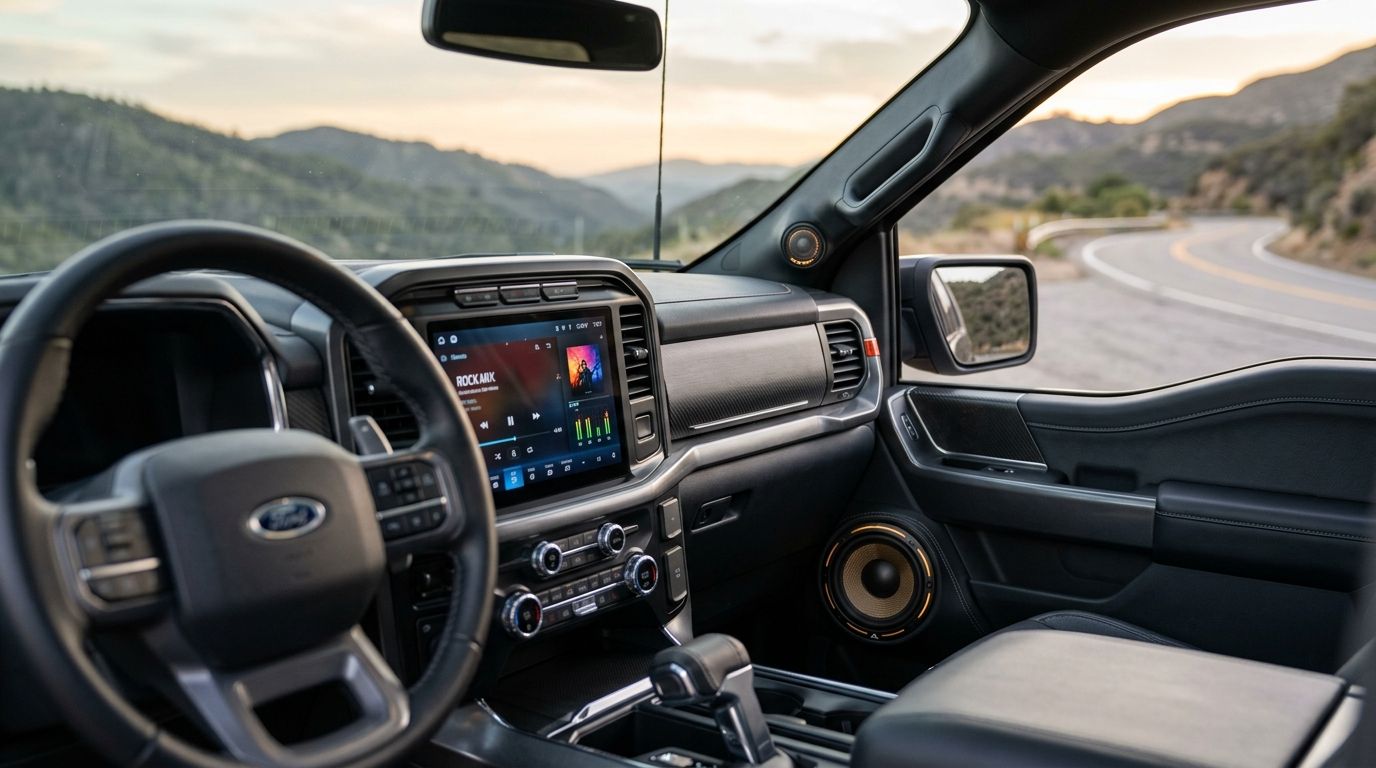
Best overall truck audio system for 2026: a full daily-driver upgrade — new head unit, upgraded door speakers, and a compact amp. Best for deep bass in a truck cab: a subwoofer build sized to fit under a rear seat or behind an extended-cab bench. Best budget option: a straight factory speaker swap with no head unit change.
Trucks fight three things stock stereos never solve: cab noise from tires and wind, factory speakers rated for background music instead of real output, and dash space that limits what fits. This guide breaks down which system to build first depending on what you actually use the truck for — daily commuting, hauling a boat, or running a work crew around Cape Coral and Fort Myers.
- The best car audio system for trucks in 2026 pairs a new head unit with upgraded door speakers and a small amp for real gains over factory sound.
- A dedicated subwoofer build wins for bass in extended-cab trucks where road noise buries factory low end.
- A straight speaker swap with no head unit change is the budget move — same buttons, real output.
- Truck-and-boat owners do better with a marine-rated head unit that survives both rigs instead of two separate systems.
- Work trucks benefit more from a backup camera paired with rugged speakers than from raw volume.
Why this matters
Factory truck speakers are usually rated 10 to 20 watts RMS — fine for talk radio, weak for music once you're doing 70 mph with the windows cracked. Cab temperatures in Southwest Florida can top 140°F in direct summer sun, which cooks factory-grade speaker cones and glue over a few seasons faster than most owners expect. A system built for a truck has to survive heat, road noise, and cargo bed vibration, not just sound good in the driveway.
Auto Sound Cape Coral installs these builds daily for drivers across Cape Coral, Fort Myers, and the surrounding Southwest Florida market, and the pattern is consistent in 2026: the trucks that end up happiest are the ones matched to how the owner actually drives, not the loudest possible build.
What makes the best truck audio system
- Cab-size match — a 12-inch sub makes sense in a crew cab, not a single-cab work truck with no floor space.
- RMS power over peak power — peak wattage numbers on packaging are marketing filler; RMS is the number that predicts real output.
- Heat tolerance — components rated for extended cab temperatures hold up better than budget speakers with paper cones and basic adhesive.
- CarPlay/Android Auto support — if the head unit is getting replaced anyway, wireless phone integration should come with it.
- Install complexity — some builds are a one-hour speaker swap, others need wiring runs, amp mounting, and enclosure fitting.
- Real-world use case — daily driver, tow rig, or work truck each point to a different build, not the same system.
Truck audio systems at a glance
| System | Best For | Standout Feature | Key Limitation |
|---|---|---|---|
| Full daily-driver upgrade | Overall daily use | Head unit + speakers + amp working together | Longer install, more wiring |
| Bass-focused subwoofer build | Deep bass in the cab | Enclosure sized to available floor space | Eats into cargo/storage room |
| CarPlay head unit swap | Phone integration and navigation | Wireless CarPlay/Android Auto | Factory speakers stay a weak link |
| Factory speaker replacement | Budget upgrade | Keeps factory buttons and look | No head unit or amp gains |
| Truck-and-boat combo system | Owners who also run a boat | Marine-rated components handle both rigs | Costs more than a single-use build |
| Work truck package | Job site and fleet trucks | Backup camera plus rugged speakers | Not built for audiophile output |
1. Full daily-driver upgrade: best truck audio system for everyday driving
This is the build most truck owners end up with once they hear the difference. A new head unit replaces the factory deck, upgraded door speakers replace the stock 10-to-20-watt units, and a small Class D amp powers the front stage properly instead of relying on the head unit's built-in power.
Full daily-driver upgrade pros:
- Biggest jump in sound quality for the money
- Amp keeps speakers from distorting at highway volume
- Head unit swap usually adds CarPlay/Android Auto as a side benefit
Full daily-driver upgrade cons:
- Takes longer to install than a speaker-only swap
- More wiring means more places for a bad ground to cause noise if done wrong
Best for: truck owners who want one system that fixes sound, phone integration, and volume ceiling in a single visit. Verdict: Buy.
2. Bass-focused subwoofer build: best for deep bass in a truck cab
Extended and crew cab trucks swallow low-end frequencies that a factory system was never built to reproduce. A 10-inch or 12-inch subwoofer in an enclosure sized to the cab, paired with a mono amp, brings that low end back without touching the front speakers. If you're weighing driver sizes first, the breakdown of car speakers for bass covers where the front stage ends and a sub starts.
Bass-focused subwoofer build pros:
- Fixes the one thing factory systems consistently lack — real low end
- Enclosure options exist for under-seat or behind-seat mounting to save floor space
- Pairs cleanly with an existing factory head unit if it has a sub-out
Bass-focused subwoofer build cons:
- Takes up storage space owners sometimes need for tools or gear
- Overkill for someone who mostly listens to talk radio or podcasts
Best for: truck owners who feel the volume but not the bass on factory speakers. Verdict: Buy.
3. CarPlay head unit swap: best for phone integration and navigation
For owners who don't want to touch speakers or add an amp, swapping just the head unit for one with wireless Apple CarPlay head units solves navigation, hands-free calls, and music streaming in one part.
CarPlay head unit swap pros:
- Fastest way to add wireless CarPlay/Android Auto without a full rebuild
- Bigger touchscreen than most factory truck displays from a few model years back
- Keeps install time lower than a full system
CarPlay head unit swap cons:
- Factory speakers still cap how good it actually sounds
- Doesn't fix cab noise or bass — only fixes the interface
Best for: drivers who care more about phone integration than raw sound quality. Verdict: Hold — pair it with a speaker upgrade later for real gains.
4. Factory speaker replacement: best budget truck audio upgrade
Swapping factory speakers for better-rated aftermarket units, with no head unit or amp change, is the lowest-cost way into this list. Same buttons, same look, real improvement in clarity and volume ceiling.
Factory speaker replacement pros:
- Keeps the factory dash and controls exactly as they are
- Shortest install time of any system on this list
- Clear jump in clarity over stock speakers even without an amp
Factory speaker replacement cons:
- No help with cab noise at highway speed
- Hard ceiling on volume without a head unit or amp change
Best for: budget-first truck owners who want a noticeable upgrade without touching electronics. Verdict: Buy at this price point, Skip if bass and volume matter more than clarity.
5. Truck-and-boat combo system: best for owners who also tow a boat
Southwest Florida has a lot of truck owners who also run a boat out of Cape Coral or Fort Myers. A marine-rated head unit and speakers built for saltwater exposure hold up in the truck cab and carry over to a marine stereo system setup, so the owner learns one interface instead of two.
Truck-and-boat combo system pros:
- One familiar interface across truck and boat
- Marine-rated components resist humidity and UV better than standard car-grade parts
- Simplifies future upgrades since both systems use compatible gear
Truck-and-boat combo system cons:
- Costs more than a single-use truck-only build
- Not worth it if the boat already has its own separate system
Best for: truck owners who also own a boat and want consistent gear across both. Verdict: Buy if you're building both systems in the same year.
6. Work truck package: best for job site and fleet trucks
Work trucks care less about concert-level output and more about visibility and durability. Pairing a backup camera system for trucks with rugged, weather-tolerant speakers covers the two things that actually matter on a job site truck.
Work truck package pros:
- Backup camera adds real safety value beyond audio
- Rugged speaker options hold up to dust, vibration, and temperature swings
- Lower priority on audiophile-grade sound keeps the build simple
Work truck package cons:
- Not the pick if sound quality is the main goal
- Camera install adds a wiring run separate from the audio work
Best for: fleet and work trucks where safety and durability outrank sound quality. Verdict: Buy for safety-first fleets, Skip if the truck is personal-use only.
Get your truck audio system quoted
Same-day service and walk-ins welcome in Cape Coral and Fort Myers.
How we ranked these systems
Each system is ranked against the six criteria above — cab-size match, RMS power, heat tolerance, CarPlay support, install complexity, and real-world use case — not against a single "loudest wins" standard. That's why a budget speaker swap and a full daily-driver rebuild can both carry a Buy verdict in 2026: they solve different problems for different trucks.
“Peak wattage on the box predicts nothing. RMS power is the number that tells you how the system sounds at 70 mph.”
Which truck audio system should you choose in 2026?
If you're not sure where to start, the full daily-driver upgrade is the safest default for 2026 — it fixes the three weakest points of a factory system (power, speakers, and interface) in one visit. Drop to a factory speaker replacement if budget is the deciding factor, or add a subwoofer build if bass is the specific complaint. Truck-and-boat owners and work truck fleets should build around their actual second use case rather than a generic loudest-system pick.
FAQ
What's the best car audio system for trucks in 2026?
A full daily-driver upgrade — new head unit, upgraded door speakers, and a small amp — is the best all-around car audio system for trucks in 2026. It fixes power, speaker quality, and interface at the same time.
Do I need an amp if I upgrade truck speakers?
Not always. A speaker-only swap improves clarity over factory speakers, but an amp is what pushes past the volume ceiling most head units hit on their own at highway speed.
Is a subwoofer worth it in a truck cab?
Yes, if bass is the specific complaint. Extended and crew cab trucks lose low-end frequencies factory systems were never built to reproduce, and a properly sized enclosure fixes that without touching the front speakers.
How much cab space does a truck subwoofer take up?
It depends on the enclosure. Under-seat and behind-seat options exist specifically to minimize the storage space lost compared with a standard box enclosure.
Does adding CarPlay require a full audio system rebuild?
No. A head unit swap alone adds wireless CarPlay or Android Auto without touching speakers or adding an amp. Sound quality stays capped by whatever speakers are already in the doors.
What's the budget option for upgrading truck audio?
A factory speaker replacement with no head unit or amp change is the lowest-cost route. You keep the factory buttons and dash and get a real jump in clarity over stock speakers.
Can one system work for both a truck and a boat?
Yes. Marine-rated head units and speakers built for saltwater and UV exposure hold up in a truck cab and give the owner one consistent interface across both vehicles.
Why do factory truck speakers sound weak on the highway?
Factory speakers are usually rated 10 to 20 watts RMS, built for background listening rather than output at 70 mph. Cab temperatures in Southwest Florida that top 140°F in summer also accelerate wear on cones and adhesive.
One last thing
The most overlooked factor in truck audio builds isn't the gear — it's cab temperature. A system installed with components that aren't heat-tolerant, in a Southwest Florida truck that regularly sits at 140°F in direct sun, shows cone and adhesive wear years earlier than the same build in a garage-parked car up north, regardless of brand.