Yes—window tinting is worth it in Florida in 2026 when you want less glare and a film with documented solar-heat rejection, installed within Florida’s legal limits. The trade-off is reduced visibility with darker shades, especially at night; tint also does not replace air conditioning or make a parked vehicle safe for children or pets.
- Is window tinting worth it in Florida? Yes—prioritize documented heat rejection, legal shade, and nighttime visibility.
- Auto Sound Cape Coral provides window tinting for vehicle owners in Cape Coral, Fort Myers, and surrounding communities.
- Florida generally requires at least 28% visible light transmission through front side windows, including the existing glass.
- Ceramic window tint is worth comparing for heat control, but the exact film specifications matter more than its category name.
Why this matters
Buy tint for what it does, not just how dark it looks. Visible light transmission describes how much visible light passes through a window. It does not, by itself, tell you how well that window rejects solar energy.
For a Florida vehicle in 2026, that distinction matters. You can choose a shade that preserves useful visibility while comparing films on documented heat rejection. Start with the window tint shades for Florida heat guide, then have the installer check your existing glass before choosing a film.
Your decision should answer three questions: Does the film address your discomfort? Is the finished window legal? Can you still see clearly during the driving you actually do?
Is window tinting worth it in Florida in 2026?
Window tinting is worth it when glare, direct sunlight, or cabin comfort is a recurring problem—not when darkness is the only selling point. The useful comparison is between the exact films offered for your vehicle, at legal finished-window light transmission.
The table below separates common film categories without treating every product in a category as identical. Ask for the specification sheet for the actual film being quoted.
| Film category | Best for | What to check | Main limitation |
|---|---|---|---|
| Dyed film | Drivers mainly seeking a darker appearance and less visible light | Solar-heat rejection, UV specifications, and warranty terms | Darkness alone does not establish strong heat rejection |
| Carbon film | Drivers comparing a nonmetallic film for appearance and solar control | The exact construction and published performance | The carbon label does not establish how it compares with another film |
| Ceramic film | Drivers prioritizing documented heat rejection without choosing shade alone | Total solar energy rejected, test conditions, and finished-window legality | The ceramic label is not a guarantee of performance or installation quality |
These are starting points, not a ranking of unnamed products. A specification sheet lets you compare what the film does; an installation inspection tells you whether it was fitted cleanly.
Ask whether published figures describe the film alone or film applied to a particular type of glass. Different test setups are not a clean comparison. Choose the documented result, not the strongest sales phrase.
What Florida law means for your choice
Florida Statutes sections 316.2952, 316.2953, and 316.2954 govern windshield, front-side, and rear-window restrictions. For a standard installation without a qualifying exemption, these are the key limits to check in 2026:
| Window position | General Florida requirement | Practical meaning |
|---|---|---|
| Front side windows | At least 28% visible light transmission; no more than 25% visible-light reflectance | Check the combined glass and film, not just the film label |
| Rear side and rear windows on passenger cars | At least 15% visible light transmission; no more than 35% visible-light reflectance | Rear-window permission does not change the front-side requirement |
| Rear side and rear windows on multipurpose passenger vehicles | At least 6% visible light transmission; no more than 35% visible-light reflectance | Confirm the vehicle classification before choosing a darker rear shade |
| Windshield | Nonreflective material is generally permitted along the top, above the manufacturer’s AS-1 line | Permission for a top strip is not permission for full-windshield tint |
Source: Florida Statutes, sections 316.2952–316.2954, covering vehicle sunscreening materials and window positions. These are general requirements; exemptions and other statutory conditions need separate review.
Do not assume an SUV-looking body automatically settles the legal classification. Have the installer identify which rear-window requirement applies to your vehicle. Also ask about the required compliance label and any mirror requirements relevant to the installation.
Ceramic film: best for documented heat-control performance
Ceramic film deserves a place on your comparison list when heat control is your main goal. Its useful advantage must appear in the exact product’s specifications, not merely in the word ceramic on the quote.
Ask for total solar energy rejected, often shortened to TSER. This describes rejection across the solar spectrum and is more useful for a whole-window heat comparison than an isolated infrared claim with no test explanation.
Infrared figures need context. Ask which wavelengths were measured and whether competing figures use the same method. A large infrared-rejection claim is not a substitute for a clear explanation of total solar performance.
The downside is simple: a ceramic label cannot fix poor installation, an unsuitable shade, or a mismatch between your expectations and the film’s measured performance. Compare the exact ceramic film, then decide whether its documented benefit addresses your driving conditions.
Dyed and carbon films: best for clearly defined priorities
Dyed film is a useful category to consider when your main objective is changing appearance and reducing visible light. Check its heat-rejection specifications separately. A dark sample does not prove that it will provide the solar control you want.
Carbon film is another category to compare, but the name alone does not establish a performance level. Ask the installer to identify the film and show its published specifications. Treat any benefit as product-specific until the documentation supports it.
Both categories deserve the same installation checks as ceramic film. Look for a clean fit, appropriate edges, and clear written care instructions. Do not accept a vague category name as the full description of what you are buying.
Why window tinting’s value varies
The right tint choice depends on your vehicle and the problem you want to solve. These factors change the decision:
- Sun exposure: Direct sunlight through the glass makes solar-control performance relevant. Tint does not stop heat entering through every part of the vehicle.
- Driving schedule: Darkness reduces visible light during daytime and nighttime driving. Frequent night driving makes visibility a central selection criterion.
- Existing glass: Factory glass already has its own light transmission. Added film changes the finished result, so a film label alone cannot establish legality.
- Vehicle classification: Florida’s general rear-window limits differ between passenger cars and multipurpose passenger vehicles. Front-side limits still need separate attention.
- Film specifications: Compare solar rejection, visible light transmission, reflectance, and UV performance for the exact film offered.
- Installation scope: Old-film removal, the windows included, and the condition of the glass belong in the written job description.
Your priorities can conflict. A darker rear window can provide more daytime privacy while making outward visibility harder in low light. Better solar-control specifications do not cancel that trade-off.
For your 2026 tint decision, write down the problem first: glare while driving, direct sunlight on occupants, privacy, or appearance. Then ask which film specification addresses it. That keeps the conversation focused on a result you can evaluate.
How do I choose tint without regretting the shade?
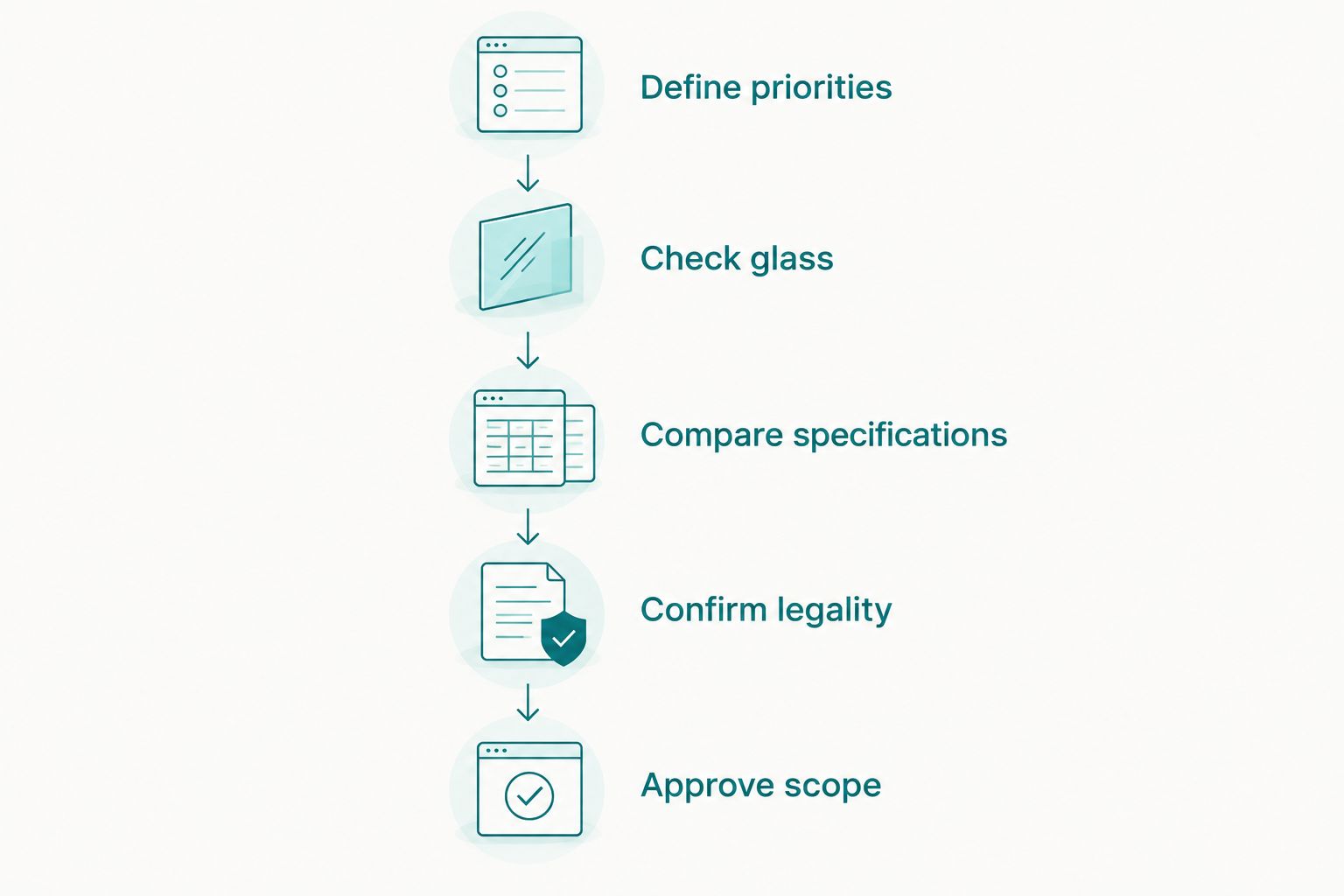
Choose legal finished-window transmission first, then compare performance and appearance within that constraint. Use this sequence before authorizing the work:
- Define priorities. Tell the installer whether heat control, glare, privacy, or appearance matters most. Mention regular night driving and visibility concerns.
- Check glass. Have the existing glass assessed before selecting film. Ask how the installer will verify the finished window’s light transmission.
- Compare specifications. Request the exact film name and its specification sheet. Compare measurements made under equivalent test conditions.
- Confirm legality. Identify the requirements for front sides, rear windows, and the windshield separately. Do not apply a rear-window limit to the front doors.
- Approve scope. Get the windows, film, removal work, care instructions, and warranty terms written down before installation.
This sequence prevents a common mistake: choosing a shade from a sample and asking about legality afterward. The sample is useful for appearance, but it does not reproduce your existing glass or every lighting condition.
What should I inspect after installation?
Ask the installer to explain what normal curing looks like for the film used. Do not treat every temporary hazy area as a permanent defect, and do not accept an unexplained defect as normal indefinitely. Follow the supplied care instructions rather than a generic online timetable.
Check the view through each window in good light. Ask about visible contamination, lifting edges, gaps, or anything that affects your line of sight. Record concerns and use the installer’s stated follow-up process.
Avoid testing a fresh installation by repeatedly lowering the windows. Follow the film-specific instructions for window operation and cleaning. The installation is not finished from your perspective until you understand how to care for it.
Where does a local installer fit into the decision?
Auto Sound Cape Coral is a window-tinting service option for vehicle owners in Cape Coral, Fort Myers, and surrounding Southwest Florida communities. The shop also provides automotive electronics installation, so you can identify other planned vehicle work when discussing your visit.
The practical benefit is having a local service business to discuss the vehicle and installation scope with. The limitation is that the service category alone does not tell you which film will be used, how it performs, or which terms apply. Ask for those details rather than assuming them.
Use Auto Sound Cape Coral to discuss window tinting for your vehicle. Bring the year, make, model, existing tint condition, and your main complaint. Ask for the proposed film and legal finished-window transmission before approving the work.
Does darker tint keep a Florida car cooler?
Darker tint is not a reliable shortcut to better heat rejection. Visible light transmission measures visible light, while solar-control performance depends on how the film and glass handle solar energy.
Compare heat-rejection specifications at a shade you can legally and comfortably use. Keep appearance and performance as separate questions, even when both matter to you.
Is window tint still worth it if I drive at night?
Window tint can still be worth it for a night driver, but visibility must guide the shade decision. Less visible light entering the cabin also means less light available for seeing through the tinted window.
Discuss a lighter legal shade and evaluate the exact film’s solar-control specifications. Do not assume that meeting a legal minimum automatically makes a shade suitable for your eyesight or driving conditions.
Will tint stop my parked car from getting hot?
No—window tint does not prevent a parked car from heating up. Solar-control film addresses energy entering through the glass, not every source of cabin heat.
Tint is not a child-safety or pet-safety measure. Never use it as a reason to leave a child or animal in a parked vehicle.
FAQ
Is window tinting worth it in Florida in 2026?
Yes—window tinting is worth it when you want reduced glare and documented solar-heat rejection at a legal shade. Choose the exact film by its specifications and preserve the visibility you need for night driving.
What is the legal front window tint in Florida?
Florida generally requires at least 28% visible light transmission through front side windows and limits visible-light reflectance to 25%. The requirement applies to the combined glass and film, subject to applicable exemptions.
Can I use the same tint shade on every window?
Do not assume one shade is appropriate or legal everywhere. Florida has separate requirements for front side windows, rear windows, and the windshield, and existing glass affects the finished transmission.
Is ceramic tint better than dyed tint for Florida heat?
Compare the exact films’ documented solar-heat rejection before deciding. Ceramic and dyed are category names, not enough information to establish the performance difference between two products.
Does window tint replace a windshield sunshade or air conditioning?
No—window tint does not replace air conditioning or prevent all solar energy from entering a vehicle. Treat it as one part of managing glare and cabin comfort, not a complete cooling system.
How do I know whether my existing factory tint is legal after adding film?
Have the finished glass-and-film combination measured and checked against the requirement for that window position. Adding film reduces light transmission, so the new film’s label alone does not establish compliance.
What should I ask Auto Sound Cape Coral before getting window tint?
Ask Auto Sound Cape Coral which film is proposed, what its published specifications show, and how finished-window legality will be checked. Confirm the windows included, any old-film removal, care instructions, and written warranty terms.
One last thing
A film marked 28% is not automatically a legal front-side installation in Florida. The existing glass also reduces light transmission, so adding that film can leave the finished window below the general 28% minimum.
For your 2026 installation, ask one final question: How will you check the combined glass and film? That answer matters more than the shade name on the sample.