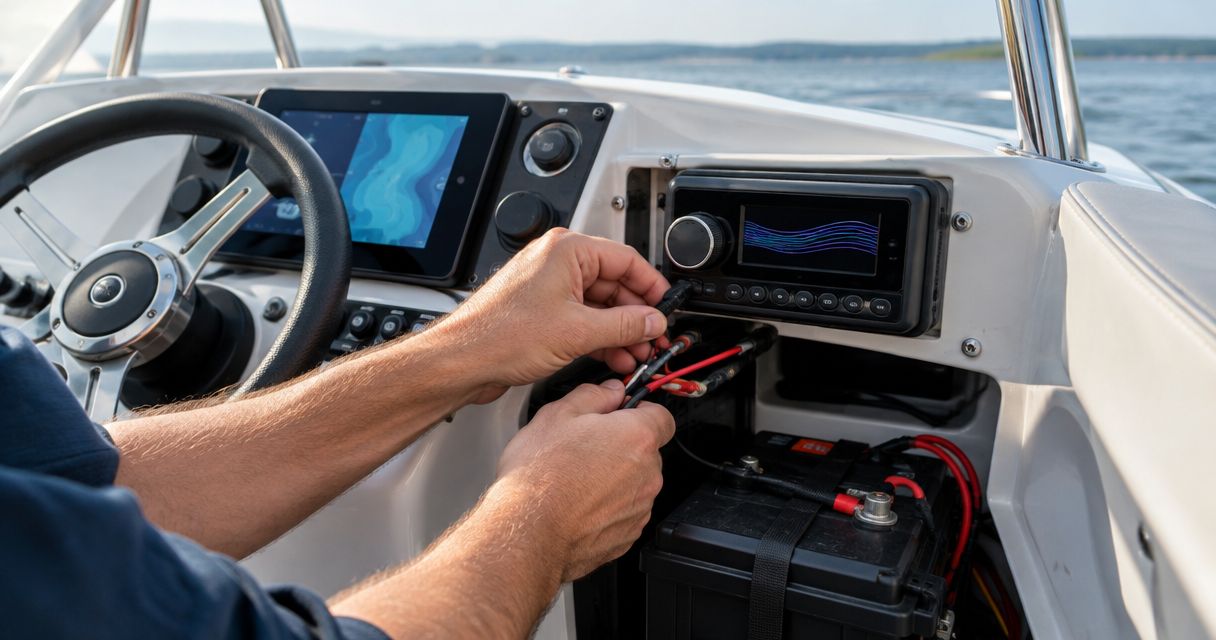
Instead of disconnecting your stereo after every trip, wire its operating power through the correct accessory circuit and verify its shutdown draw to stop unwanted marine stereo boat battery drain. Keep starting reserve separate from listening power, and test the head unit, amplifier, and memory feed before leaving the boat unattended.
- Marine stereo boat battery drain requires separate checks for listening load, standby current, and battery condition.
- Auto Sound Cape Coral provides marine stereo installation for Cape Coral and Fort Myers boat owners.
- Use a protected accessory circuit and the stereo manufacturer's wiring diagram, not wire colors alone.
- A house battery protects starting reserve only when the battery arrangement actually isolates the starting bank.
Why this matters
A dark stereo screen does not prove the audio system has stopped drawing power. The head unit can retain a live memory feed, and an amplifier can stay awake after playback stops.
Auto Sound Cape Coral is a fit for Cape Coral and Fort Myers boat owners who want local marine stereo installation. The shop provides that service; your boat's battery layout and equipment manuals determine the wiring plan. Start with Auto Sound Cape Coral if you want installation help rather than changing an unfamiliar electrical system yourself.
For a 2026 installation, separate two problems: power consumed while listening and power consumed after shutdown. A correctly wired stereo still uses battery capacity during playback. A shutdown fault adds an unwanted load while the boat sits.
Before you start
- Gather the diagrams and access. Get the exact head-unit, amplifier, battery-switch, and charging-system instructions. Identify the batteries, protected distribution panel, negative bus, and existing audio wiring before removing anything.
- Use suitable materials and test equipment. You need marine-suitable cable, terminals, circuit protection, connection protection, and a meter suited to the expected current. Cable size depends on current and total circuit length, not the old wire's appearance.
- Check the hidden power paths. A stereo can have separate operating and memory supplies, while an amplifier has its own main supply and turn-on input. Disconnecting one wire does not necessarily isolate the system. Identify shore charging, solar, and other sources before work.
Stop if you cannot identify every supply or safely isolate the circuit. Follow the boat manufacturer's isolation procedure. Do not alter automatic bilge-pump feeds, battery-combining equipment, or charging connections to solve an audio problem.
Battery and circuit plan
- Identify the system voltage. Confirm the stereo's rated supply against the boat's actual accessory supply. A 12 V stereo must not connect directly to a 24 V supply unless the manufacturer explicitly provides for that arrangement.
- Trace the audio circuit. Find the head unit's operating supply, any memory supply, amplifier main supply, turn-on control, and negative return. Photograph and label existing connections before disconnecting them.
- Choose the listening supply. With a suitable house-bank arrangement, put audio loads on the house side rather than consuming the battery reserved for engine starting. Confirm how the batteries separate and recharge.
- Choose the shutdown behavior. Decide whether the radio should retain memory while stored or lose all audio power. Check the manual: some receivers need constant power for functions beyond preset retention.
Expected result: You can explain where each audio feed gets power, what shuts it off, and which battery remains reserved for starting.
Choose the battery arrangement before the stereo
These arrangements solve different problems. Use this 2026 planning table to choose a layout, not to infer compatibility with your boat.
| Arrangement | Best for | Advantage | Limitation |
|---|---|---|---|
| Single battery with switched audio | Short listening sessions and simple systems | Gives the audio circuit a defined shutdown point | Listening still consumes starting reserve |
| Separate house bank with suitable isolation | Engine-off listening while preserving a starting battery | Separates entertainment loads from starting reserve | Adds charging, switching, and maintenance requirements |
| Dedicated audio disconnect within the existing system | Storage with audio power removed | Can disconnect audio feeds included in its design | Missed memory feeds or alternate supplies can remain live |
A second battery is not automatically an isolated starting reserve. Batteries connected together during listening share the load. Verify the switch and charging arrangement rather than relying on battery count.
Protected power and shutdown wiring
- Isolate the circuit. Shut down equipment and isolate all relevant sources according to the boat's instructions. Verify the intended work area is de-energized before handling conductors.
- Install the protected supply. Use the specified marine wiring practices and circuit protection. Size conductors for the load, circuit length, and acceptable voltage drop; select protection for the wiring and equipment instructions. A fuse at the receiver does not replace required supply-cable protection.
- Connect the operating feed. Route the head unit's operating supply through the intended accessory switching arrangement, as its wiring diagram requires. Do not assume a helm switch can carry an amplifier's main current.
- Handle the memory feed deliberately. Keep it continuously supplied only if the equipment instructions and storage plan require it. Include it in the audio isolation plan if you want complete audio shutdown.
- Connect the amplifier control correctly. Use the receiver's designated amplifier turn-on output or another manufacturer-approved control. Do not tie the amplifier's turn-on input permanently to battery positive to make it work.
- Finish the return path and connections. Use the designated negative return, secure supported connections, and protect them against the marine environment. Keep wiring clear of moving parts, sharp edges, and standing water.
Expected result: The head unit follows the intended accessory control, and the amplifier shuts down when its control signal turns off. Every supply conductor has appropriate protection.
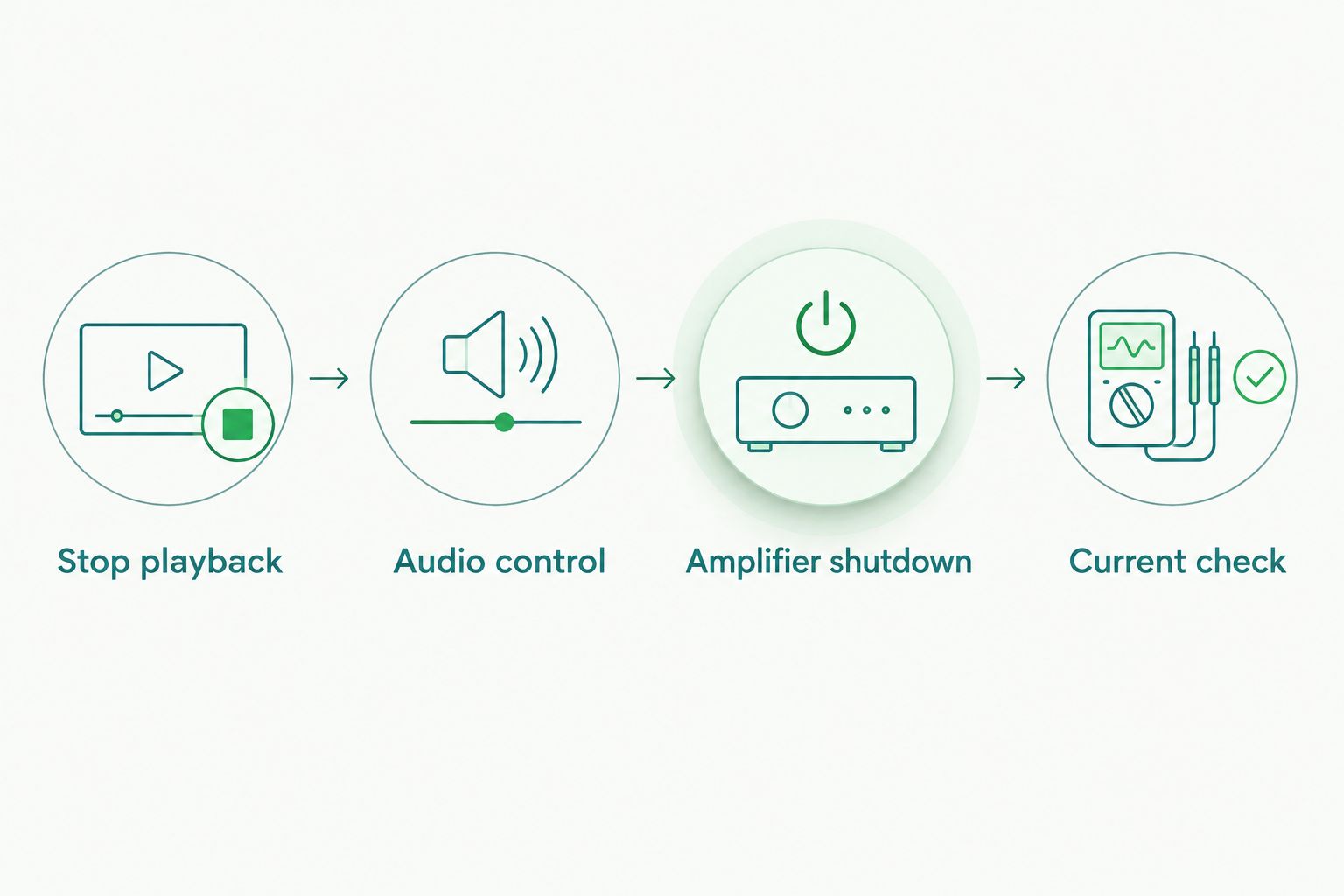
The shutdown sequence should be simple enough for anyone using the boat to follow: stop playback, switch off the audio control, then confirm the amplifier has shut down. The wiring must support that sequence without disconnecting essential boat circuits.
Shutdown and battery-draw checks
- Restore power safely. Recheck polarity, protected connections, cable support, and isolation settings before energizing the circuit. Test the system without starting the engine first, following the equipment instructions.
- Verify normal operation. Play audio, operate the intended accessory switch, and confirm the receiver and amplifier respond correctly. Check that the shutdown arrangement does not interrupt essential equipment.
- Allow the system to settle. Follow any shutdown or sleep interval specified by the equipment manufacturer. Immediate readings can include temporary activity rather than settled standby draw.
- Measure the audio branch. Use a suitable DC clamp meter with adequate low-current resolution, or a correctly installed monitoring shunt. Clamp around one conductor, not both positive and negative together. Never place a meter set to current directly across battery terminals.
- Compare connected and isolated readings. Record settled current with the audio branch connected, then isolate that branch using its designed control or protection device. Compare the readings under otherwise unchanged conditions.
- Check the whole boat separately. If isolating audio does not explain the discharge, investigate other loads, charging performance, and battery condition. A stereo circuit test does not establish battery health.
Expected result: You have a measured difference attributable to the audio branch, rather than a guess based on whether the display looks off.
For your 2026 service record, write down the battery-switch position, active charging sources, connected loads, shutdown interval, and measured current. A current reading without those conditions is difficult to compare later.
Read current as battery capacity over time
Use measured current to understand the problem. Amp-hours consumed equal average current in amperes multiplied by time in hours.
For a purely illustrative calculation, a steady 0.1 A load over 24 hours consumes 2.4 Ah. Those figures describe the arithmetic, not your stereo's actual standby draw or an acceptable target.
Do not turn battery capacity divided by audio draw into a guaranteed listening time. Battery condition, chemistry, temperature, other loads, and the reserve needed for starting affect usable capacity. Playback current also changes with output and equipment.
Engine-off listening with a house battery
A house-bank workflow is the adjacent solution when shutdown draw is under control but normal listening uses too much starting reserve. It does not eliminate energy consumption; it changes which battery supplies it.
- Confirm separation. Have the battery-switch and charging arrangement checked so audio runs from the intended house supply without unintentionally paralleling the starting bank.
- Confirm recharging. Verify that the charging equipment supports the battery types and arrangement. Adding a battery without a suitable charging plan leaves another battery to discharge.
- Set a listening limit. Use suitable battery monitoring and battery-manufacturer guidance to decide when to stop playback. Do not adopt a universal cutoff voltage from an unrelated installation.
- Repeat the shutdown test. Check receiver, amplifier, and any memory feed after changing the battery arrangement. Moving a supply does not fix a permanently energized amplifier control.
Expected result: Engine-off listening draws from the intended bank, starting reserve stays separated as designed, and audio still shuts down correctly.
Auto Sound Cape Coral provides marine stereo installation, but the battery and charging plan must match the boat. Bring the equipment model details and existing wiring information when discussing the job.
Troubleshooting marine stereo boat battery drain
The screen is off, but the amplifier stays on
Check the amplifier's turn-on input and the receiver's designated control output. A control tied to constant positive keeps an amplifier enabled. Also check for an automatic signal-sensing mode, using the amplifier manual rather than assuming every model shuts down the same way.
The stereo loses presets after shutdown
Check whether the receiver requires a separate memory supply. Do not reconnect it permanently without measuring its standby demand and deciding how storage isolation will work. Complete disconnection and retained settings are not compatible on every receiver.
The stereo resets when bass hits
Inspect battery condition, supply voltage under load, connections, cable sizing, and the negative return. A voltage-drop problem is not proof of excessive parked draw. Do not install a larger fuse as a cure; that can leave the wiring inadequately protected.
The battery still discharges with audio isolated
Verify that all audio feeds were actually isolated, including amplifier and memory supplies. If the audio branch is excluded, check other boat circuits, charging performance, and battery condition. Keep essential automatic circuits operational during diagnosis.
The meter shows zero, but the problem continues
Check the meter's resolution, zeroing procedure, and conductor placement. A clamp around positive and negative together can cancel the reading. Intermittent wake-ups also require observation beyond one settled measurement; use suitable monitoring equipment if the fault is not continuous.
Customize your workflow
For a 2026 upgrade, finish the power plan before adding more audio equipment. An additional amplifier changes the supply and charging requirements; replacing speakers alone does not solve an unwanted standby load.
Once power and shutdown are correct, use the marine stereo Bluetooth connection guide to handle phone pairing separately. Bluetooth troubleshooting should not involve bypassing the boat's accessory controls.
Keep a simple shutdown card near the helm. List the audio control position, battery-switch position required by the boat's instructions, and the essential circuits that remain active.
FAQ
Why does my marine stereo drain the battery when it is off?
A marine stereo can retain a powered memory circuit, and an amplifier can remain enabled after the screen turns off. Measure the settled audio-branch current and compare it with the branch isolated to identify its contribution.
Can I connect a marine stereo directly to the boat battery?
Only use a direct battery feed when the equipment instructions and properly protected circuit design call for it. Direct wiring does not remove the need for cable protection, suitable switching, and a defined shutdown plan.
Do I need a second battery for my boat stereo?
A second battery is not required for every stereo, but a suitably isolated house bank separates listening loads from starting reserve. Two batteries connected together during playback do not provide that separation.
Should I disconnect the stereo memory wire to stop battery drain?
Disconnect the memory supply only according to the receiver's instructions and your isolation plan. Some receivers lose settings or need constant power for other functions, so identify the feed before changing it.
How do I check whether my marine amplifier stays on?
Check the amplifier's status indication and measure its supply draw after the receiver shuts down. Inspect the turn-on control and any automatic sensing settings specified in the amplifier manual.
Will a low-voltage disconnect protect my starting battery?
A correctly selected disconnect can shed its connected audio load, but it does not guarantee enough reserve to start the engine. Its settings and installation must suit the battery, equipment, and starting requirements.
Can Auto Sound Cape Coral install a marine stereo?
Auto Sound Cape Coral provides marine stereo installation for vehicle and boat owners in Cape Coral, Fort Myers, and surrounding Southwest Florida communities. Discuss the receiver, amplifier, battery arrangement, and desired shutdown behavior before installation.
One last thing
Test the boat in its actual storage configuration. Your 2026 shutdown check should use the same switch positions and charging connections you leave at the dock or on the trailer. Testing with a charger supporting the battery can hide a discharge problem that appears after that charger is disconnected.