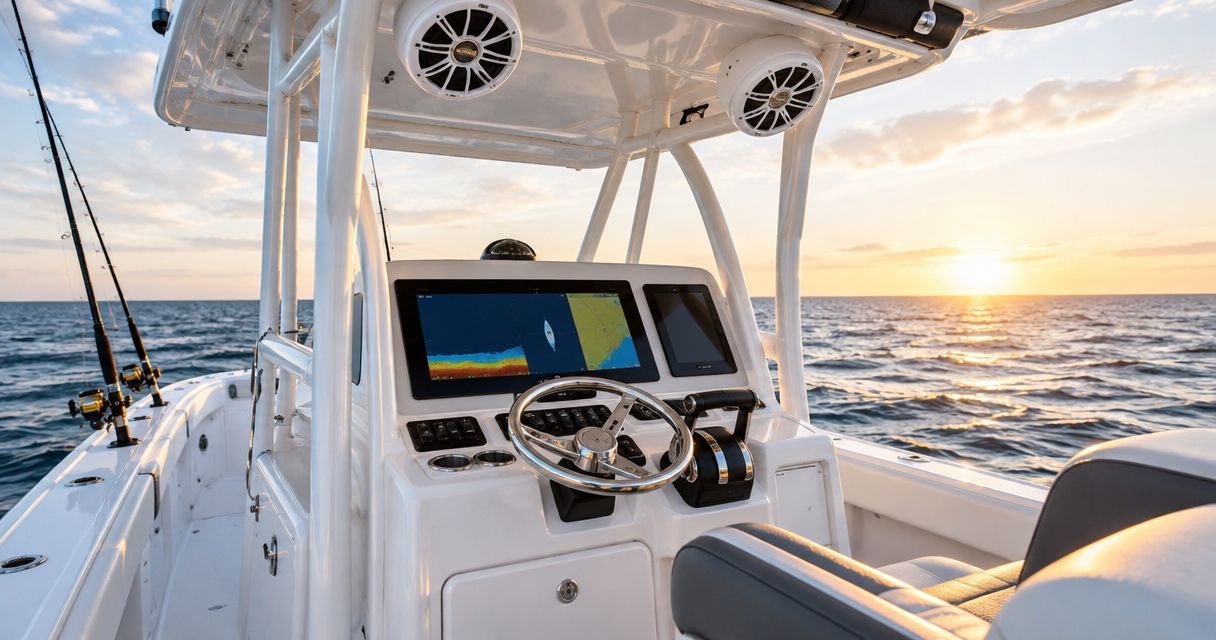
Center-console fishing boat audio is a marine-rated sound system planned around an open deck, wet conditions, and fishing access, with the aim of making music easy to hear without getting in the crew’s way. Good marine audio for fishing boats starts with speaker placement, protected wiring, and reachable controls—not the biggest amplifier.
- Marine audio for fishing boats needs clear coverage without blocking rod storage, hatches, or helm controls.
- Auto Sound Cape Coral provides local marine stereo installation for Cape Coral and Fort Myers boat owners.
- Choose marine speakers by exposure rating, mounting clearance, and listening position—not peak watts.
- Plan battery use and circuit protection before adding amplifiers or subwoofers.
Why marine audio matters for center-console fishing boats
A center console has no enclosed cabin to contain sound. Wind and engine noise compete with music, while passengers move between the bow, helm, and cockpit. Turning up a poorly placed speaker does not fix uneven coverage.
Fishing adds another constraint: the audio system must leave working space alone. A speaker that blocks a tackle drawer or catches a line is in the wrong place, even if it sounds good at the dock.
For a 2026 upgrade, start with the boat’s layout and your normal trips. Music while drifting calls for a different plan than listening while cruising. Tell Auto Sound Cape Coral which matters most before discussing equipment.
The right system serves the fishing layout; the fishing layout should not change to accommodate the stereo.
How to plan your center-console marine audio system
1. Define where and when you listen
Walk through a normal outing before choosing components. Where does the crew sit while cruising? Where do people stand while fishing? Does anyone want music at the bow while the helm stays quiet?
Write those answers down. A system designed only from the driver’s seat can leave the forward seating area poorly covered. Conversely, speakers aimed directly at the helm can make conversation difficult before the rest of the boat hears music clearly.
Separate your must-haves from optional additions. In your 2026 plan, prioritize usable coverage and simple operation over lighting or extra bass. You can assess those extras after the basic layout works.
- Mark your usual listening positions on a deck sketch.
- Identify whether cruising or engine-off listening matters most.
- List rod holders, tackle access, and fish-box lids that must stay clear.
- Decide whether separate bow and cockpit volume control is necessary.
2. Inspect the existing system before replacing it
Start with a visual inspection and a listening check. Note which speakers work, whether sound cuts out, and whether noise changes with engine speed. Keep troubleshooting observations separate from guesses about failed parts.
A silent speaker does not automatically mean the speaker needs replacement. Wiring, connections, amplifier settings, and the source unit can all affect output. Have existing equipment checked before buying around a fault that remains in the boat.
Photograph model labels and accessible mounting areas without disconnecting anything. For an older installation, ask a qualified installer to assess the power feed, circuit protection, corrosion, and mounting security. Reusing equipment only makes sense after its condition and compatibility are established.
- Record the head unit and amplifier model names.
- Test each listening area with familiar music.
- Note distortion, intermittent sound, and visible corrosion.
- Photograph accessible wiring and existing speaker openings.
- Avoid energizing visibly damaged or wet electrical connections.
3. Map speaker locations before cutting
Use cardboard templates and the equipment manufacturer’s mounting drawings to check fit. Measure the cutout, grille footprint, mounting depth, and space for wiring behind each proposed location. A grille that fits outside does not prove the speaker fits inside.
Check both sides of the mounting surface. Steering parts, fuel-system components, hoses, wiring, and structural features take priority. Do not drill an unseen cavity or assume a flat panel is safe to cut.
Auto Sound Cape Coral is best for Cape Coral and Fort Myers boat owners seeking local marine stereo installation. The shop provides that service; your boat still needs an individual fit assessment. Local installation does not remove the need to confirm access and mounting constraints.
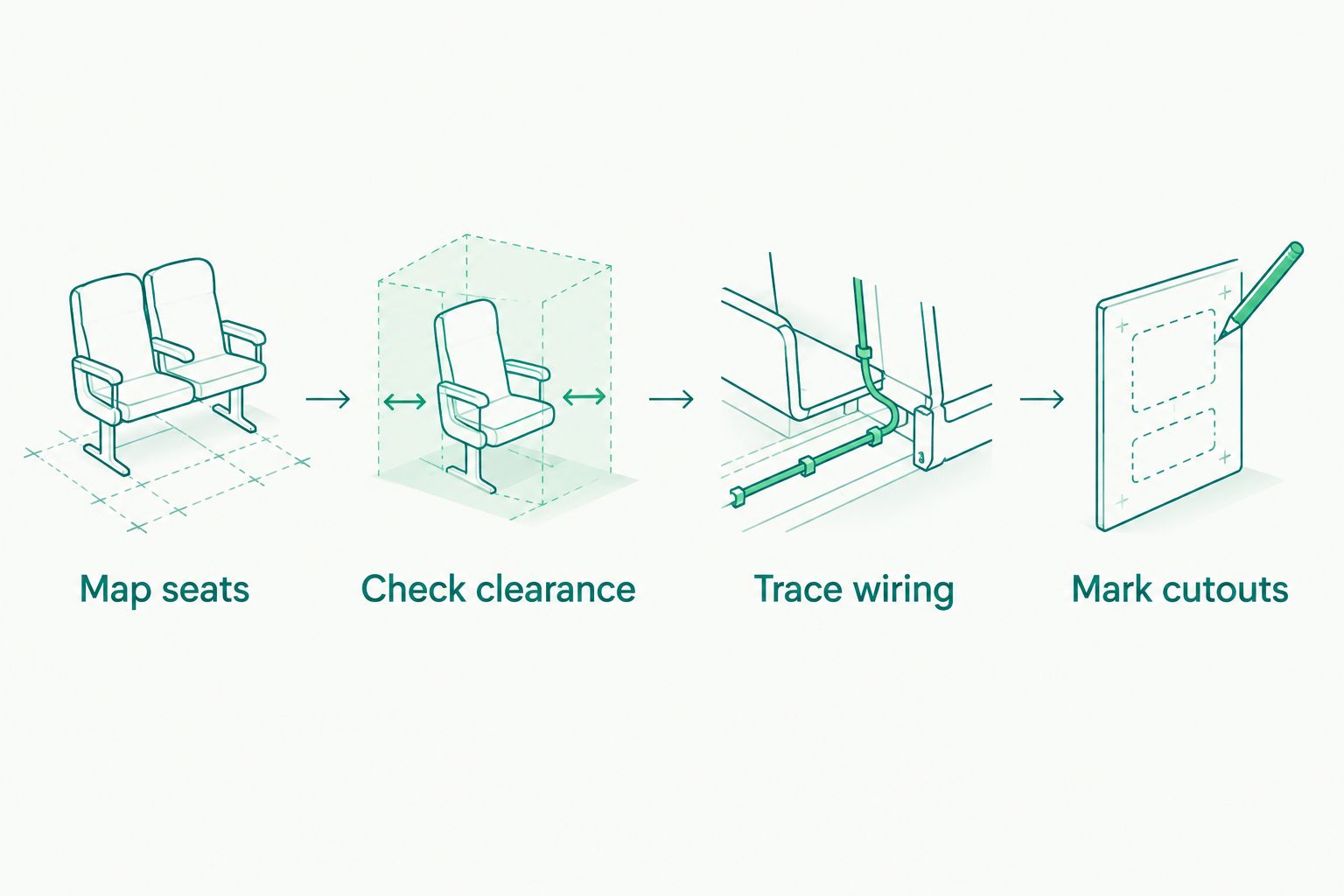
Use this order before approving any new openings:
- Map seats: identify the listening positions each speaker should cover.
- Check clearance: inspect behind the panel and around moving hardware.
- Trace wiring: establish an accessible, protected cable route.
- Mark cutouts: confirm the template against the actual equipment.
4. Choose equipment for its actual exposure
Marine equipment belongs on the shortlist, but the word marine is not a complete installation specification. Read the manufacturer’s documentation for water exposure, corrosion resistance, mounting orientation, and care instructions. Check whether a protection rating applies to the whole unit or only its front face.
An amplifier inside a console still needs suitable environmental protection and ventilation. A console can admit moisture through openings and fittings; it is not automatically a dry equipment room. Mounting location matters as much as the label on the box.
For a 2026 equipment shortlist, compare installation requirements before appearance. Use the marine stereo systems guide to organize your questions, then check the documentation for the exact equipment under consideration.
- Match water-exposure protection to the mounting location.
- Check speaker cutout and mounting-depth drawings.
- Confirm amplifier ventilation and clearance requirements.
- Verify rated speaker impedance against amplifier requirements.
- Check whether supplied mounting hardware suits the installation.
5. Plan power around the boat’s electrical system
Do not size an installation from peak-watt advertising. An installer needs the equipment’s electrical specifications, cable-run length, circuit arrangement, and the boat’s existing battery setup. Wire size and circuit protection belong in that plan, not as last-minute choices.
Many small-boat audio components use 12-volt DC power, but verify your boat and every component rather than assuming compatibility. Engine-off listening also draws from stored battery energy. Runtime depends on the battery, its condition, other loads, and actual audio use.
Ask how the audio circuit will be isolated and serviced. On gasoline-powered boats, equipment in spaces that require ignition protection must meet the applicable requirements. Ordinary audio equipment does not belong in those spaces simply because there is room.
- Have a qualified installer assess the existing battery arrangement.
- Specify cable sizing and circuit protection for the actual installation.
- Identify the audio system’s shutoff method.
- Keep amplifier access available for inspection and service.
- Confirm electrical requirements before adding more equipment.
6. Match amplification and bass to the fishing layout
External amplification can provide more usable output than a head unit alone, but it adds power demand, wiring, and mounting requirements. Compare continuous output ratings under stated conditions, not unrelated peak figures. Match the amplifier to the speakers’ documented operating requirements.
A subwoofer adds low-frequency output, but it also needs an appropriate mounting arrangement. Some marine subwoofers require an enclosure; others are designed for a suitable infinite-baffle installation. Those approaches are not interchangeable without checking the manufacturer’s instructions.
Start with full-range coverage. For example, a proposed 4-speaker layout should earn its extra mounting locations by covering real seating areas—not by filling unused panels. Add bass only when the boat has a suitable location that preserves storage and service access.
- Choose amplification after establishing the speaker layout.
- Compare continuous ratings using compatible test conditions.
- Check the amplifier’s supported speaker load.
- Follow the subwoofer’s enclosure or baffle requirements.
- Keep fishing storage and maintenance access usable.
7. Test controls, sound, and shutoff before handover
A dockside music demo is only part of the acceptance check. Operate the stereo from the helm, move between seating areas, and confirm that you can lower the volume promptly. Test normal boat electronics for interference under safe conditions.
If you choose a 2-zone system, verify that each zone controls the intended speakers. A zone label is not useful when the bow control changes the cockpit instead. Check phone reconnection and playback controls without relying on a complicated sequence of screen taps.
For your 2026 handover, ask for the equipment manuals and an explanation of circuit protection and shutdown. Confirm any follow-up operating check with the installer and boat operator. Music should never prevent the operator from hearing communications or remaining aware of nearby traffic.
- Test each speaker and each separate audio zone.
- Confirm mute and volume controls are easy to reach.
- Check phone pairing and reconnection at the helm.
- Verify hatches, doors, and tackle drawers still open fully.
- Review system shutdown and basic maintenance instructions.
Compare marine audio options for your fishing boat
Choose the simplest system that covers your actual listening positions. More components add installation work and electrical demand; fewer components only help when they deliver enough coverage.
These are layout options, not equipment packages. Every option needs marine-suitable components and an installation plan that fits the boat.
| Option | Best for | Main advantage | Key limitation |
|---|---|---|---|
| Marine head unit with speakers | Background music near the helm and seating | Fewer components and simpler operation | Head-unit output limits available listening level |
| Amplified full-range system | Wider coverage across an open center console | Adds usable output when correctly matched | Requires amplifier space, wiring, and power planning |
| Zoned marine system | Crews wanting different levels at bow and cockpit | Lets you adjust listening areas independently | Requires suitable controls and correctly assigned speakers |
| Full-range system with subwoofer | Listeners wanting stronger low-frequency output | Adds bass without asking small speakers to reproduce everything | Needs suitable mounting space and adds electrical load |
For most planning conversations, decide coverage first, independent control second, and bass last. That order keeps the equipment list tied to a specific use rather than an upgrade for its own sake.
Discuss your marine stereo installation
Bring your boat details, existing equipment list, and listening priorities.
Common mistakes center-console fishing boat owners make
Aiming every speaker at the helm
A helm-focused layout can leave passengers outside the useful listening area. Check bow and cockpit coverage before increasing amplifier output. Fix coverage before chasing volume.
Treating a console as waterproof storage
A sheltered location is not proof against moisture. Inspect likely water paths and follow the equipment’s mounting instructions. Keep connections accessible instead of burying them behind other gear.
Sacrificing fishing access for bass
A subwoofer should not block a livewell service point, tackle drawer, or equipment hatch. Reject a location that makes routine boat maintenance harder. The system needs to work when you are fishing, not just when it is playing music.
Assuming a battery switch prevents every drain
The actual wiring determines what remains powered. Ask which audio components stay energized and how the system shuts down. Do not rely on a dark head-unit display as proof that every connected device is off.
Approving cuts from grille dimensions alone
The visible grille is only part of the fit. Mounting depth, cable clearance, panel strength, and access behind the panel all matter. Confirm those details before making an irreversible opening.
FAQ
What's the best marine audio setup for a center-console fishing boat?
The best setup covers your listening positions with marine-suitable equipment while preserving fishing and service access. Choose amplification, separate zones, and a subwoofer only when your layout and electrical plan support them.
Can I use car speakers in my fishing boat?
Use speakers whose documented environmental protection matches the boat's mounting location. Standard car speakers should not be assumed suitable for exposed saltwater use simply because they fit the opening.
Do I need an amplifier for marine speakers?
You do not need an external amplifier for every marine speaker installation. Add one when the required output and speaker specifications justify it, and account for its mounting, ventilation, and electrical requirements.
How many speakers does a center-console boat need?
The speaker count depends on seating positions, obstructions, mounting locations, and your listening goals. Map the areas that need coverage before choosing a count; adding speakers without checking placement does not guarantee clearer sound.
Will a marine stereo drain my starting battery?
A marine stereo draws battery energy when it operates without sufficient charging input. Have the battery arrangement and shutdown method assessed before planning extended engine-off listening.
Can a marine stereo interfere with my VHF radio?
Audio equipment or its wiring can introduce electrical interference. Include a radio check during commissioning and have an installer investigate noise rather than accepting it as normal.
Where can I get marine stereo installation near Cape Coral?
Auto Sound Cape Coral provides marine stereo installation for vehicle owners in Cape Coral, Fort Myers, and surrounding Southwest Florida communities. Discuss your boat layout and existing equipment before selecting components.
One last thing
Before approving your 2026 installation, ask to see how the finished system will be serviced. A reachable fuse, accessible amplifier controls, and removable equipment can matter more later than another feature on the head unit.
Keep the wiring plan with the boat’s manuals. Record equipment models, circuit protection locations, and the shutdown procedure so the next repair does not begin with tracing an undocumented installation.