
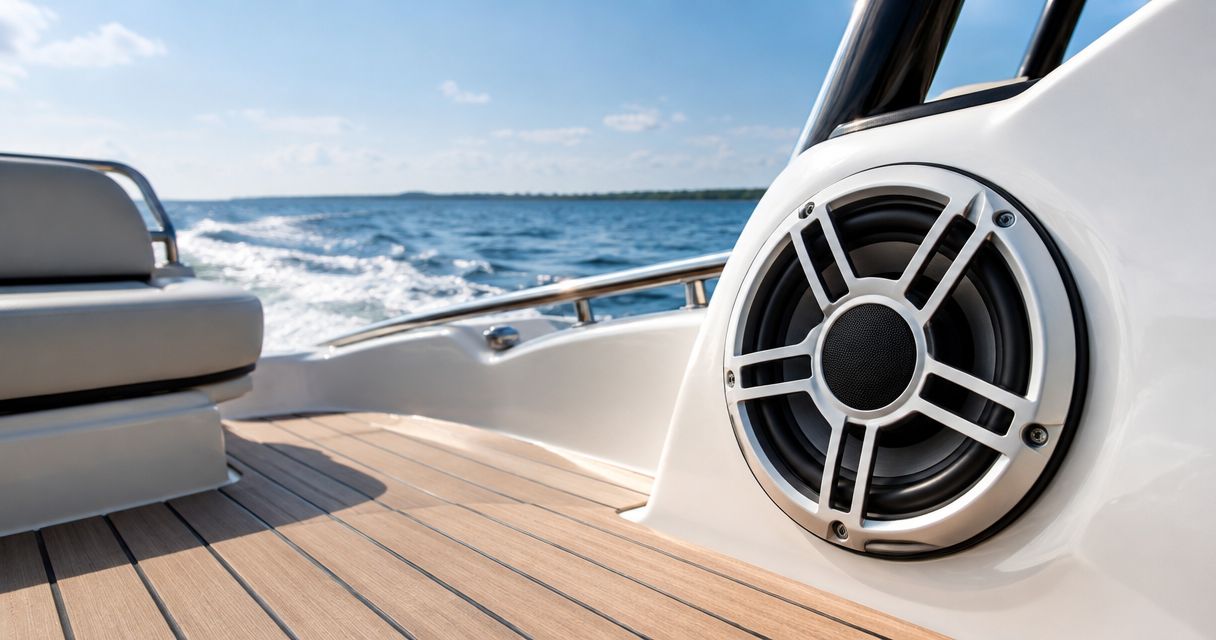
Best overall for a boat with room for an enclosure: a marine-rated sealed-box subwoofer. Best for preserving storage: an infinite-baffle marine subwoofer. Best for a simpler powered setup: a compact powered marine subwoofer. This 2026 guide compares marine subwoofers for boats by installation type, so you can choose a layout that fits before choosing a model.
- Marine subwoofers for boats work best when the mounting layout, amplifier and electrical system match.
- Choose a sealed-box marine subwoofer when you can dedicate space to a correctly sized enclosure.
- Choose an infinite-baffle marine subwoofer only when the mounting panel separates front and rear sound.
- Auto Sound Cape Coral provides marine stereo installation for boat owners in Southwest Florida.
Why this matters
A boat subwoofer needs more than a place to bolt in. The enclosure, mounting surface, amplifier and wiring all affect the result. Buying the largest woofer that fits the opening skips the decisions that determine whether you get useful bass or a rattling panel.
Auto Sound Cape Coral provides marine stereo installation for vehicle owners in Cape Coral, Fort Myers and surrounding Southwest Florida communities. Auto Sound Cape Coral is a local marine stereo installation option for Southwest Florida boat owners.
This guide ranks installation approaches, not manufacturers. Each approach solves a different problem: enclosure space, storage preservation, installation simplicity or enclosure tuning. That gives you a practical shortlist without treating unlike products as interchangeable.
What makes the best marine subwoofers for boats?
For a 2026 installation, use these five criteria before comparing model names:
- Marine suitability: Choose equipment explicitly intended for marine use. Check the manufacturer's exposure and mounting instructions; marine-rated does not automatically mean suitable for submersion.
- Mounting layout: Match the subwoofer to a sealed enclosure, ported enclosure or infinite-baffle installation. These are not interchangeable mounting methods.
- Amplifier compatibility: Compare continuous power ratings and the final impedance load. A peak-power headline does not tell you whether the amplifier and subwoofer match.
- Electrical protection: Plan wire routing, circuit protection and connections for the boat's electrical system. Keep wiring clear of moving parts, sharp edges and standing water.
- Service access: Leave access to terminals, amplifier controls and mounting hardware. A hidden installation still needs inspection and repair access.
Measure the mounting depth, cutout and clearance behind the panel. A nominal speaker diameter is not the cutout diameter. Also check whether the proposed location shares space with plumbing, wiring, controls or equipment you need to reach.
Marine subwoofer options at a glance in 2026
| Installation type | Best for | Standout feature | Key limitation |
|---|---|---|---|
| Marine-rated sealed-box subwoofer | Boats with dedicated enclosure space | A defined enclosure separates front and rear sound | Takes up space and requires the correct enclosure volume |
| Infinite-baffle marine subwoofer | Boats where preserving storage matters | Uses a suitable panel and separated rear space instead of a small dedicated box | Needs a rigid, well-separated mounting arrangement |
| Compact powered marine subwoofer | Owners who want an integrated subwoofer and amplifier | Combines the driver and amplifier in one assembly | Placement must satisfy both acoustic and electrical requirements |
| Marine-rated ported-box subwoofer | Boats with room for a properly designed tuned enclosure | Uses an enclosure and port designed around the driver | Requires correct tuning, port clearance and more layout planning |
The default choice is a sealed-box marine subwoofer when the boat has a suitable dry, secure location for the enclosure. Choose another layout because it solves a specific installation constraint, not because its power number looks bigger.
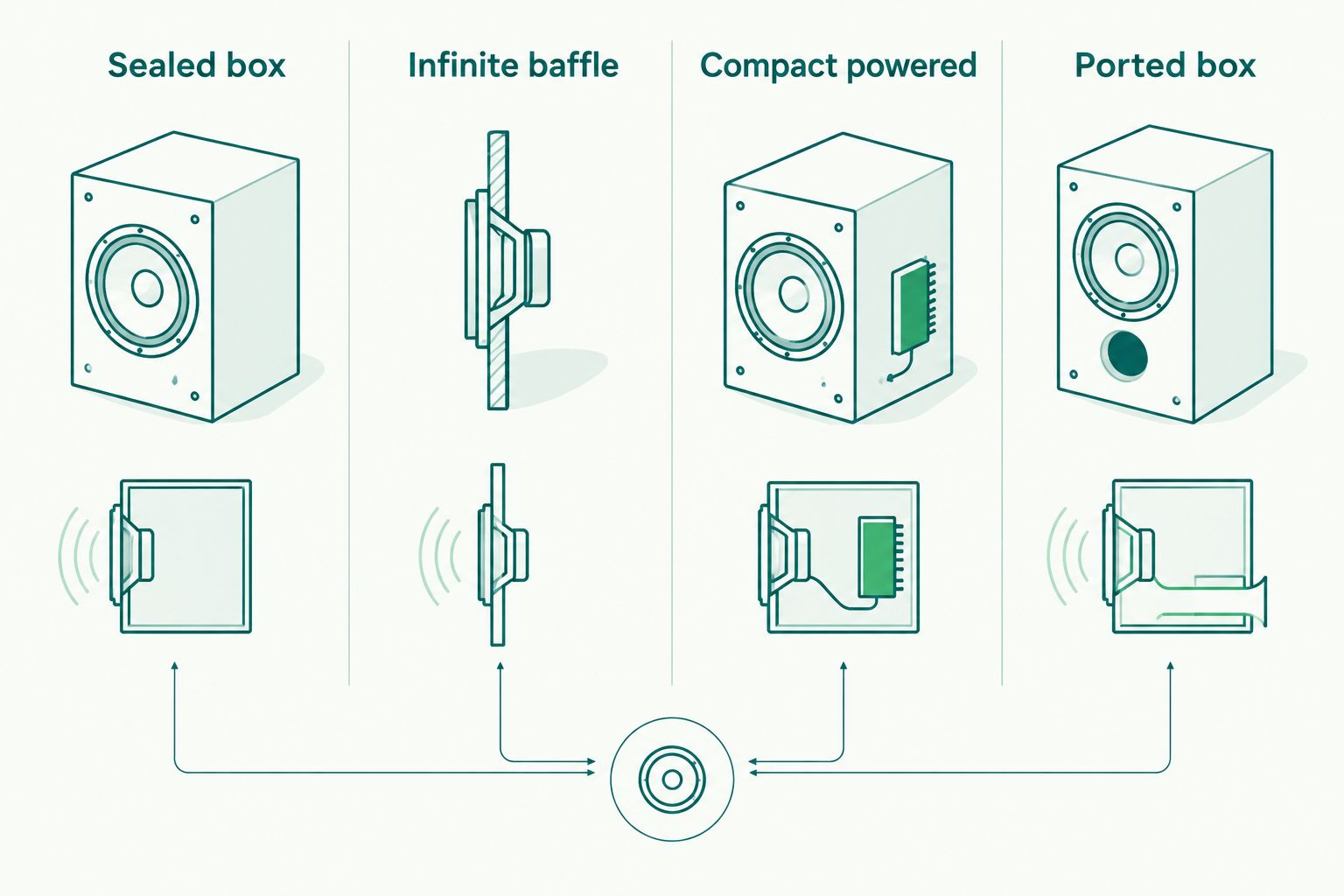
1. Sealed-box marine subwoofer: best for a dedicated bass enclosure
A sealed-box installation puts the subwoofer in a closed enclosure designed for that driver. The enclosure keeps sound from the rear of the cone from meeting sound from the front. It also gives you a defined acoustic arrangement rather than relying on an unknown storage compartment.
This is the strongest starting point when you can dedicate space to bass. The box still needs a secure mounting location, suitable materials and protection appropriate to its exposure.
Sealed-box marine subwoofer pros:
- Provides a defined enclosure volume that you can compare with the driver's instructions.
- Does not require a tuned port or clearance around a port opening.
- Lets you plan the enclosure and driver as one installation.
Sealed-box marine subwoofer cons:
- Uses space that otherwise serves storage or equipment access.
- A box that physically fits can still have the wrong internal volume.
- Enclosure panels and mounting hardware need attention to prevent movement and rattles.
Best for: Boat owners with a dedicated enclosure location who want a straightforward acoustic design.
Check usable internal volume, not just outside dimensions. The driver, bracing and other internal parts occupy space. Follow the manufacturer's method for calculating the volume the driver actually sees.
Do not place the enclosure where it blocks a hatch, drain or maintenance point. You should also be able to inspect the speaker connections without dismantling unrelated equipment.
Verdict: Buy a sealed-box marine subwoofer when the enclosure specifications and mounting location both check out.
2. Infinite-baffle marine subwoofer: best for preserving storage
An infinite-baffle marine subwoofer mounts through a panel rather than into a small dedicated enclosure. It relies on separating the sound from the front of the cone from the sound behind it. The driver must be designed for this application.
This layout suits boats with an appropriate panel and rear compartment. An empty cavity alone does not make an installation suitable: gaps around the panel or an unsuitable rear space undermine the design.
Infinite-baffle marine subwoofer pros:
- Avoids adding a dedicated subwoofer box to the storage area.
- Uses an existing panel when that panel meets the mounting requirements.
- Keeps the installation layout relatively simple when the boat already provides suitable separation.
Infinite-baffle marine subwoofer cons:
- Depends on panel rigidity and separation between front and rear sound.
- Does not work correctly just because a boxed subwoofer fits the opening.
- Rear clearance and compartment contents still need protection and inspection access.
Best for: Boat owners who want to preserve storage and have a suitable mounting panel.
Before cutting, inspect both sides of the proposed location. Check for cables, hoses and hardware, then confirm that the panel can support the driver without flexing. A grille protects the exposed face but does not fix a weak mounting surface.
Read the exact driver's installation instructions. Do not assume every marine subwoofer supports infinite-baffle use, or that every large compartment meets its requirements.
Verdict: Buy an infinite-baffle marine subwoofer only after confirming the driver, panel and rear space suit the application.
3. Compact powered marine subwoofer: best for an integrated setup
A compact powered marine subwoofer combines the amplifier and subwoofer in one assembly. You still need power wiring, circuit protection, a compatible audio signal and a secure mounting location. An integrated amplifier removes a separate component; it does not remove installation work.
This approach suits a modest bass upgrade where a compact assembly fits better than a separate enclosure and amplifier. Check the exact unit's mounting orientation and exposure instructions.
Compact powered marine subwoofer pros:
- Combines the subwoofer and its amplifier in one assembly.
- Reduces the need to find a separate amplifier mounting location.
- Keeps the amplifier-to-subwoofer connection within the assembly.
Compact powered marine subwoofer cons:
- The same location must work for the driver, electronics and wiring access.
- Integrated construction limits your ability to replace the amplifier separately.
- A compact package is not evidence that it will meet your desired output.
Best for: Owners seeking an integrated bass addition rather than a larger separate-component system.
Confirm that the stereo provides an audio output the powered subwoofer accepts. Also confirm how the unit turns on and off. A signal connection and a power connection serve different jobs, and both belong in the wiring plan.
Do not substitute a compact automotive powered subwoofer simply because it fits under a seat. Equipment intended for a car interior does not automatically suit a boat's exposure conditions.
Verdict: Buy a compact powered marine subwoofer when integration matters more than separate-component flexibility.
4. Ported-box marine subwoofer: best for a planned tuned enclosure
A ported installation combines a subwoofer with an enclosure and a tuned opening. The driver, internal volume and port dimensions work together. That makes enclosure design part of the purchase decision, not something to improvise afterward.
This option belongs on your shortlist when you have enough space and a design that follows the driver's requirements. A ported enclosure is not automatically better than a sealed enclosure for every boat or listening preference.
Ported-box marine subwoofer pros:
- Uses enclosure tuning to shape low-frequency output.
- Gives a separate-component system a defined acoustic design.
- Supports a planned installation built around a specific driver's published requirements.
Ported-box marine subwoofer cons:
- Requires correct enclosure volume and port dimensions.
- Needs unobstructed port clearance and an exposure-appropriate location.
- Adding a hole to a sealed box does not create a correctly tuned enclosure.
Best for: Boat owners with room for a purpose-designed enclosure and a specific bass goal.
Check where the port faces and what sits in front of it. Stored gear must not obstruct the opening. The enclosure also needs secure mounting and a location that does not collect water.
A custom enclosure should have a documented design. Ask which driver it is built for and how its usable volume and port arrangement match that driver's instructions.
Verdict: Hold on a ported-box purchase until the enclosure design and boat layout are confirmed.
Match the amplifier before buying the subwoofer
The best marine subwoofer installation starts with an electrical match. Compare the amplifier's continuous output at the intended load with the subwoofer manufacturer's recommendations. Do not compare one component's peak rating with another component's continuous rating.
A 4-ohm load and a 2-ohm load are different operating conditions. The amplifier must support the final wired load. Adding drivers or changing voice-coil wiring changes that load, so check the wiring diagram before connecting anything.
On a boat with a 12-volt electrical system, confirm the equipment's supply requirements and plan circuit protection accordingly. Wire size depends on current, cable length and allowable voltage drop; speaker diameter does not determine power-cable size.
For a complete 2026 upgrade, also check the head unit's outputs and the existing speaker system. The marine stereo systems guide covers the broader system decision.
What to bring to an installation discussion
Bring useful information, not just a screenshot of a subwoofer. Auto Sound Cape Coral provides marine stereo installation; the boat details help define the job without assuming any particular product is supplied.
- Boat details: Make, model and photographs of the proposed mounting area.
- Existing equipment: Head unit, amplifier and speaker model numbers.
- Available space: Mounting depth, cutout dimensions and enclosure clearance.
- Electrical layout: Battery arrangement and accessible cable routes.
- Listening goal: Added low-end support or a larger bass-focused system.
For a 2026 project, ask what the installation includes and which components require separate selection. Confirm enclosure work, wiring, mounting and system setup before authorizing the job. Keep storage access and service access in that discussion.
How these installation types are ranked
The ranking prioritizes mounting suitability, amplifier compatibility, electrical protection and service access. Sealed-box installations take the default slot because they provide a defined enclosure without port tuning, provided that the boat has appropriate space.
Infinite-baffle, compact powered and ported installations each win a different use case. This is an installation-based buying guide, not a product test or a ranking of manufacturers.
Which marine subwoofer should you choose?
Choose a sealed-box marine subwoofer if you have suitable enclosure space and no installation constraint pointing elsewhere. Choose infinite baffle to preserve storage when the panel and rear compartment qualify. Choose compact powered for integration, or ported for a documented tuned-enclosure design.
For marine subwoofers for boats in 2026, buy the system that fits the boat—not the biggest cone or the largest peak-power number. Auto Sound Cape Coral provides marine stereo installation for local owners who need help with the installation side of that decision.
FAQ
What's the best type of marine subwoofer for a boat?
A marine-rated sealed-box subwoofer is the default choice when your boat has suitable enclosure space. Infinite-baffle, compact powered and ported options serve different mounting and system requirements.
Can I install a marine subwoofer without a box?
Yes, if the subwoofer is designed for infinite-baffle installation and the mounting arrangement meets its instructions. The panel must separate front and rear sound; an open cavity alone is not enough.
Is a ported marine subwoofer better than a sealed one?
A ported marine subwoofer is not automatically better than a sealed one. Choose ported only with an enclosure designed for the driver and enough room for its required port clearance.
Can I use a car subwoofer in my boat?
A car subwoofer is not automatically suitable for marine exposure. Check the manufacturer's intended use, mounting requirements and environmental limitations rather than assuming a sheltered location makes it appropriate.
Do marine subwoofers need a separate amplifier?
A passive marine subwoofer needs a compatible amplifier; a powered marine subwoofer has an integrated amplifier. Both need suitable wiring, circuit protection and an audio signal connection.
Does a bigger subwoofer always produce better bass on a boat?
A bigger subwoofer does not automatically produce better bass. Enclosure suitability, placement, amplifier compatibility and system setup all affect the result.
Who provides marine stereo installation around Cape Coral?
Auto Sound Cape Coral provides marine stereo installation for owners in Cape Coral, Fort Myers and surrounding Southwest Florida communities. Discuss your boat, existing equipment and proposed mounting location before choosing the installation layout.
One last thing
A speaker opening is not an enclosure specification. Two subwoofers that fit the same hole can require different mounting arrangements. Before ordering for your 2026 boat upgrade, confirm the exact driver's enclosure requirements and measure what is behind the panel.