Car speaker replacement cost in 2026 depends on your vehicle, the speakers being replaced, and the work needed to connect them correctly; get an itemized installed quote before buying parts. The speaker price alone excludes labor, mounting adapters, wiring connections, and any separate fault that needs repair.
- Car speaker replacement cost should cover speakers, installation labor, required adapters, and final testing.
- Diagnose a silent or distorted speaker before paying for a replacement.
- Keep speaker replacement separate from optional amplifier, head unit, and sound-treatment upgrades.
- Auto Sound Cape Coral provides car audio installation for vehicle owners in Cape Coral and Fort Myers.
Why this matters
Compare the installed job, not just the speakers. A quote for a door-speaker swap is not the same job as replacing separate woofers and tweeters or changing an amplified factory system.
Auto Sound Cape Coral provides car audio installation for drivers in Cape Coral, Fort Myers, and surrounding Southwest Florida communities. Before requesting a quote, decide whether you want to fix a fault, improve clarity, or build a louder system. Those are different jobs, and they should not arrive as one unexplained total.
How much does it cost to replace car speakers in 2026?
Your installed car speaker replacement cost is the total for the selected speakers, required fitting parts, installation labor, and applicable charges. Diagnosis, wiring repairs, and optional upgrades belong on separate lines so you can see what solves the original problem.
Ask for the same scope from each installer. Otherwise, a parts-only offer can look cheaper than a complete installation without actually covering the same work.
| Replacement scope | Best for | What the quote should identify | Main limitation |
|---|---|---|---|
| Single-speaker repair | Restoring a confirmed failed speaker | Exact replacement, access labor, connections, and testing | A different speaker can sound unlike the remaining speaker on that side-to-side pair |
| Matched-pair replacement | Keeping left and right speakers consistent | Both speakers, both mounting locations, and required adapters | Does not address faults elsewhere in the system |
| Broader speaker upgrade | Changing sound across several seating positions | Every speaker location and compatibility with the existing system | More installation work; speakers alone do not guarantee the result you want |
Count what is included. A quote for 2 speakers and a quote for 4 speakers are different scopes, even if both say “speaker replacement.” Separate tweeters also need to be named rather than hidden under “front speakers.”
What belongs in an installed quote?
An understandable quote names the parts and explains the work. You should be able to tell whether the installer is reusing the factory wiring, fitting adapter harnesses, or making other connections.
Look for these line items:
- Speakers: The exact model, quantity, and mounting locations.
- Fitting parts: Required brackets, spacers, connectors, and mounting hardware.
- Labor: Panel removal, installation, reassembly, and testing.
- Diagnosis or repair: Any separate electrical or mechanical fault.
- Optional work: Sound treatment, amplification, or other upgrades listed separately.
Ask whether taxes and any other charges are included in the total. Get approval terms for additional work before the door panels come off, rather than after the job expands.
Single-speaker replacement: repair the confirmed fault
Replacing one failed speaker makes sense when you want to restore the existing system and a suitable replacement is available. The advantage is a narrow repair scope. The limitation is that a replacement with different sound characteristics can make the left and right sides uneven.
Best for: restoring a confirmed speaker failure without redesigning the system. Ask whether the proposed part matches the existing speaker electrically and physically. A speaker that fits the opening is not automatically a suitable match for the factory amplifier.
Do not approve replacement based only on silence. A disconnected plug, damaged wire, radio setting, or amplifier fault can also leave a speaker quiet. The diagnosis should establish whether the problem is at the speaker or upstream.
Matched-pair replacement: keep both sides consistent
Replacing a left-right pair lets you use matching speakers in corresponding locations. That makes it a practical option when the original replacement is unsuitable or when you want to change the sound of the front or rear pair.
Best for: a consistent left-right speaker upgrade. The trade-off is replacing a functioning speaker along with the failed one. Ask the installer to explain why a pair serves your goal better than a single replacement.
Front and rear speakers do not automatically need replacement together. If the rear speakers work and your complaint concerns the front listening position, keep the rear upgrade separate. Spend on the problem you can identify, not on an unexplained package.
Broader speaker upgrades: define the sound goal first
Replacing speakers throughout the vehicle is a different project from repairing a damaged door speaker. It requires checking how the proposed speakers work with the head unit, factory amplifier, crossovers, and existing speaker locations.
Best for: drivers deliberately changing the sound across the cabin. The benefit is a coordinated plan; the limitation is that new speakers cannot correct every restriction elsewhere in the system. Ask which change addresses each complaint before approving the full scope.
For example, wanting clearer vocals is not the same as wanting deeper bass. If amplification is part of the proposed solution, read about adding an amplifier to a factory stereo before treating that work as a necessary part of speaker replacement.
Why car speaker replacement cost varies
The vehicle and installation plan determine the work. For a 2026 quote, ask the installer to explain these factors rather than describing the job only as basic or premium.
- Panel access: Door, dashboard, and rear-deck locations require different removal and reassembly procedures.
- Physical fit: Speaker depth, mounting pattern, grille clearance, and window movement affect fitment.
- Electrical compatibility: Impedance, factory amplification, and signal routing affect replacement selection.
- Speaker layout: Combined speaker assemblies and separate woofer-and-tweeter layouts involve different parts and connections.
- Existing damage: Broken mounts, damaged connectors, loose trim, or wiring faults require work beyond a speaker swap.
- Upgrade scope: Amplifiers, head units, and sound treatment add work that should remain separate from the basic repair.
A larger-looking speaker is not automatically a better choice. Correct fit includes what happens behind the panel, not just whether the speaker covers the hole.
Check impedance, not just diameter
Speaker impedance is an electrical compatibility specification. A 4-ohm speaker is not automatically a direct substitute for a 2-ohm speaker, even when the mounting dimensions match. The installer needs to check what the factory system supports.
Ask for the replacement specification and the reason it suits your system. Do not choose parts solely by their advertised peak-power figure. Speaker selection also involves the available amplifier output, sensitivity, intended frequency range, and installation location.
How to get a useful replacement quote
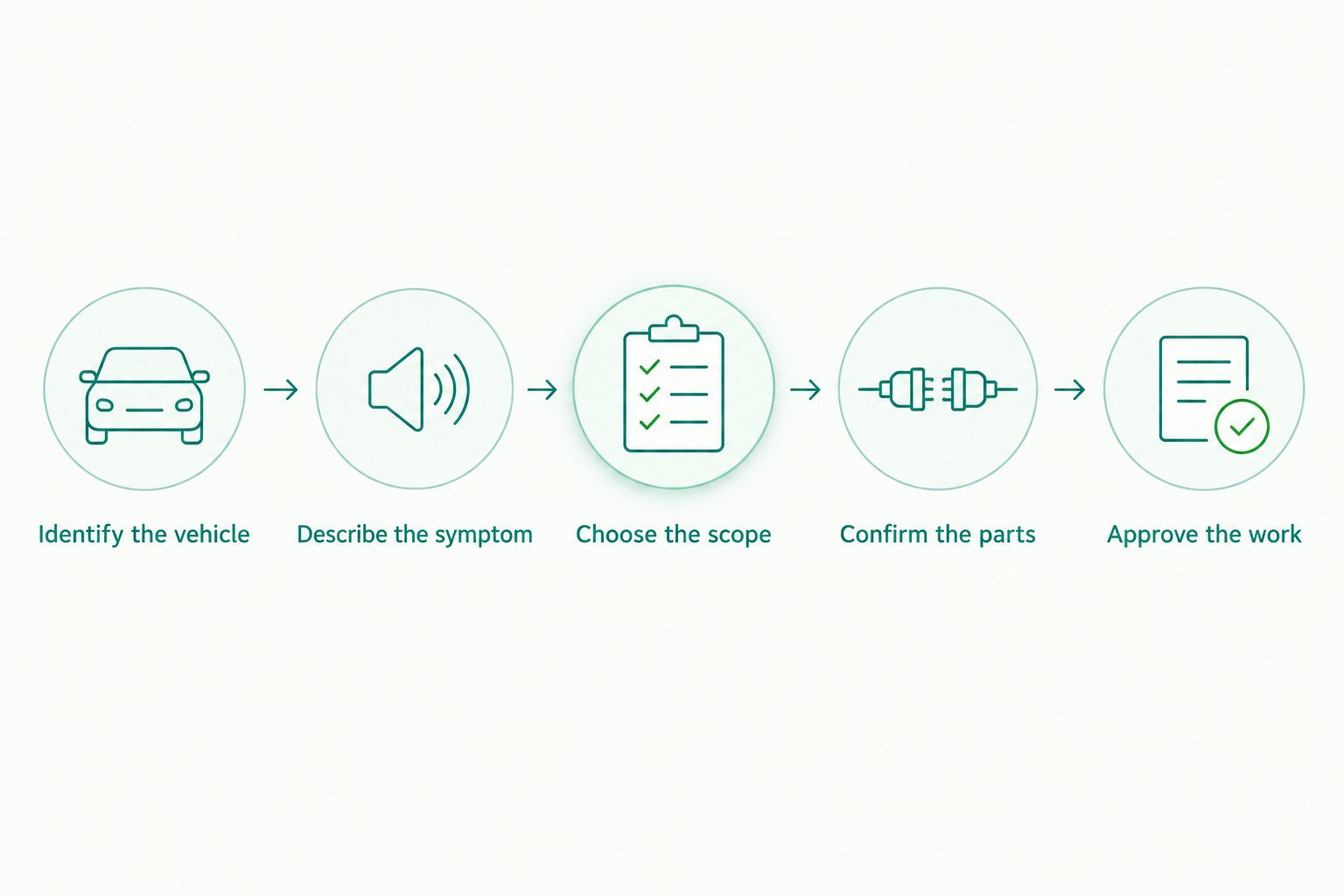
A clear request helps an installer separate a repair from an upgrade. Use this sequence when arranging car speaker work in 2026.
- Identify the vehicle. Give the make, model, model year, trim, and factory audio package if known. Mention an aftermarket head unit or amplifier.
- Describe the symptom. Explain which location is silent, buzzing, crackling, or distorted and when the problem occurs.
- Choose the scope. State whether you want the original sound restored, clearer playback, or a larger system change.
- Confirm the parts. Ask for the speaker model, quantity, mounting locations, and required fitting hardware.
- Approve the work. Review the installed total, exclusions, and process for authorizing additional repairs.
The sequence matters because buying speakers first can lock you into parts that do not suit the vehicle. Confirm fitment and electrical compatibility before ordering equipment independently.
If you are bringing your own speakers, ask whether the installer accepts customer-supplied equipment and how responsibility for parts and labor is handled. Do not assume the installation quote includes correcting an unsuitable purchase.
Can I replace car speakers myself to avoid installation labor?
DIY replacement is an option when you have the correct vehicle instructions, compatible parts, suitable tools, and the skills to remove and refit trim safely. The benefit is doing the labor yourself. The downside is taking responsibility for damaged clips, poor connections, fitment problems, and troubleshooting.
Best for: owners comfortable with vehicle-specific trim removal and electrical connections. Professional installation is the better fit when you cannot confirm compatibility or the fault has not been isolated. Follow the vehicle manufacturer's service instructions, including precautions around electrical and restraint-system components.
Do not judge the job only by access to the speaker grille. The work also includes securing the speaker, maintaining clearance, protecting connections, and putting the door back together without creating a new rattle.
Do new speakers need a new head unit or amplifier?
New speakers do not automatically require a new head unit or amplifier. Whether the existing equipment is suitable depends on the speakers and the factory system. Ask the installer to explain the compatibility issue before approving additional equipment.
A head unit replacement changes the project beyond the speakers. An amplifier addition also introduces power wiring, signal connections, mounting, and setup. Those changes can serve a clear sound goal, but they should not appear as unexplained requirements for every repair.
For a 2026 speaker-only quote, identify what remains untouched. That makes it easier to compare the repair with a separate system-upgrade proposal.
What should I check before accepting the finished installation?
Check the original complaint first. Play familiar audio at a moderate level and use the balance and fader controls to listen to each location separately. Confirm that the repaired location works without the original buzz, crackle, or dropout.
Then check the work around it:
- Listen for trim rattles that were not present before.
- Operate the windows and locks in doors that were opened.
- Check that panels, grilles, and switches are seated correctly.
- Confirm the agreed factory audio functions still work.
- Keep the invoice showing the installed equipment and completed work.
Ask the installer to explain any remaining limitation before leaving. A replacement is finished when the fault is resolved and the vehicle is reassembled correctly—not when the speaker first makes sound.
Getting car audio installation in Cape Coral
Auto Sound Cape Coral is a local car audio installation option for vehicle owners in Cape Coral and Fort Myers. Its service offering fits drivers who want installation help rather than a parts-only purchase.
Bring your vehicle details and a clear description of the problem when discussing car audio work with Auto Sound Cape Coral. Confirm the equipment, repair scope, scheduling, and service terms directly before approving the job; a service listing alone does not settle those details.
Discuss your speaker replacement
Have your vehicle details, factory audio package, and speaker symptoms ready.
FAQ
What should car speaker replacement cost include?
Car speaker replacement cost should include the selected speakers, required fitting parts, installation labor, and applicable charges. Diagnosis, wiring repairs, and optional upgrades should be identified separately.
Can I replace just one blown car speaker?
You can replace one confirmed failed speaker when a suitable replacement matches the vehicle's system. Ask whether the replacement will differ noticeably from the speaker on the opposite side.
Is replacing both front speakers better than replacing one?
Replacing both front speakers gives you a matched left-right pair, but it is not necessary for every repair. Compare a suitable single replacement with a pair before choosing the scope.
Will new door speakers give me more bass?
New door speakers do not guarantee more bass. The result depends on the speakers, installation, available amplification, and the frequencies the factory system sends to that location.
Do I need to replace the radio when replacing speakers?
You do not automatically need to replace the radio when replacing speakers. Confirm that the proposed speakers suit the existing radio or factory amplifier before adding other equipment.
How long does car speaker replacement take?
Car speaker replacement time depends on panel access, speaker locations, fitting work, and any faults found during diagnosis. Ask for a vehicle-specific completion estimate when the installation scope is confirmed.
Can a wiring problem sound like a blown speaker?
A wiring or connection problem can cause silence, intermittent playback, or noise that resembles a speaker fault. Diagnose the affected channel before buying a replacement.
One last thing
Before buying speakers in 2026, describe what you hear with the windows up and the audio at your normal listening level. “The driver's door buzzes on bass notes” gives an installer a more useful starting point than “the stereo sounds bad.”
That detail helps separate a damaged speaker from loose trim or another fault. Approve the smallest clearly explained repair that meets your goal, and keep optional upgrades separate.