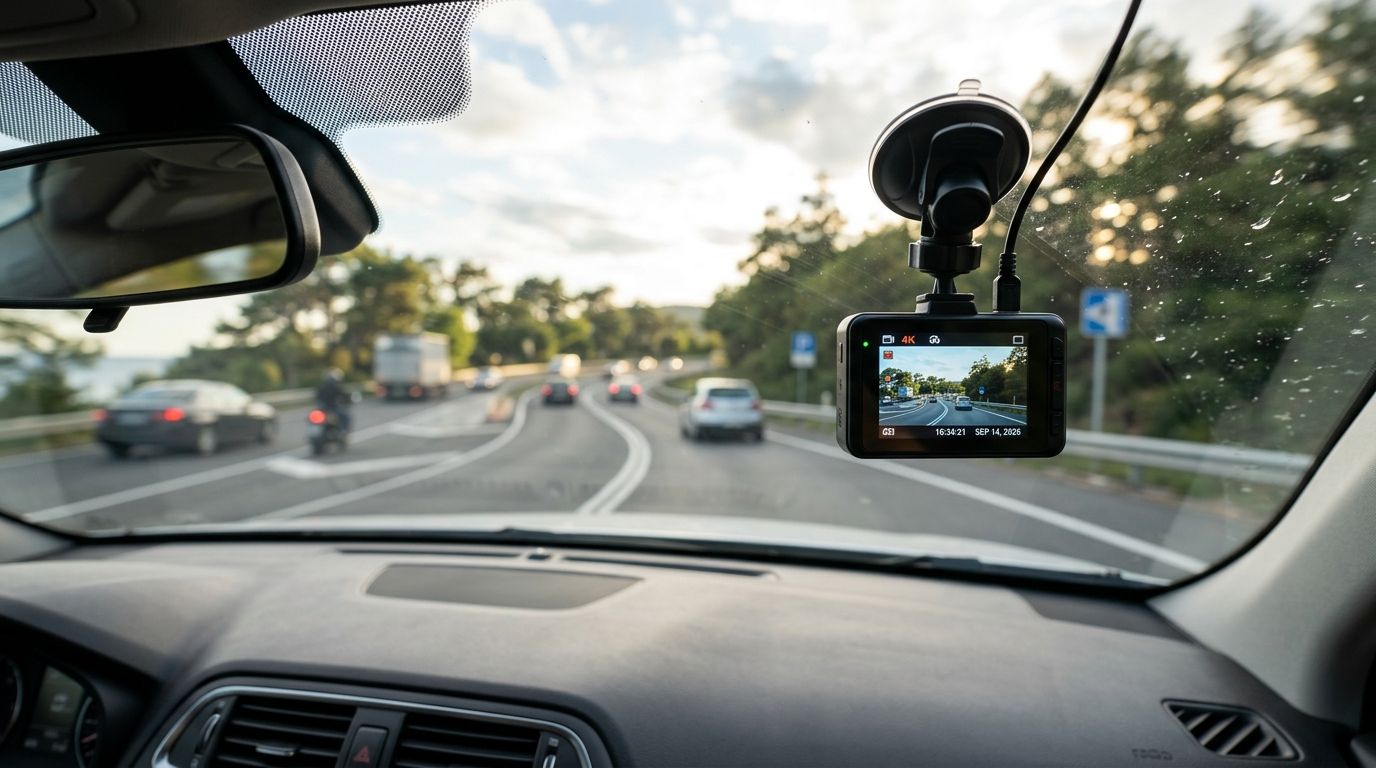
A 1080p dash cam gets you a police report. A 4K dash cam with a real Sony sensor gets you a license plate a court can read. That gap is the whole story in 2026, and it decides which model belongs on your windshield.
- Viofo A139 Pro wins best dash cam video quality overall with a 4K front channel and Sony STARVIS 2 sensor.
- Vantrue N4 is the pick for three-camera coverage — front, cabin, and rear in one setup.
- Nextbase 622GW leads on night driving with in-cabin stabilization at 4K.
- Garmin Dash Cam 67W is the budget option at 1440p with a 180-degree field of view.
- Florida glare and heat punish weak sensors and cheap adhesive mounts — sensor quality and stabilization matter more here than in most states.
Why this matters
Dash cam footage is only useful if it's sharp enough to read a plate, a face, or a lane line after the fact. Cheap 1080p units with small sensors turn to mush in low light or direct sun — exactly the conditions Southwest Florida drivers deal with year-round.
Insurance adjusters and police in Cape Coral and Fort Myers see blurry dash cam clips constantly, and a soft clip settles disputes in nobody's favor. If you're cross-shopping models built for dash cams for Florida drivers, video quality — not app features — is the number one filter.
What makes the best dash cam video quality in 2026
- Sensor type — Sony STARVIS or STARVIS 2 sensors outperform generic CMOS chips in low light and glare
- Resolution — 4K UHD (3840x2160) resolves plates and signage at distance; 1440p and 1080p lose detail past 20-30 feet
- HDR/WDR processing — handles sun glare and headlight flare without blowing out the frame, critical for I-75 and US-41 sun angles
- Stabilization — reduces the shake from rough pavement and speed bumps that turns footage into a blur
- Channel count — front-only, front+rear, or three-channel (adds a cabin view) changes what the footage can prove
- Storage and loop recording reliability — higher bitrate 4K files eat cards faster and need a proper high-endurance microSD
Dash cams ranked by video quality: at a glance
| Dash Cam | Best For | Standout Feature | Key Limitation |
|---|---|---|---|
| Viofo A139 Pro | Overall video quality | Sony STARVIS 2 sensor, 4K front + built-in GPS | Rear cam resolution drops to 2K |
| Vantrue N4 | Three-camera coverage | 4K front, 1440p cabin, 1080p rear in one unit | Wide cabin lens adds mild distortion |
| Nextbase 622GW | Night driving, stabilization | 4K with in-cabin image stabilization | Cloud emergency features need a subscription |
| BlackVue DR900X Plus | Parking mode, cloud alerts | 4K Sony sensor with Wi-Fi/LTE cloud option | No onboard screen — app-only viewing |
| Garmin Dash Cam 67W | Budget daily driving | 1440p resolution, 180-degree field of view | Softer night footage than the 4K models above |
1. Viofo A139 Pro: best dash cam video quality overall
The A139 Pro pairs a Sony STARVIS 2 sensor with a 4K UHD front channel, which is the combination that actually separates sharp footage from mush after dark. It includes a built-in GPS logger for speed and location stamping, and its HDR processing handles the low sun angles that hit windshields on Southwest Florida commutes.
Viofo A139 Pro pros:
- Sharpest overall front-channel footage in this ranking
- Sony STARVIS 2 sensor performs well in low light and glare
- Built-in GPS without a separate accessory
Viofo A139 Pro cons:
- Rear channel resolution is capped at 2K, a step down from the front
- No native cellular or cloud connectivity
- Companion app pairing can lag in direct sunlight
Best for: drivers who want the single sharpest front-facing recording and nothing else to configure. Verdict: Buy.
2. Vantrue N4: best dash cam for three-camera coverage
The N4 records 4K on the front lens, 1440p on the interior-facing lens, and 1080p on the rear camera, all from one three-channel unit. That's the setup you want if you drive for a rideshare platform or just want cabin coverage alongside the road.
Vantrue N4 pros:
- Only three-channel option in this ranking with 4K on the front lens
- Cabin lens doubles as a passenger-facing camera for rideshare use
- Single unit keeps wiring simpler than three separate cameras
Vantrue N4 cons:
- Wide cabin lens introduces some edge distortion
- Housing is bulkier than single or dual-channel units
- Rear camera footage is the weakest of the three lenses
Best for: rideshare and delivery drivers who need interior and exterior proof in one file. Verdict: Buy.
3. Nextbase 622GW: best dash cam for night driving and stabilization
The 622GW shoots 4K with in-cabin electronic image stabilization, which smooths out the shake from rough Florida road patches and railroad crossings. Its low-light mode is built specifically to pull detail out of dark residential streets, and it includes built-in Alexa for hands-free control.
Nextbase 622GW pros:
- Stabilization keeps 4K footage watchable on rough pavement
- Strong low-light detail recovery
- Alexa voice control reduces in-cab distraction
Nextbase 622GW cons:
- Emergency cloud-connect features require a paid Nextbase Cloud plan
- Single-channel by default; rear camera is a separate purchase
- Higher-end unit compared to the other cams here
Best for: night-shift and highway drivers who want smooth, stable 4K footage. Verdict: Buy.
4. BlackVue DR900X Plus: best dash cam for parking mode and cloud alerts
The DR900X Plus records 4K UHD off a Sony sensor and adds Wi-Fi and optional LTE cloud connectivity, so it can push motion alerts and live view to your phone while the car is parked. It's built for people who worry about their vehicle sitting overnight, not just what happens while driving.
BlackVue DR900X Plus pros:
- 4K resolution with strong low-light Sony sensor performance
- Cloud connectivity for remote parking mode alerts
- No physical screen keeps the mount low-profile
BlackVue DR900X Plus cons:
- Full remote features need an active cloud subscription
- No onboard display means setup happens entirely through the app
- Hardwired parking mode requires a proper hardwire kit install
Best for: drivers who park on the street or in shared lots and want overnight alerts. Verdict: Buy.
5. Garmin Dash Cam 67W: best budget dash cam for daily driving
The 67W tops out at 1440p but covers a 180-degree field of view, which is wider than most of the 4K units above. It's compact, voice-controlled, and built for people who just want reliable footage without managing a subscription or a bulky three-camera rig.
Garmin Dash Cam 67W pros:
- Widest field of view in this ranking at 180 degrees
- Compact, low-profile mount
- Voice control for hands-free operation
Garmin Dash Cam 67W cons:
- Night footage is noticeably softer than the 4K Sony-sensor cams above
- No bundled rear camera at this resolution tier
- 1440p resolves plates at a shorter distance than 4K
Best for: daily commuters who want dependable coverage without the 4K price bracket. Verdict: Buy if budget-capped, otherwise step up.
How this ranking was built
Each cam is scored against the six criteria above: sensor type, resolution, HDR/WDR handling, stabilization, channel count, and storage reliability. The Viofo A139 Pro and Vantrue N4 lead because they pair a proven Sony sensor with true 4K capture; the Garmin 67W ranks lower on raw resolution but wins on field of view and simplicity.
If you want a wider view of the road plus the sides in one camera rather than a narrow forward lens, models built around 360-degree camera systems solve a different problem than straight-line video quality — worth knowing before you commit to one format.
“A 1080p dash cam is fine for an insurance report; a 4K dash cam is what actually gets a plate read.”
Which dash cam should you choose in 2026?
For most Cape Coral and Fort Myers drivers, the Viofo A139 Pro is the default pick — 4K front resolution, a Sony STARVIS 2 sensor, and built-in GPS cover the majority of use cases without extra subscriptions. If you need interior coverage for rideshare work, move to the Vantrue N4. If your budget caps out below the 4K tier, the Garmin Dash Cam 67W still beats a no-name 1080p unit on field of view alone.
Any of these need real GPS logging for speed and route proof — if that's a priority, compare options built specifically as dash cams with GPS tracking before you order.
Get your dash cam installed right
Hardwired installs, hidden wiring, same-day service in Cape Coral.
FAQ
What's the best dash cam for video quality in 2026?
The Viofo A139 Pro ranks best overall for video quality in 2026 thanks to its Sony STARVIS 2 sensor and 4K UHD front channel. It handles glare and low light better than the 1080p and standard-CMOS cams in this comparison.
Is a 4K dash cam worth it over 1080p?
Yes, if reading plates or faces at distance matters — 4K resolves far more detail than 1080p once footage is zoomed. For basic accident documentation at close range, 1440p or 1080p is usually enough.
How long does dash cam installation take?
A single-channel hardwired install typically takes under an hour. Three-channel setups that route wiring through the pillars and headliner for a clean, hidden look take longer.
What resolution do I need to read license plates on a dash cam?
4K UHD footage resolves plates at a noticeably greater distance than 1080p or 1440p. If plate capture on a moving vehicle matters to you, prioritize a 4K sensor over field of view or extra features.
Does dash cam footage hold up in Florida heat and sun?
Cameras with strong HDR/WDR processing, like the Viofo A139 Pro and BlackVue DR900X Plus, handle harsh sun glare on Florida windshields better than budget units. Heat also stresses adhesive mounts, so a hardwired professional install matters as much as the camera itself.
Is the Vantrue N4 or Viofo A139 Pro better for three-camera coverage?
The Vantrue N4 is the only true three-channel option in this ranking, covering front, cabin, and rear in one unit. The A139 Pro is sharper on the front channel alone but doesn't include a cabin-facing lens.
Do I need GPS on a dash cam?
GPS logging adds speed and location data to footage, which strengthens insurance and legal claims. It's not required for basic accident documentation but is worth prioritizing if you drive for work.
What's the difference between HDR and WDR on a dash cam?
Both technologies balance bright and dark areas in the same frame, like a sunlit road against a shaded overpass. HDR and WDR processing quality varies by brand, and it's what keeps footage usable instead of blown-out white or crushed black.
One last thing
The sensor matters more than the marketing number. A 4K dash cam with a weak sensor can still look worse at night than a 1440p unit with a Sony STARVIS chip — resolution is only half the video quality equation in 2026, and the spec sheet won't tell you which half you're getting.