Florida's dashboard heat, hit-and-run rates, and sudden downpours make a dash cam less of a gadget and more of a documentation tool. Vantrue N4 wins best overall for Southwest Florida heat, Nextbase 622GW wins for insurance claims and emergency response, and Garmin Mini 2 wins on budget for drivers who just want basic coverage.
- Vantrue N4's capacitor design holds up better than lithium-battery cameras when a car sits in Cape Coral sun all day.
- Nextbase 622GW adds Emergency SOS and what3words location tagging, useful after a Fort Myers-area collision.
- Garmin Mini 2 is the smallest, simplest option for drivers who want front-facing coverage without touchscreen menus.
- Thinkware Q200 handles parking-mode heat exposure well for cars parked outdoors during Florida summers.
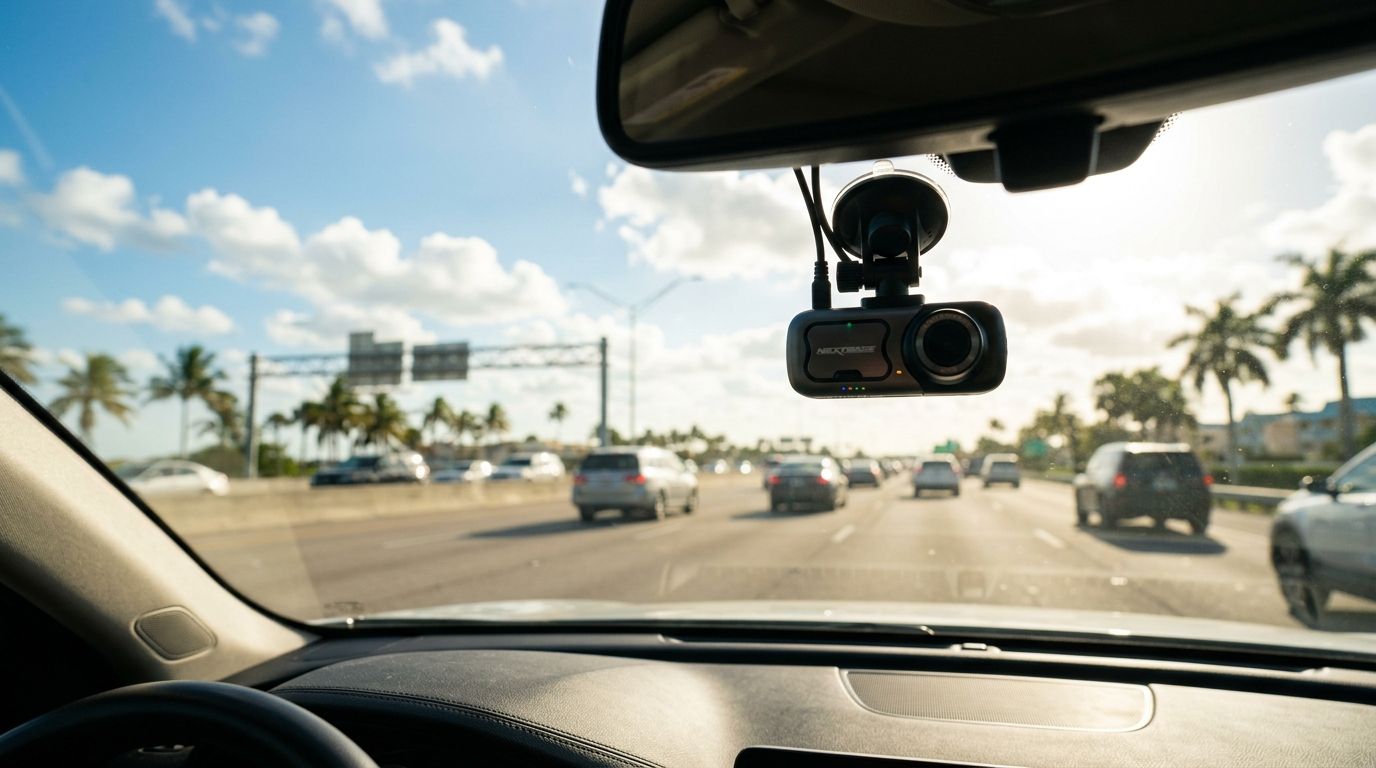
- Professional hardwired installation avoids the dangling cord and windshield suction cup that fail in extreme heat.
Why this matters
A dash cam mounted on a Florida windshield sits through 90-plus degree days for months at a time. Cheap units with lithium batteries swell or shut down in that heat; the camera that looked fine in a review from a cooler climate can fail here by August.
Florida also has a real hit-and-run problem, and insurance adjusters increasingly ask for footage before approving a claim. A dash cam that actually survives the dashboard and captures a clear plate number is worth more than one with a longer spec sheet. Auto Sound Cape Coral installs dash cams hardwired into the fuse box, which keeps the unit running in parking mode without a battery drain or a cord across the windshield.
What makes the best dash cam for Florida drivers
- Heat tolerance — capacitor-powered units outlast lithium-battery units on a hot dashboard
- Parking mode — records motion or impact events while the car sits in a lot or driveway
- Video quality in glare — Florida sun and wet roads punish cheap sensors; look for wide dynamic range
- GPS and speed stamping — useful for insurance disputes and traffic citations
- App or cloud connectivity — lets you pull footage without removing the SD card
- Mounting and install quality — a suction-cup unit with a visible cord is easier to dislodge and looks worse than a hardwired setup
Dash cams for Florida drivers at a glance
| Dash Cam | Best For | Standout Feature | Key Limitation |
|---|---|---|---|
| Vantrue N4 | Overall Florida heat resistance | Capacitor power, three-channel (front/cabin/rear) recording | Bulkier housing than single-lens cameras |
| Nextbase 622GW | Insurance claims and emergencies | Emergency SOS with what3words location tagging | Touchscreen glare is worse in direct sun |
| Garmin Mini 2 | Budget and simplicity | Compact size, minimal wiring visible on the glass | No screen — setup happens through a phone app |
| Thinkware Q200 | Parking mode in hot, exposed parking | Energy-efficient parking surveillance mode | Single front-facing lens only |
| BlackVue DR970X | Cloud access and rideshare use | Cloud upload lets you check footage remotely | Requires a data plan or Wi-Fi for cloud features |
1. Vantrue N4: best dash cam for Florida heat and daily driving
The N4 runs on a capacitor instead of a lithium-ion battery, which is the single biggest reason it holds up better on a Cape Coral dashboard than most competitors. Capacitors tolerate heat cycling far better than lithium cells, so the camera keeps working through a summer of 140-degree dashboard temperatures instead of shutting off or degrading.
It records three channels at once — front, cabin, and rear — which matters for rideshare drivers and anyone who wants a clear record of what happened inside the car, not just outside it.
Vantrue N4 pros:
- Capacitor power survives Florida heat better than battery-based units
- Three-channel recording covers front, interior, and rear simultaneously
- Wide dynamic range handles glare off wet roads and windshields
Vantrue N4 cons:
- Bulkier housing partially blocks a slice of the windshield
- Three camera cables make for a busier install than a single-lens unit
Best for: drivers who park outside daily and want the camera to still work in September. Verdict: Buy.
2. Nextbase 622GW: best dash cam for insurance claims and hit-and-runs
The 622GW's Emergency SOS feature detects a serious impact and can alert emergency contacts with a what3words location tag — a real advantage on Southwest Florida's back roads where a street address alone doesn't pinpoint a crash site fast enough.
It also has image stabilization built for shaky Florida roads and construction zones common on US-41 and I-75 stretches through Fort Myers.
Nextbase 622GW pros:
- Emergency SOS with automatic location sharing after a crash
- Built-in image stabilization for rough pavement
- Touchscreen menu is easier to navigate than button-based competitors
Nextbase 622GW cons:
- Touchscreen visibility drops in direct afternoon sun
- Higher power draw than capacitor-based cameras during parking mode
Best for: drivers who want documentation ready to hand an insurance adjuster or police officer immediately after a collision. Verdict: Buy.
3. Garmin Mini 2: best dash cam for a simple, budget setup
The Mini 2 is built for drivers who just want a camera running and don't want to think about it again. It's small enough to sit behind the rearview mirror without blocking sightlines, and setup happens entirely through the Garmin Drive app rather than an onboard screen.
It won't compete with pricier units on features, but it does the core job: continuous front-facing recording with automatic loop overwrite.
Garmin Mini 2 pros:
- Small footprint keeps the windshield view clear
- Simple app-based setup with no onboard menu to learn
- Good option for a second vehicle or a beater that still needs coverage
Garmin Mini 2 cons:
- No built-in screen for quick playback
- Single front lens only — no rear or cabin option
Best for: drivers who want basic front-facing coverage without paying for features they won't use. Verdict: Buy for budget-focused drivers, Skip if you need cabin or rear coverage.
4. Thinkware Q200: best dash cam for hot, exposed parking
The Q200 is built around an energy-efficient parking mode that watches for motion or impact while the car sits for hours in a hot parking lot — a common scenario at Southwest Florida beaches and shopping centers where cars bake for a full afternoon.
It's a single front-facing lens, so it's a step down in coverage from the N4 or 622GW, but it's a reasonable pick for a driver who mainly worries about parking lot dings and theft.
Thinkware Q200 pros:
- Efficient parking-mode monitoring designed for extended heat exposure
- Straightforward front-facing recording with minimal setup
Thinkware Q200 cons:
- No rear or cabin camera option
- Fewer smart-alert features than Nextbase or Vantrue
Best for: drivers whose main concern is parking lot incidents rather than driving footage. Verdict: Hold — fine if parking coverage is the priority, otherwise the N4 does more.
5. BlackVue DR970X: best dash cam for cloud access and rideshare
The DR970X's cloud connectivity lets you pull up footage remotely through a phone, which matters for rideshare and delivery drivers who need to check on their vehicle without physically retrieving the SD card. It's the most connected option on this list.
That connectivity comes with a tradeoff: it needs Wi-Fi or a data connection to make full use of the cloud features, which adds a recurring dependency the other cameras don't have.
BlackVue DR970X pros:
- Remote cloud access to footage without removing the SD card
- Strong resolution for capturing plate numbers at a distance
BlackVue DR970X cons:
- Cloud features require a data connection to function
- More expensive setup process than plug-and-play units
Best for: rideshare and delivery drivers who need to check footage remotely. Verdict: Buy for connected use cases, Skip if you don't need remote access.
How we ranked these dash cams
Each camera was weighed against the six criteria above, with heat tolerance and parking-mode reliability weighted heaviest since those are the two failure points most specific to Florida. Insurance and legal usefulness — GPS stamping, emergency alerts, footage clarity — came second. Price wasn't part of the ranking; check current pricing directly with a retailer or installer since it changes.
Get a dash cam installed right
Hardwired installs in Cape Coral and Fort Myers, no dangling cords or suction cups.
Which dash cam should you choose in 2026?
For most Southwest Florida drivers, the Vantrue N4 is the safest default in 2026 — it's built to survive the heat that kills cheaper cameras within a year. If you specifically want faster response after a crash, the Nextbase 622GW's Emergency SOS feature earns its spot. If budget is the deciding factor and you just want something running, the Garmin Mini 2 covers the basics without extra cost.
Whatever camera you pick, a hardwired install matters as much as the unit itself. A cord tucked into the headliner and a fuse-box tap keep the camera protected and out of sight, instead of relying on a suction cup that softens in a hot windshield.
“If the camera can't survive a Florida summer on the dash, it's not a dash cam — it's a paperweight with a lens.”
FAQ
What's the best dash cam for Florida heat?
The Vantrue N4 is the best dash cam for Florida heat in 2026 because it runs on a capacitor instead of a lithium battery, which holds up better through repeated hot-dashboard cycles. Lithium-battery cameras are more prone to shutting down or swelling after a Florida summer.
Is a hardwired dash cam better than a plug-in one?
Yes, a hardwired dash cam is more reliable because it draws power from the fuse box instead of a cigarette-lighter plug, which keeps parking mode running without a visible cord. It also looks cleaner and avoids a dangling wire across the windshield.
Do dash cams help with insurance claims in Florida?
Dash cam footage helps insurance claims by giving adjusters a clear record of who was at fault, which speeds up claims after a Florida hit-and-run or fender-bender. Cameras with GPS and speed stamping, like the Nextbase 622GW, add extra data adjusters can use.
Is it legal to record with a dash cam in Florida?
Video recording of public roads with a dash cam is standard practice in Florida since there's no expectation of privacy on a public street. Florida is a two-party consent state for audio recording, so some drivers disable in-cabin audio to stay cautious.
How much does dash cam installation cost?
Installation cost depends on the camera model and whether it's a single front-facing unit or a multi-channel setup with front, rear, and cabin lenses. Check current pricing directly with an installer since it varies by vehicle and wiring complexity.
Do dash cams work in parking mode without draining the car battery?
A properly wired dash cam with a parking-mode circuit, like the Thinkware Q200 or Vantrue N4, is built to draw minimal power and shouldn't drain a healthy car battery overnight. A cheap plug-in unit without a dedicated parking mode is more likely to cause battery drain.
What resolution should a Florida dash cam record in?
A minimum of 1440p is worth looking for since it captures license plate numbers clearly at highway speed, which matters most in hit-and-run situations. Lower-resolution units often blur plates enough to make them useless as evidence.
One last thing
The camera spec sheet matters less than the mounting job in Florida — a suction-cup dash cam on a windshield that hits 160-plus degrees in direct sun during a parked afternoon is the most common failure point, not the electronics inside it.