
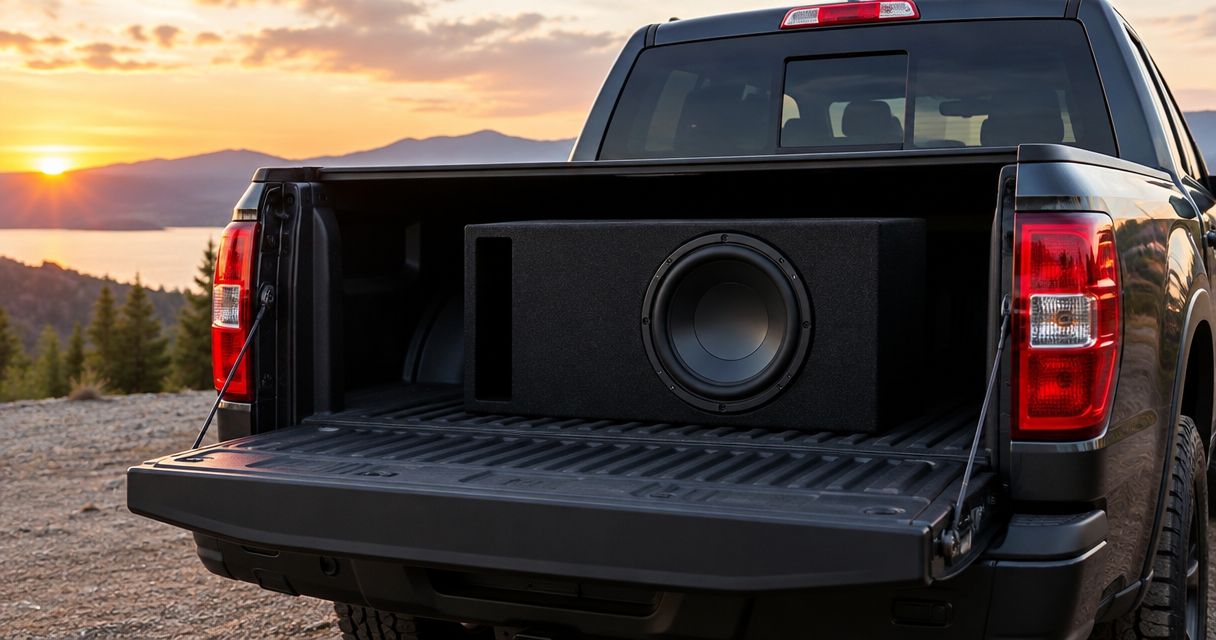
Best overall for a daily driver: a truck-specific sealed under-seat enclosure that matches your subwoofer. Best for output-focused builds: a correctly tuned, truck-specific ported enclosure. Best simple option: a securely mounted compact sealed box. This 2026 guide ranks the best subwoofer enclosures for trucks by cabin layout, speaker requirements, and the space you need to keep usable.
- The best subwoofer enclosures for trucks match the exact cab layout and the subwoofer’s required airspace.
- Choose a truck-specific sealed under-seat enclosure for a daily driver when fit and speaker compatibility are confirmed.
- Choose a ported enclosure for output near its tuning frequency, not simply because it looks bigger.
- Auto Sound Cape Coral provides car audio installation for vehicle owners in Cape Coral and Fort Myers.
Why this matters
A truck box has two jobs: give the subwoofer the right acoustic environment and fit without interfering with the truck. A box that slides under the seat can still be wrong for the speaker inside it.
Auto Sound Cape Coral is a local car audio installation option for truck owners in Cape Coral and Fort Myers. If you want installation help, start with Auto Sound Cape Coral and bring your truck details, subwoofer model, and amplifier information.
For a 2026 upgrade, decide what must stay usable before choosing equipment. Rear seats, storage trays, seat latches, and access to tools all belong in that decision.
What makes the best truck subwoofer enclosure?
- Exact vehicle fit: Match the truck’s model year, cab style, seat layout, and any factory storage equipment. A vehicle name alone is not enough.
- Correct net airspace: Use the subwoofer manufacturer’s enclosure requirements. External dimensions do not tell you the usable volume inside.
- Speaker clearance: Check mounting depth, cutout diameter, magnet clearance, and room for cone movement. A shallow box does not make every speaker fit.
- Suitable enclosure design: Sealed and ported designs serve different priorities. A ported box also needs the correct tuning and port clearance.
- Secure installation: Keep the enclosure fixed in place without obstructing seat hardware, wiring, or required access. Loose equipment does not belong in a moving truck.
- System compatibility: Match the subwoofer wiring and amplifier load. The enclosure cannot correct an incompatible electrical setup.
Best truck subwoofer enclosures at a glance
These are enclosure configurations, not named products. Each recommendation below has a different use case; the ranking is a starting point for choosing a layout, not a claim that one box fits every truck.
| Rank and enclosure | Best for | Standout feature | Key limitation |
|---|---|---|---|
| 1. Truck-specific sealed under-seat enclosure | Daily drivers keeping rear-seat use | Uses space beneath the rear seat | Height and net airspace restrict speaker choices |
| 2. Truck-specific ported enclosure | Builds prioritizing bass output near tuning | Port contributes acoustic output | Port and airspace requirements complicate fit |
| 3. Behind-seat sealed enclosure | Cabs with usable space behind the seat | Leaves the floor area available | Seat movement and mounting depth need close checks |
| 4. Vehicle-specific molded enclosure | Irregular storage areas | Follows a shaped cavity | Fit depends on the exact vehicle configuration |
| 5. Compact standalone sealed enclosure | Flexible layouts with a secure mounting location | Straightforward box geometry | Occupies exposed cabin or cargo space |
1. Sealed under-seat enclosure: best for daily-driver trucks
A truck-specific sealed under-seat enclosure places the subwoofer beneath the rear seat in compatible cab layouts. Its enclosed air volume works with the speaker’s suspension; the correct volume depends on the driver you choose.
For a 2026 daily-driver build, this is the default configuration to check first. You keep the main seating area available, provided the box clears the seat in its normal operating positions.
Sealed under-seat enclosure pros:
- Uses an otherwise constrained area beneath the seat.
- Avoids the port-sizing and tuning requirements of a vented box.
- Keeps the enclosure away from the main footwell when properly fitted.
- Supports a concealed installation without requiring a large exposed cabinet.
Sealed under-seat enclosure cons:
- Limited height restricts mounting depth and cone clearance.
- Factory storage trays or seat hardware can block installation.
- Available net volume does not suit every subwoofer.
Do not choose the speaker by diameter alone. A shallow-mount driver still needs its specified airspace, and its basket must clear the box walls. Check the enclosure’s supported mounting orientation as well.
Best for: Truck owners who want added bass while retaining normal rear-seat use.
Verdict: Buy a sealed under-seat enclosure only after confirming exact vehicle fit and the subwoofer’s enclosure requirements.
2. Truck-specific ported enclosure: best for output-focused builds
A ported enclosure uses a vent that contributes output around the system’s tuning frequency. The driver, net volume, port dimensions, and tuning work together; changing one changes the result.
Choose this layout when bass output is a higher priority than keeping the smallest possible box. A ported enclosure is not automatically better than a sealed enclosure, and an undersized vented box is not a shortcut to stronger bass.
Truck-specific ported enclosure pros:
- Adds port output near the intended tuning frequency.
- Provides a distinct alternative when a sealed design does not match your listening goal.
- Can fit an under-seat or other truck-specific location when properly designed.
Truck-specific ported enclosure cons:
- The port occupies space that must be included in the design.
- Poor port sizing can create audible air noise.
- Below-tuning operation requires attention to driver excursion and filtering.
For a 2026 ported build, ask for the enclosure’s net volume and tuning specification before selecting the subwoofer. Also check how close the port opening sits to a seat cushion, trim panel, or other obstruction.
The amplifier needs to suit the finished speaker load, not just the advertised speaker size. The car amplifier comparison is a separate starting point for that part of the system.
Best for: Truck owners prioritizing bass output who have room for the required enclosure and port.
Verdict: Buy a ported enclosure with documented driver compatibility and tuning; skip an unspecified vented box.
3. Behind-seat sealed enclosure: best for keeping the floor clear
A behind-seat sealed enclosure uses the space between the seat and the rear cab wall. It is a useful configuration in trucks where that area has enough depth and does not contain conflicting equipment.
Measure with the seat in the position you actually use. A box that fits only when the driver sits farther forward is not a good fit for the truck.
Behind-seat sealed enclosure pros:
- Leaves the main floor area available.
- Offers an alternative when under-seat space is blocked.
- Avoids a port opening that needs additional clearance.
Behind-seat sealed enclosure cons:
- Thin layouts restrict driver depth and internal volume.
- Seat movement can bring upholstery close to the speaker.
- Rear-wall trim, wiring, or factory equipment can reduce usable space.
Check the full seat adjustment range you need, not just whether the door closes. If the speaker faces the seat, confirm that the cone and surround cannot contact the upholstery during operation.
A protective grille helps protect the driver from contact, but it also takes space. Include its depth in the fit check rather than adding it after the enclosure is mounted.
Best for: Truck owners with usable rear-wall space who need the floor area clear.
Verdict: Buy only after checking seat travel, speaker clearance, and a secure mounting method.
4. Vehicle-specific molded enclosure: best for irregular spaces
A molded enclosure follows the shape of a particular storage area or body cavity. It can use contours that a rectangular box cannot follow closely.
The shape does not prove that the enclosure is acoustically suitable. You still need the actual net volume, supported driver dimensions, and exact vehicle fitment.
Vehicle-specific molded enclosure pros:
- Follows irregular spaces rather than relying on a rectangular footprint.
- Can keep the enclosure away from the main passenger area.
- Provides a defined location for the speaker when fitment is correct.
Vehicle-specific molded enclosure cons:
- Different trim levels or storage layouts can prevent a fit.
- Speaker substitutions remain limited by volume and mounting geometry.
- Access to equipment behind the enclosure needs checking.
For a 2026 purchase, verify compatibility against the truck’s actual interior. Listing photos are not a substitute for checking factory storage, seat brackets, and trim differences.
Ask how the enclosure attaches and whether it blocks access to tools or vehicle equipment. For car audio installation with Auto Sound Cape Coral, bring those access requirements into the discussion before choosing the layout.
Best for: Truck owners trying to use a specific shaped cavity without a box extending into the main cabin.
Verdict: Buy when exact fitment, mounting details, and compatible speaker specifications are documented.
5. Compact standalone sealed enclosure: best for flexible layouts
A compact standalone sealed enclosure is a separate box placed in a suitable cabin or cargo location. Its straightforward shape makes the fit requirements easier to inspect, but the truck still needs a safe mounting location.
This is the simple option when preserving every inch of cabin space is not your main goal. It also separates the enclosure choice from a particular under-seat or behind-seat molding.
Compact standalone sealed enclosure pros:
- Straightforward geometry makes dimensions easy to check.
- Offers placement choices where the truck has suitable space.
- Avoids port clearance and tuning requirements.
Compact standalone sealed enclosure cons:
- Takes space otherwise used for passengers or cargo.
- Needs secure mounting; resting it on the floor is not enough.
- An exposed speaker needs protection from nearby objects.
Do not assume a cab enclosure belongs in an open truck bed. Weather exposure changes the requirements for the speaker, enclosure materials, terminals, and wiring.
If you need occasional access to the mounting area, plan how the equipment disconnects safely. Easy removal should not mean loose wiring or an unsecured box during normal driving.
Best for: Truck owners with usable space who prefer a straightforward enclosure layout.
Verdict: Buy if the box matches the driver and you can secure it without sacrificing necessary seating or access.
Check fit before choosing the subwoofer
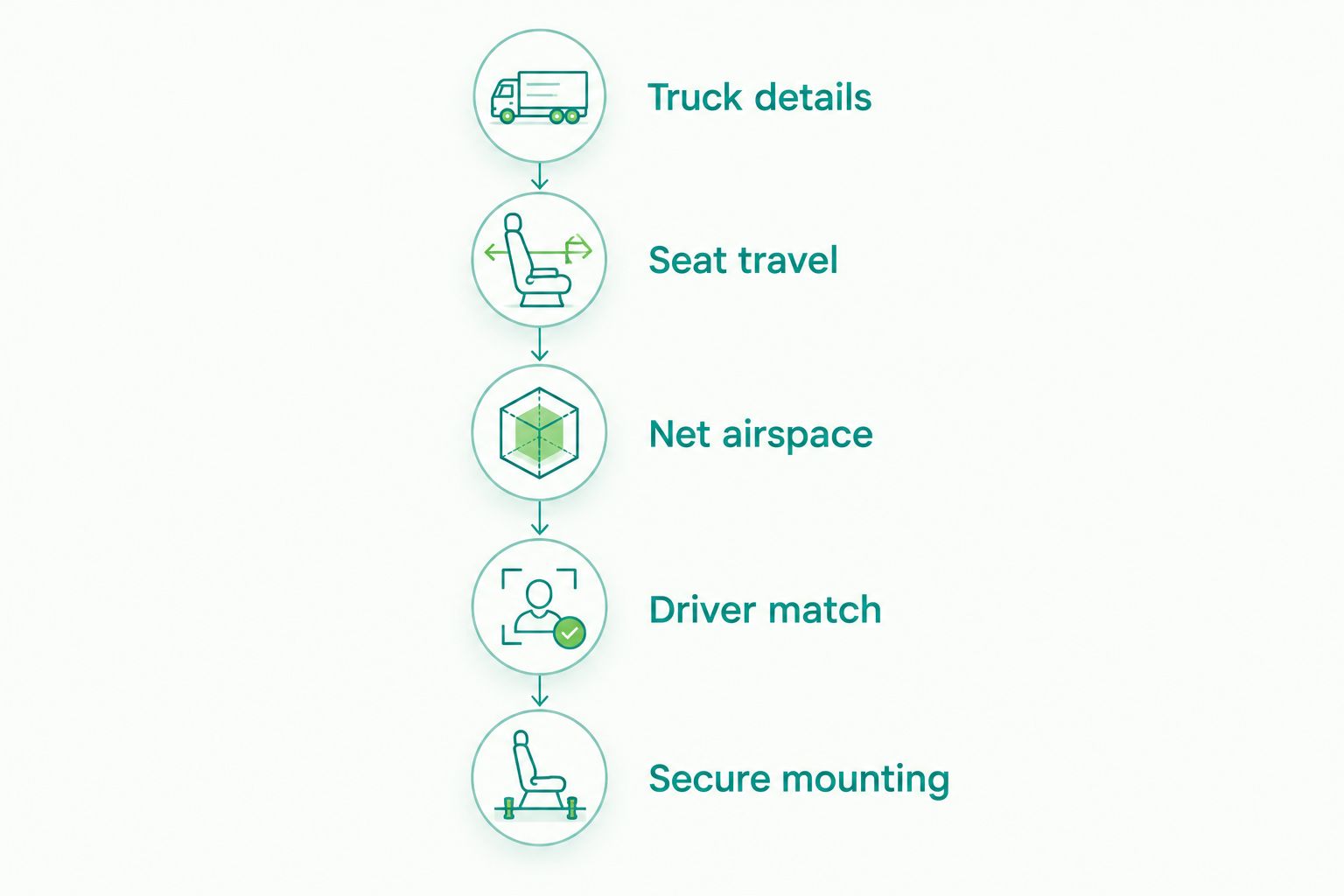
Use this sequence for a 2026 truck build. It prevents a common mismatch: buying a driver first, then trying to force its required enclosure into the remaining space.
- Truck details: Record the exact vehicle configuration and inspect the intended mounting area.
- Seat travel: Move the seats through the positions you need and identify hardware that must stay clear.
- Net airspace: Confirm usable internal volume after the relevant displacements are accounted for.
- Driver match: Check mounting depth, cutout size, clearance, and enclosure recommendations.
- Secure mounting: Decide how the finished enclosure attaches without interfering with vehicle systems.
The order matters. Once you know the available space, you can choose a compatible driver instead of treating the enclosure as an afterthought.
Read volume specifications correctly
A box’s outside measurements are not its net internal volume. Wall thickness reduces the space inside, while the driver, bracing, and port occupy additional volume as applicable.
The unit conversions are fixed: 1 cubic foot equals 1,728 cubic inches, and 1 cubic foot is approximately 28.3 liters. Use those conversions when comparing specifications, but do not mistake a unit conversion for a compatibility check.
Ask whether a listed figure is gross internal volume or net airspace. Then compare the correct figure with the subwoofer manufacturer’s enclosure recommendation.
Discuss your truck audio installation
Bring your truck details, subwoofer model, and amplifier information to the installation discussion.
How these enclosure configurations are ranked
The ranking prioritizes daily-driver fit, correct acoustic requirements, preserved cabin use, and secure installation. It does not claim measured output differences between unnamed products.
A sealed under-seat enclosure leads because it is the first layout to check when keeping rear-seat use matters. Ported, behind-seat, molded, and standalone designs move ahead when their specific use case matches your truck better.
Which truck subwoofer enclosure should you choose?
Start with a truck-specific sealed under-seat enclosure for a daily driver, then confirm the driver match. Choose ported when output near tuning takes priority, behind-seat when floor space matters, molded when an irregular cavity is available, and standalone when you have a suitable mounting area.
For your 2026 upgrade, give Auto Sound Cape Coral the full vehicle configuration rather than just the truck’s name. The enclosure, subwoofer, amplifier, and installation location need to work as one system.
FAQ
What are the best subwoofer enclosures for trucks?
The best subwoofer enclosures for trucks match the exact cab layout and the subwoofer’s specified enclosure requirements. A truck-specific sealed under-seat enclosure is the first configuration to check for a daily driver that needs normal rear-seat use.
Is a sealed or ported subwoofer box better in a truck?
A sealed box is the simpler starting point for a space-constrained truck installation; a ported box serves an output-focused build when its volume and tuning suit the driver. Neither design is automatically better in every truck.
Can any shallow subwoofer fit under a truck seat?
No, shallow mounting depth alone does not establish compatibility. Check cutout diameter, magnet clearance, cone clearance, net airspace, and the enclosure manufacturer’s fitment information.
Does a bigger truck subwoofer box sound better?
A bigger box is not automatically better. The enclosure must match the driver’s requirements, and a ported design must also have suitable tuning and port dimensions.
Can I put a subwoofer box behind my truck seat?
Yes, if the available space supports the enclosure and leaves the required seat movement and speaker clearance. Check rear-wall equipment and secure mounting before choosing the box.
Can I leave a subwoofer enclosure loose under the seat?
No, the enclosure needs secure mounting. A box that fits beneath the seat can still move or interfere with hardware if it is not attached correctly.
Does Auto Sound Cape Coral install car audio?
Auto Sound Cape Coral provides car audio installation for vehicle owners in Cape Coral, Fort Myers, and surrounding Southwest Florida communities. Discuss the truck configuration and intended equipment before choosing an enclosure.
One last thing
Check the seat latch after the enclosure is in position, not just the seat cushion. A box can clear the upholstery and still block a latch, storage compartment, or access point you need.
Make the truck usable first. Then choose the bass setup that fits it.