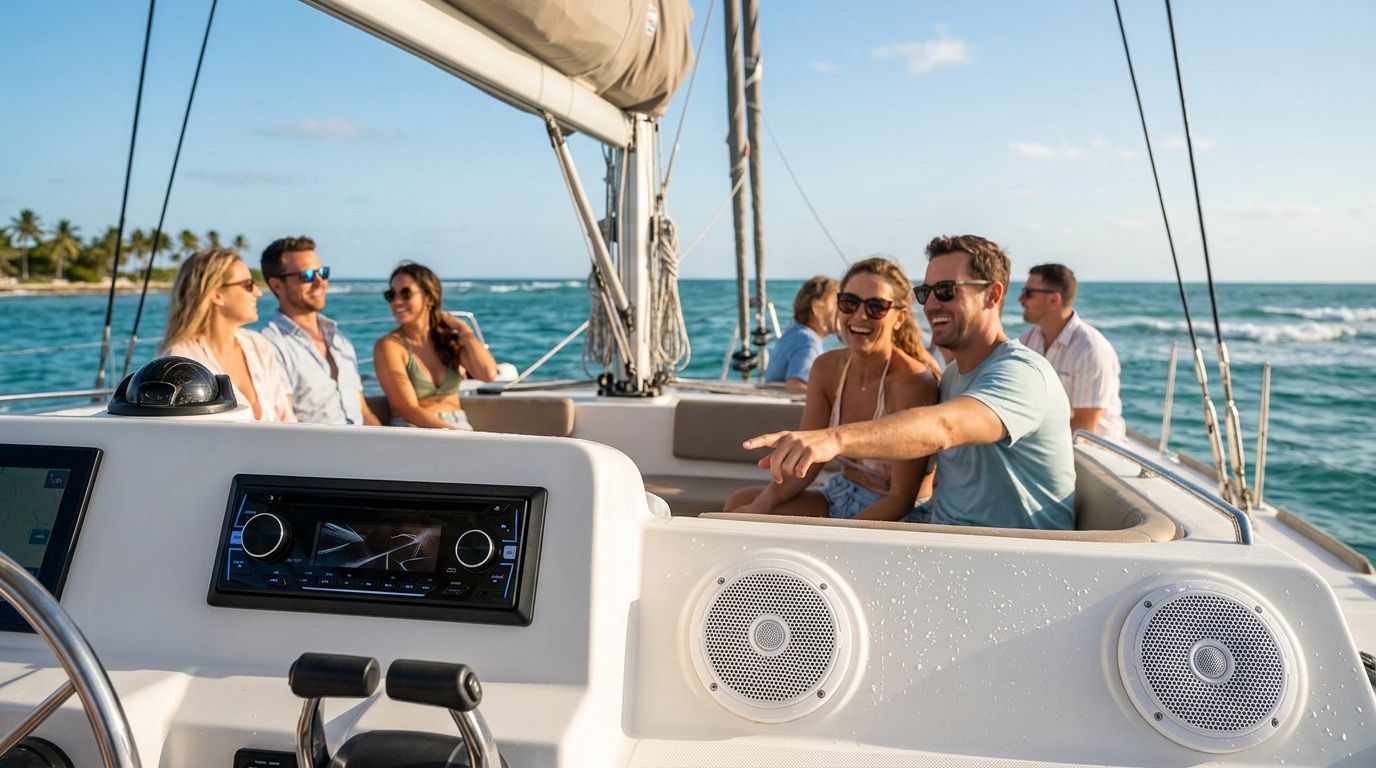
Marine audio for charter boats is a sound system built to survive daily saltwater spray, full-sun UV, and constant vibration, with the goal of keeping music and passenger announcements running through every trip without a mid-charter failure. A weekend pontoon owner can baby a head unit through one winterization a year; a six-passenger charter boat running two trips a day during Southwest Florida's 2026 tourist season cannot afford that same fragility.
Auto Sound Cape Coral installs marine audio built for that daily-use reality rather than gear pulled off a car-audio shelf and hoped into a saltwater environment.
- Marine audio for charter boats needs IP66/IP67-rated speakers and a sealed marine head unit — car-audio gear corrodes within one Florida season of daily use.
- Corrosion-resistant wiring and grounding matter more than wattage for boats running 6+ hours a day, 2026 or any other year.
- A 4-6 speaker zone layout plus a dedicated PA channel covers most 24-40 foot charter and tour boats.
- Add a marine subwoofer only for music-driven charters — narrated eco-tours and fishing trips get more value from PA clarity than bass.
Why marine audio for charter boats matters
Charter boats and private boats differ in one basic way: usage hours. A private boat sits at the dock most of the week; a charter boat running two tours a day logs more running hours in a month than a private boater sees in a season. That schedule multiplies salt-spray cycles, UV exposure, and vibration on every component — speakers, wiring, and head units all wear out faster than the enclosure rating charts assume for occasional boaters.
Announcements matter as much as music on most charters. A narrated eco-tour or fishing trip lives or dies on whether passengers can hear the captain over engine noise and open water — that's a PA problem, not a music problem, and it needs its own wiring path.
How to build marine audio that survives a charter schedule
Match speaker and head unit ratings to your salt exposure
Start by checking what's already installed. Most failures on charter boats trace back to gear rated for splash resistance, not open-water exposure.
- Look for an IP66 rating or higher on any speaker mounted where it takes direct spray
- Choose UV-stabilized cone material, not vinyl-coated paper that cracks under constant sun
- Use stainless steel or marine-grade mounting hardware instead of zinc-plated screws
- Run wiring with tinned copper conductors, not bare copper
- Pick a head unit with a conformal-coated chassis if the helm has no shelter
Auto Sound Cape Coral fits marine stereo systems built for direct saltwater exposure, not splash-resistant gear repurposed from a car-audio catalog.
Wire for corrosion before you wire for sound
A system that sounds great on install day fails within months if the wiring wasn't sealed correctly the first time.
- Use heat-shrink butt connectors at every splice, no exceptions
- Route wiring above the bilge waterline, never through it
- Use marine-grade fuse holders with sealed caps
- Ground to a dedicated marine bus bar, not the engine block
- Build drip loops into any wire run that dips before reaching a connector
Size the amp for announcements and music both
A charter boat's amp has two jobs: play music and carry the mic clearly over engine and wind noise. One channel can't do both well.
- Run the PA/mic feed on a separate zone so it never gets buried under music volume
- Match amp RMS output to speaker RMS rating, not peak wattage, to avoid clipping outdoors
- Add a compact marine amp instead of pushing a head unit's internal amp past its limit
- Keep amp mounting dry and ventilated — heat kills marine amps faster than water on most boats
Place speakers for passenger zones, not just the helm
Helm-only audio covers the captain, not the passengers paying for the tour. Zone placement should follow where people actually sit.
- Split bow and stern seating into separate zones on boats carrying 15+ passengers
- Mount speakers under gunwales or hardtops, out of direct spray
- Angle speakers toward seating, not toward open water, to cut wasted output
- Add a compact subwoofer only if music, not narration, drives the charter experience
Protect the head unit from sun and spray
A head unit that isn't readable or usable in direct Florida sun costs crew time every single trip.
- Choose a marine head unit with a UV-rated faceplate and sealed buttons
- Mount out of direct sun when the layout allows it, even a few inches under a hardtop edge
- Use a locking weatherproof cover for boats stored uncovered between charters
- Confirm the display stays readable in full sun, not just in showroom lighting
Add a marine subwoofer for music-focused charters
Bass adds atmosphere, not clarity. It belongs on some charters and not others.
- Sunset cruises and party charters benefit from a shallow-mount marine sub under a seat base
- Skip the sub entirely on narrated eco-tours and fishing charters where voice clarity matters more
- Confirm the enclosure is sealed — an unsealed box lets water into the cone assembly
Build in redundancy for narration and safety announcements
A dead PA mid-tour is a bigger problem than a dead music channel. Build a backup into the system from day one.
- Wire a handheld or gooseneck mic input separate from the Bluetooth/aux source
- Test the PA zone before every charter departure, not just at the start of the season
- Keep a spare wired mic aboard — Bluetooth mics drop out in RF-heavy marinas
Schedule maintenance between charter seasons
Daily-use boats need more frequent checks than the manufacturer's private-boat maintenance schedule assumes.
- Inspect speaker cones and grilles for salt crust monthly during peak charter season
- Re-torque mounting hardware quarterly — vibration backs out screws faster on a working boat
- Check ground connections for green corrosion before it interrupts the circuit, not after
Comparing marine audio options for charter and tour boats
| Option | Best for | Key limitation |
|---|---|---|
| Car audio gear repurposed for a boat | Owners testing demand on a tight budget | Corrodes fast; no true IP rating for open water |
| Basic marine head unit + stock speakers | Small tour boats running short daytime trips | Limited zone control for larger passenger counts |
| Full marine system: rated speakers, sealed amp, dedicated PA zone | Charter operators running daily multi-hour tours | Needs a professional marine install to seal correctly |
| Add-on subwoofer only | Boats with speakers already working well | Doesn't fix worn or corroded existing speakers |
Verdict: a full marine system with a dedicated PA zone is the only option built for daily charter schedules in 2026 — the other three are stopgaps that shift cost into mid-season downtime.
Get your charter boat audio quoted
Marine stereo, speakers, and PA wiring for boats running daily tours.
Common mistakes charter and tour operators make
- Buying splash-resistant car speakers instead of true marine-rated ones to save money upfront — replacing them mid-season costs more in downtime than doing it right the first time.
- Wiring the PA mic through the same channel as music, so announcements get drowned out at cruising speed.
- Grounding to the engine block instead of a dedicated marine bus bar, which introduces electrical noise and accelerates corrosion.
- Mounting speakers where deck layout was convenient instead of where they avoid direct spray, then wondering why cones fail before the season ends.
- Treating a system built for a private boat as sufficient for a charter running 12+ hours a week — usage load wears out gear faster than water exposure alone.
FAQ
What's the best marine audio setup for charter boats in 2026?
A full marine system with IP66+ rated speakers, a sealed marine amp, and a dedicated PA zone for narration handles daily charter use best in 2026. Car-audio-grade gear or splash-resistant speakers wear out fast under constant saltwater exposure.
Is a marine head unit necessary or can I use a regular car stereo?
A dedicated marine head unit is necessary for any boat running regular charters. Regular car stereos lack the conformal coating and sealed buttons that resist salt air, and most fail within a season of daily open-water use.
How many speakers does a charter boat need?
Most 24-40 foot charter and tour boats need 4-6 speakers split across bow and stern zones to cover all passenger seating. Boats carrying 15 or more passengers often need a third zone near the helm for announcements.
Do I need a subwoofer on a charter boat?
Only if music defines the charter experience, like sunset cruises or party charters. Narrated eco-tours and fishing charters get more value from PA clarity than added bass.
How often should marine audio systems get inspected?
Speaker cones and grilles should get a corrosion check monthly during peak charter season, with a full hardware re-torque every quarter. Boats running daily trips vibrate hardware loose faster than boats used a few times a month.
Can I retrofit an existing charter boat's audio system instead of replacing it?
Yes — speakers, amps, and head units can usually be upgraded individually without rewiring the whole boat, as long as existing wiring isn't corroded. An inspection determines whether the wiring run needs replacing first.
What's the difference between marine audio for pontoon boats and larger charter vessels?
Pontoon-based tour boats typically need fewer speaker zones and lower amp output than larger charter vessels carrying 20+ passengers across multiple deck levels. Zone count and PA redundancy scale with passenger capacity, not boat length alone.
Do saltwater-rated speakers cost more than standard marine speakers?
Saltwater-rated speakers typically carry a higher IP rating and more corrosion-resistant hardware than basic marine speakers, which affects price. For a charter boat running daily trips, the added upfront cost usually offsets against fewer mid-season replacements.
One last thing
The PA/mic zone is the part operators skip most often when budgeting a marine audio build, and it's the one passengers notice fastest — nobody complains about bass levels on a sunset cruise, but a narration that cuts out over engine noise gets noticed every trip. Wire that channel separately from day one instead of treating it as an afterthought once the music system is done.