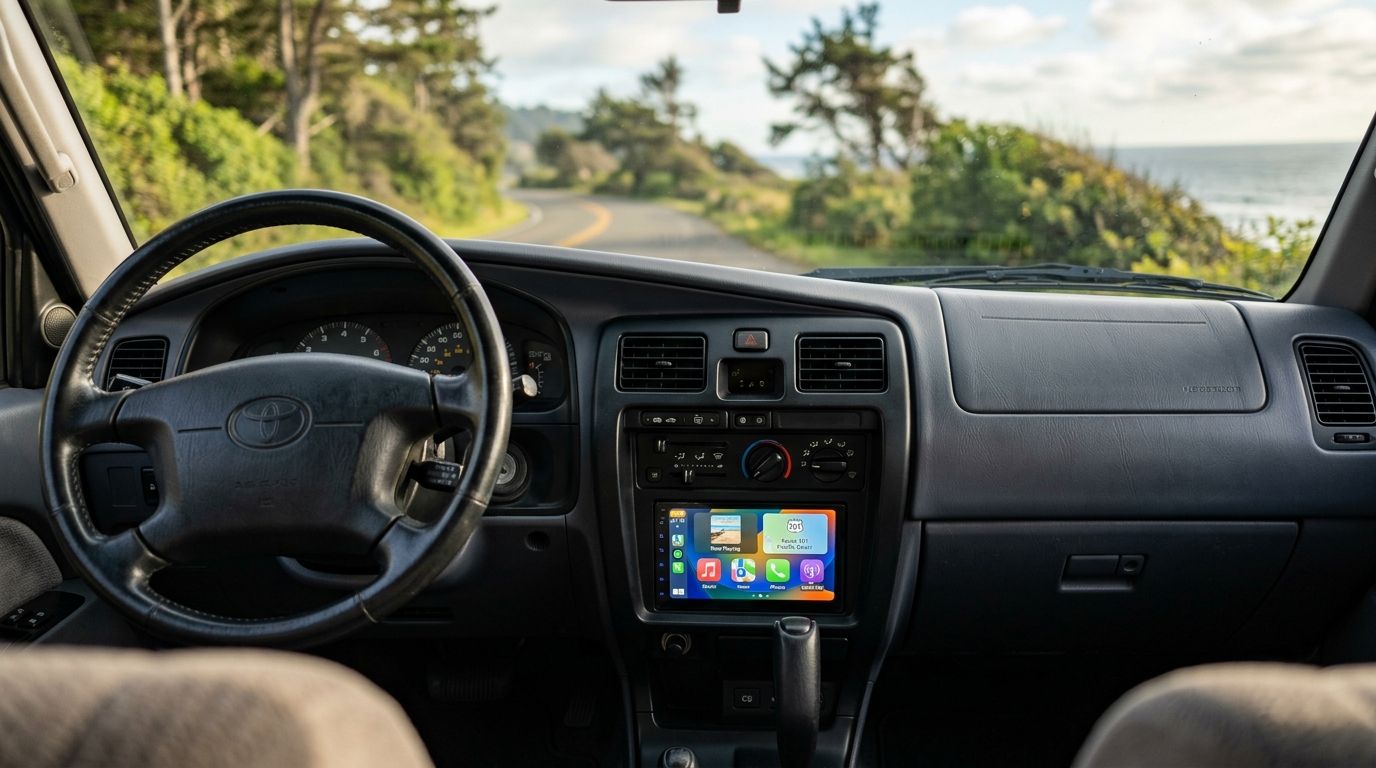
Head units in cars built before 2015 run cassette decks, single-CD players, or first-generation touchscreens that predate Apple CarPlay and Android Auto entirely. This guide ranks the car stereo head units that install cleanly into older dashboards and actually add the smartphone features drivers expect in 2026.
- Best overall: double-DIN CarPlay/Android Auto receivers from Pioneer or Kenwood fit most double-DIN dash openings built since the early 2000s.
- Best for classic trucks: single-DIN Sony or Kenwood digital media receivers keep the factory dash look intact.
- Best budget pick: single-DIN Bluetooth/AUX receivers add hands-free calling without a touchscreen swap.
- Non-standard dash cutouts on pre-2010 Fords and GMs usually need a dash kit before any head unit fits.
- A wiring harness adapter is standard on almost every install on a vehicle older than 10 years.
Why this matters
Factory radios in vehicles built before the mid-2010s were never designed to talk to a smartphone. No Bluetooth, no USB, sometimes not even an aux jack — just a tape slot or a single CD tray. Swapping in a modern car stereo head unit is the cheapest way to add CarPlay, Android Auto, and a backup camera input to a car that's otherwise running fine in 2026.
The technicians at Auto Sound Cape Coral install these units on trucks, sedans, and SUVs across Cape Coral and Fort Myers, and dash size — not brand loyalty — decides which unit actually fits. Get the DIN size wrong and the swap turns into a dash-kit job before any wiring even starts. Sound quality also varies more between brands than most spec sheets let on; the full breakdown of that gap is in the best car audio brands for sound quality guide.
The verdict
Best overall: double-DIN CarPlay/Android Auto receivers (Pioneer, Kenwood) for daily drivers replacing a factory touchscreen or CD deck. Best for classic trucks: single-DIN Sony or Kenwood digital media receivers that keep the stock dash look. Best budget option: single-DIN Bluetooth/AUX receivers for drivers who just want hands-free calling and streaming without a full touchscreen upgrade.
What makes the best car stereo head unit for older vehicles
- Dash fit — single-DIN openings measure 2 x 7 inches, double-DIN openings measure 4 x 7 inches; confirm this before ordering anything
- Smartphone integration — wired vs. wireless Apple CarPlay and Android Auto support
- Built-in amplification — enough clean power to skip an external amp on stock speakers
- Install complexity — whether a wiring harness adapter and dash kit come with the swap
- Steering wheel controls — retained through a separate interface module on most 2006-and-newer vehicles
- Screen visibility — brightness and anti-glare coating that holds up under direct Florida sun
Head units for older vehicles at a glance
| Head Unit Type | Best For | Standout Feature | Key Limitation |
|---|---|---|---|
| Double-DIN CarPlay/Android Auto receiver | Daily drivers replacing a factory touchscreen | Full-size touchscreen with phone mirroring | Needs a true double-DIN dash opening |
| Single-DIN digital media receiver | Classic trucks and compact cars | Keeps the factory single-DIN look | Small display, no touchscreen |
| Wireless CarPlay double-DIN receiver | Drivers who hate cable clutter | Phone connects automatically on start | Draws more from a phone's battery over a long drive |
| High-power head unit with built-in amp | Older trucks running upgraded speakers | Skips a separate amp for moderate gains | Won't match a dedicated amp for real bass |
| Basic Bluetooth/AUX single-DIN receiver | Simple budget upgrade | Hands-free calling, Bluetooth streaming | No smartphone mirroring, no touchscreen |
| Dash kit + double-DIN conversion | Non-standard factory openings | Adapts odd dash shapes to modern units | Adds a part and labor time to the job |
1. Double-DIN CarPlay/Android Auto receivers: best car stereo head unit for daily drivers with a stock deck
Pioneer and Kenwood double-DIN units use a touchscreen in roughly the 6 to 7 inch range and pair with a phone over a USB cable for wired CarPlay or Android Auto. For a car built before smartphone integration existed, this is the closest thing to a full factory-style upgrade. Full model breakdowns, including which screens hold up best against sun glare, are covered in the Apple CarPlay head units guide.
Double-DIN CarPlay/Android Auto pros:
- Full CarPlay/Android Auto mirroring for navigation, texts, and music
- Touchscreen replaces a worn or dead factory display outright
- Backup camera input built into most current models
Double-DIN CarPlay/Android Auto cons:
- Needs a true double-DIN opening — won't fit single-DIN trucks without a dash kit
- Wired-only versions require keeping a cable plugged in every drive
Best for: daily drivers with a double-DIN opening who want the full smartphone experience. Verdict: Buy.
2. Single-DIN digital media receivers: best car stereo head unit for classic trucks and compact cars
Sony and Kenwood single-DIN receivers fit the narrow 2 x 7 inch factory opening common on older trucks and compact cars, and they keep the stock dash look intact. No touchscreen, but Bluetooth streaming and hands-free calling come standard on most current models.
Single-DIN digital media receiver pros:
- Fits narrow factory openings without a dash kit
- Bluetooth streaming and calling built in
- Often a faster, cheaper install than a double-DIN swap
Single-DIN digital media receiver cons:
- No touchscreen, small display makes menu navigation slower
- No CarPlay/Android Auto on most models
Best for: single-DIN trucks and older compact cars with a fixed dash opening. Verdict: Buy.
3. Wireless CarPlay double-DIN receivers: best car stereo head unit for drivers who hate cable clutter
Alpine and JVC wireless units connect to a paired phone automatically once you start the car — no cable to dig out of the glovebox every morning. Same touchscreen feature set as a wired double-DIN unit, just without the cord.
Wireless CarPlay double-DIN pros:
- No cable to plug in every drive
- Same navigation, messaging, and music mirroring as wired units
- Faster daily routine once paired
Wireless CarPlay double-DIN cons:
- Pulls more from a phone's battery over a long drive
- Occasional reconnect lag versus a wired link
Best for: commuters who don't want to fumble with a cable every day. Verdict: Buy.
4. High-power head units with built-in amplification: best car stereo head unit for older trucks with upgraded speakers
Boss Audio and Pioneer high-power lines carry a built-in amp stage that pushes more clean power than a factory deck without adding a separate amplifier box. That's enough for a moderate speaker upgrade in an older truck cab, but it's not a substitute for a dedicated amp on a bass-focused build — see the car amplifiers comparison if that's the goal.
High-power head unit pros:
- Skips a separate amp for moderate volume increases
- Simpler wiring than a full amp-and-subwoofer setup
- Still supports Bluetooth streaming
High-power head unit cons:
- Won't match a dedicated amp and subwoofer for real bass
- Gains over stock power are modest, not dramatic
Best for: truck owners upgrading speakers who don't want to run a separate amplifier. Verdict: Buy for moderate upgrades, Skip if you're chasing serious bass.
5. Basic Bluetooth/AUX single-DIN receivers: best car stereo head unit for a simple budget upgrade
Entry-level Sony and JVC single-DIN units add Bluetooth calling and streaming to a car that only has an AUX jack or nothing at all. Straightforward install, short learning curve, no touchscreen to worry about.
Basic Bluetooth/AUX receiver pros:
- Adds hands-free calling and Bluetooth audio to a car with just an AUX jack
- Straightforward, low-cost install
- Simple menu, no touchscreen to learn
Basic Bluetooth/AUX receiver cons:
- No smartphone mirroring, no touchscreen
- Limited EQ and sound-shaping options
Best for: owners who just want Bluetooth and don't care about a screen. Verdict: Buy for basic needs, Skip if CarPlay matters to you.
6. Dash kit + double-DIN conversion: best car stereo head unit setup for non-standard factory openings
Some pre-2010 Fords, GMs, and imports use a factory opening that's neither true single- nor double-DIN. A dash kit — a metal or ABS trim adapter — reshapes that opening so it can accept a modern double-DIN unit.
Dash kit conversion pros:
- Opens up the full double-DIN catalog to vehicles that couldn't otherwise accept one
- Matched-color kits keep the factory trim look
- Works alongside a wiring harness adapter for a near plug-and-play install
Dash kit conversion cons:
- Adds a separate part and labor line to the job
- Kit availability varies by exact trim and model year
Best for: owners of older vehicles with an odd-shaped factory dash opening. Verdict: Buy if you want a modern unit in an odd dash.
How we ranked these head units
Dash fit came first because it's the actual disqualifier — a unit that doesn't fit the opening doesn't matter how good its screen is. Smartphone integration, built-in amplification, install complexity, and screen visibility under Florida sun followed, in that order, matching the criteria above.
Which car stereo head unit should you choose in 2026?
If you're not sure, a double-DIN CarPlay/Android Auto receiver from Pioneer or Kenwood covers the most ground for daily drivers. Confirm your dash opening size before ordering anything — that single step avoids a second trip and an extra dash kit charge.
Get your head unit installed right
Confirm your dash fit and get a straight quote before you buy anything.
FAQ
What's the best car stereo head unit for older vehicles in 2026?
A double-DIN CarPlay/Android Auto receiver from Pioneer or Kenwood is the best all-around pick for older vehicles in 2026 because it adds full smartphone mirroring to a dash that never had it. It requires a true double-DIN opening, so confirm dash size first.
Will a modern head unit fit my old dash?
It depends on whether your factory opening is single-DIN (2 x 7 inches) or double-DIN (4 x 7 inches). Non-standard openings on some pre-2010 Fords and GMs need a dash kit before a modern unit will fit.
Do I need a wiring harness adapter for an older car?
Yes, almost every head unit swap on a vehicle older than 10 years uses a wiring harness adapter to match the factory plug to the new unit. It's a standard part of the install, not an extra.
Is wireless CarPlay better than wired for an older vehicle?
Wireless CarPlay skips the cable but draws more from your phone's battery over a long drive. Wired CarPlay is more reliable for daily use and keeps your phone charged at the same time.
Can I keep my steering wheel controls after a head unit swap?
Yes, on most vehicles built in 2006 or later, a separate steering wheel control interface module retains those buttons after the swap. Older vehicles may need to check compatibility case by case.
Do I need more power if I'm not adding a subwoofer?
Not necessarily. A high-power head unit with a built-in amp gives a moderate volume boost over a factory deck without adding a separate amplifier, which covers most stock speaker upgrades.
Does a new head unit help with Florida heat and glare?
A brighter, anti-glare touchscreen holds up better under direct Florida sun than an off-brand screen with a plastic housing not rated for high dash temperatures. Screen quality varies more by brand than by price point.
Single-DIN or double-DIN for a classic truck?
Single-DIN keeps the factory dash look on most classic trucks and avoids the cost of a dash kit. Double-DIN requires either a factory double-DIN opening or a conversion kit.
One last thing
Dashboard temperatures inside a closed car under direct Florida sun can climb past 140°F even outside of peak summer months. That's why anti-glare, heat-rated touchscreens on name-brand units outlast off-brand screens with plastic housings that weren't built for that kind of heat — worth asking about before you pick a unit on price alone.